
Created: 2026.09.15. 14:16
In 2024, Pető Pont in Győr began operating at the MedTech Health Technology Campus of SZE becoming the first development centre of its kind outside Budapest. The centre, which specialises in conductive Education, is now continuing its activities under a new structure: Uni-Medicampus Kft., owned by SZE, is taking over management from the András Pető Faculty of Semmelweis University. The reorganisation was celebrated with the unveiling of a new plaque a few days ago.
SZE is establishing its MedTech Health Technology Campus on Zrínyi utca in Győr, within the former hospital complex. The first building to be completed was inaugurated in May 2024. The facility houses Hungary’s first Pető Pont outside the capital, established in collaboration with the Pető András Faculty of Semmelweis University, where on-site care from specialist Conductors is now available to those requiring developmental support.
To ensure stable and predictable operations, the development centre will be reorganised from this autumn onwards. In future, Uni-Medicampus Kft. will be responsible for delivering the service; the Pető András Faculty of Semmelweis University will maintain high standards through professional oversight and methodological guidance; while SZE, which provides the venue, will supply the necessary infrastructure and equipment. Gergely Ekler, Managing Director of Uni-Medicampus Kft., emphasised that the collaboration, through which these three parties are continuing to run Pető Pont, is exemplary.
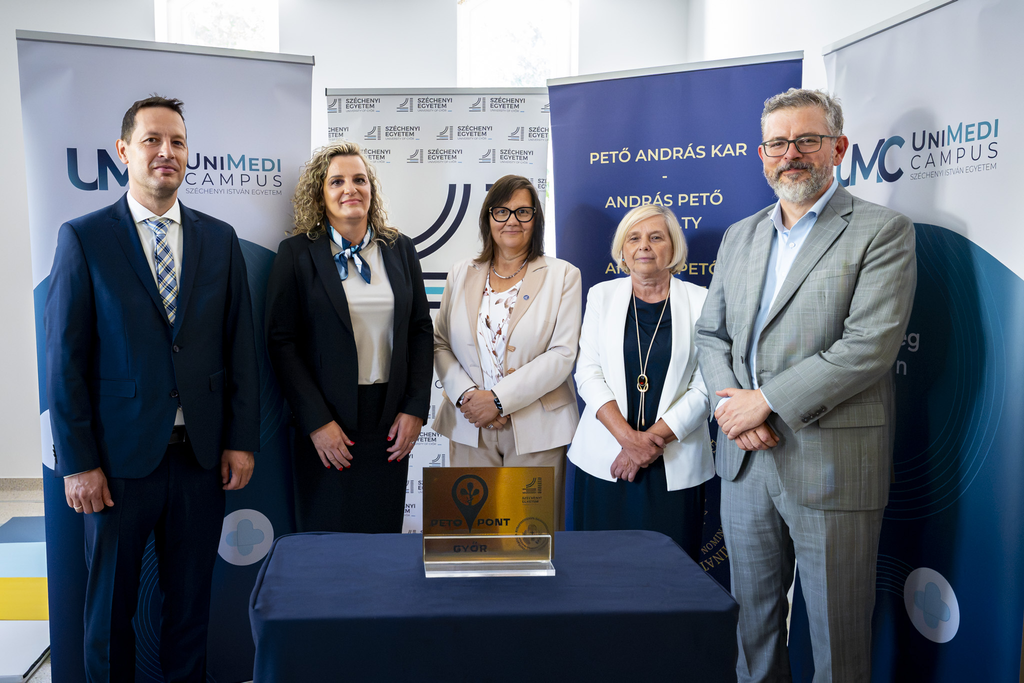
The plaque, located at Pető Pont on the MedTech Health Technology Campus of SZE, was unveiled at the event. Pictured are Dr Zsolt Kovács, Vice-President for General and Educational Affairs at the University, Dr Angéla Somogyi, Dean of the Faculty of Health and Sports Sciences, Dr Andrea Zsebe Miklósné Tenk, Dean of the András Pető Faculty at Semmelweis University, Dr Éva Szabó Feketéné, Vice-Rector for Strategy and Development at Semmelweis University, and Gergely Ekler, Managing Director of Uni-Medicampus Kft. (Photo: András Adorján)
At the ceremony, Dr Zsolt Kovács, Vice-President for General and Educational Affairs at SZE, said that the MedTech Health Technology Campus, which houses Pető Pont, was completed two years ago, and that the Institution continues to receive a great deal of support from Semmelweis University in the development of the centre, which employs the conductive pedagogical method. “We are confident that, through this renewal, we will be able to develop a shared model that can subsequently be transferred to other cities across the country. Pető is, in fact, a very important social responsibility initiative on the part of our University, enabling local access to an excellent professional service that assists families and significantly improves the quality of life of those using the service,” he stated. He added that the method can be applied not only in helping children but also in supporting the elderly, which is also in line with the mission of the MedTech Campus.
“Beyond the service itself, as higher education institutions, we view teaching and research as fundamental to our mission, so we would like to involve our students in this work as well. On the research front, work is already underway. We have developed a pilot product redesigning the specialist developmental furniture used in the method,” explained the vice-president. He emphasised his deep gratitude for the support and trust SZE receives as a partner to Semmelweis University. “We hope to continue collaborating and developing jointly across an increasing number of areas in the future,” he concluded.
In her welcoming address, Dr Angéla Somogyi, Dean of the Faculty of Health and Sports Sciences at SZE, ed out that conductive Education does not simply aim to treat a specific condition or diagnosis, but help the child or adult taking part in the programme to achieve the greatest possible independence and to apply the skills they have acquired in everyday life. “This approach aligns with our faculty’s activities in many respects: in both our training programmes and our research, we are placing ever greater emphasis on prevention, health promotion, rehabilitation, mental and physical wellbeing, and ensuring that scientific findings are put into practice, too,” she emphasised.
“Our institution’s MedTech Campus creates a unique environment for this, facilitating close collaboration between health and sports sciences, medical practice and technology,” she said. She added that the University’s MedTech and Sport Competence Centre operates on the same principles, where researchers and practising professionals work together on developing innovative solutions in areas such as diagnostics, rehabilitation and health technology.
According to Dr Andrea Zsebe Miklósné Tenk, Dean of the Pető András Faculty at Semmelweis University, the collaboration agreement signed by the two universities almost three years ago enabled the Pető András Faculty to become involved in innovation processes. “This has been a very important milestone for us, as it laid the foundations for the Pető Pont in Győr,” she revealed. As she emphasised, joint equipment development is another project in which SZE provides the technological background, while the Pető Faculty sets the professional standards.
“I believe it is a good decision that, in the interests of families, students and future professionals, Pető is now available as a local service, as a development centre of this kind can only function effectively in the long term if it is able to take local circumstances into consideration,” she said. She revealed that the conductive method may also be incorporated into the training of health visitors in Győr in the future.
At the event, the parties marked their collaboration by unveiling a commemorative plaque. It was announced that Pető will cater to both children and adults, offering both individual and group sessions.