
Created: 2026.06.11. 14:23
The SZEngine Team has reached a significant milestone in its evolution from engine developers to race car constructors by unveiling its first self-built Formula Student vehicle, along with a newly developed hybrid powertrain that forms the heart of the car. Although the team will now compete independently, its members remain committed to the drivetrain development that has become their hallmark. In fact, more than half of the team continues to focus on engine optimization.
Established as a student team at Széchenyi István University, SZEngine was founded with the aim of providing students with practical experience in the development of internal combustion racing engines through the radical modification of commercially available production units. This represented a unique undertaking within the Formula Student community, as did the team’s long-standing role in supplying powertrains to its institutional partner, Arrabona Racing Team. That successful collaboration, which lasted for many years, resulted in numerous achievements, with SZEngine’s reliable, high-performance and fuel-efficient engines consistently outperforming off-the-shelf alternatives that offered limited scope for modification.
A turning point came during the previous season when Arrabona Racing Team decided to transition to electric propulsion, bringing the cooperation between the two teams to an end. Shortly thereafter, SZEngine’s partnership with the OUR Team of Óbuda University also concluded. Faced with a new reality, the team chose to establish itself as an independent Formula Student competitor by designing and building its own race car. After eighteen months of intensive work, the team finally unveiled the vehicle at its traditional rollout event.
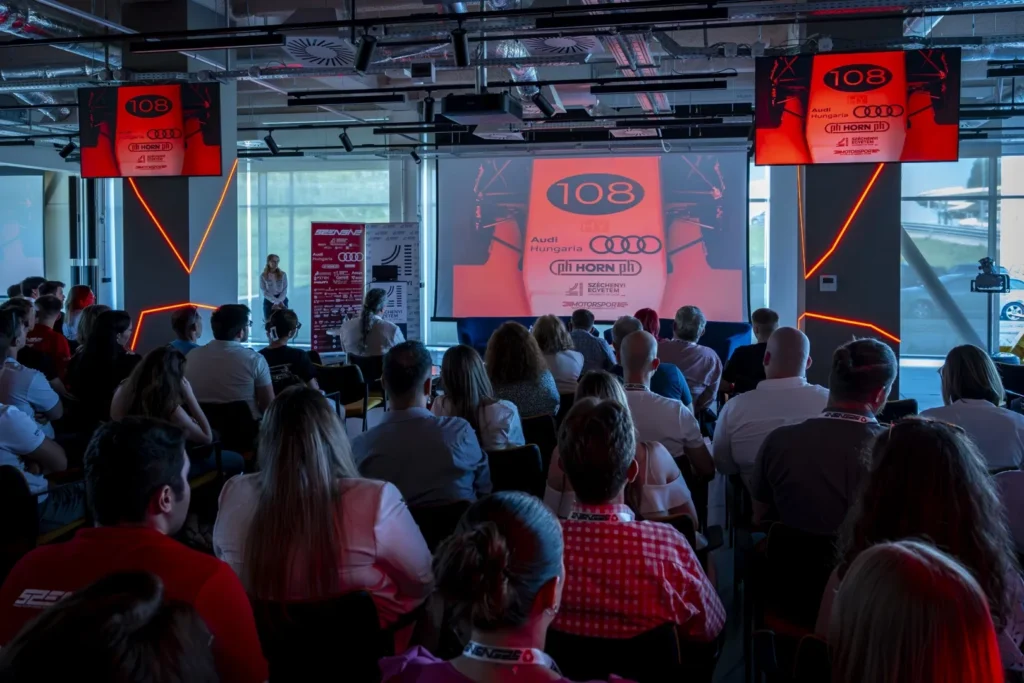
Hosted at the Győr Innovation Park of Széchenyi István University, the event marked a major achievement for the student team. (Photo: Máté Dudás)
“Creating a race car from scratch is an enormous challenge that requires extensive effort and the successful integration of highly complex engineering solutions,” said Professor Gábor Dogossy, Dean of the Audi Hungaria Faculty of Automotive Engineering, in his opening remarks. “It represents a tremendous step forward that the team undertook and successfully completed this challenge.”
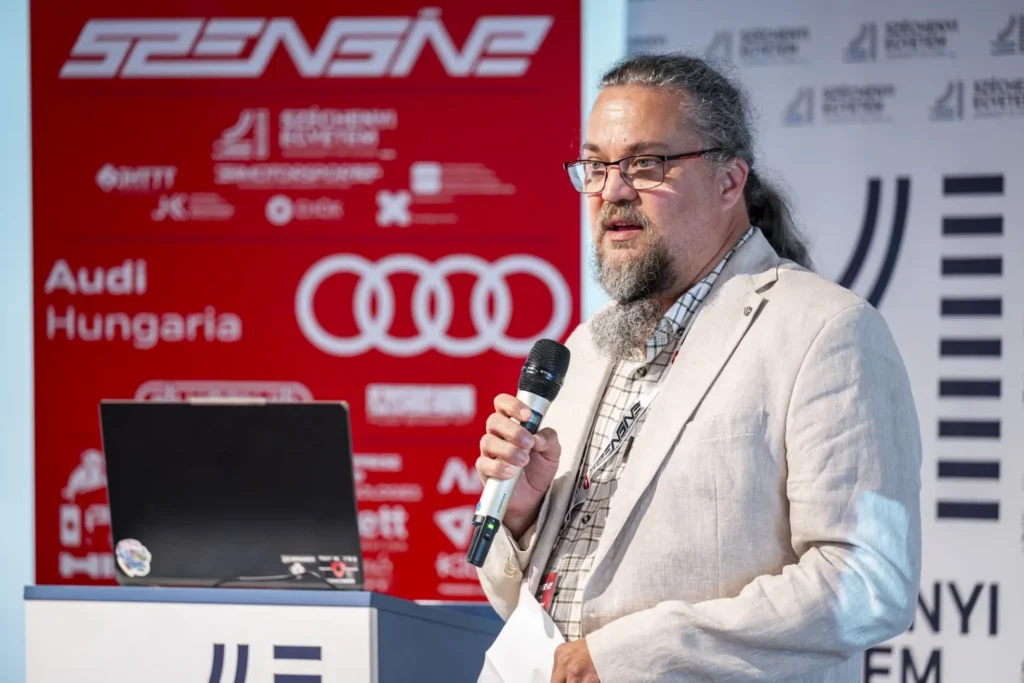
According to Professor Gábor Dogossy, the SZEngine Team sets an example not only for students but also for faculty members. (Photo: Máté Dudás)
Gellért Ádám Gladics, Head of Vehicle Design at SZEngine Team, emphasized that the presentation showcased not only the team’s first race car but also its first-ever hybrid powertrain. “The rear axle is driven by an internal combustion engine, while the front axle is equipped with electric motors integrated into the wheel uprights. This configuration enables regenerative braking and significantly improves acceleration when exiting corners,” he explained.
The team has also changed its base engine platform. After several years of development based on the KTM 690, it has returned to the smaller-displacement KTM 450/500 engine, which previously served as the foundation for SZEngine projects between 2013 and 2020. “The primary reason for the change was our intention to develop a turbocharged engine, supported by one of our partners. A smaller displacement requires less airflow, allowing us to achieve more favourable performance characteristics. The KTM 450/500 is ideally suited for this purpose,” Gladics noted.
Regarding the vehicle itself, he explained that, as a first-time car-building team, the focus was not on sophisticated technical innovations but rather on creating the simplest possible functional design. “The car is built around a steel tubular frame to which all other components are attached. We incorporated only the mandatory aerodynamic elements, such as the nose cone and cooling air duct, while arranging all components to achieve the lowest possible centre of gravity,” he said.
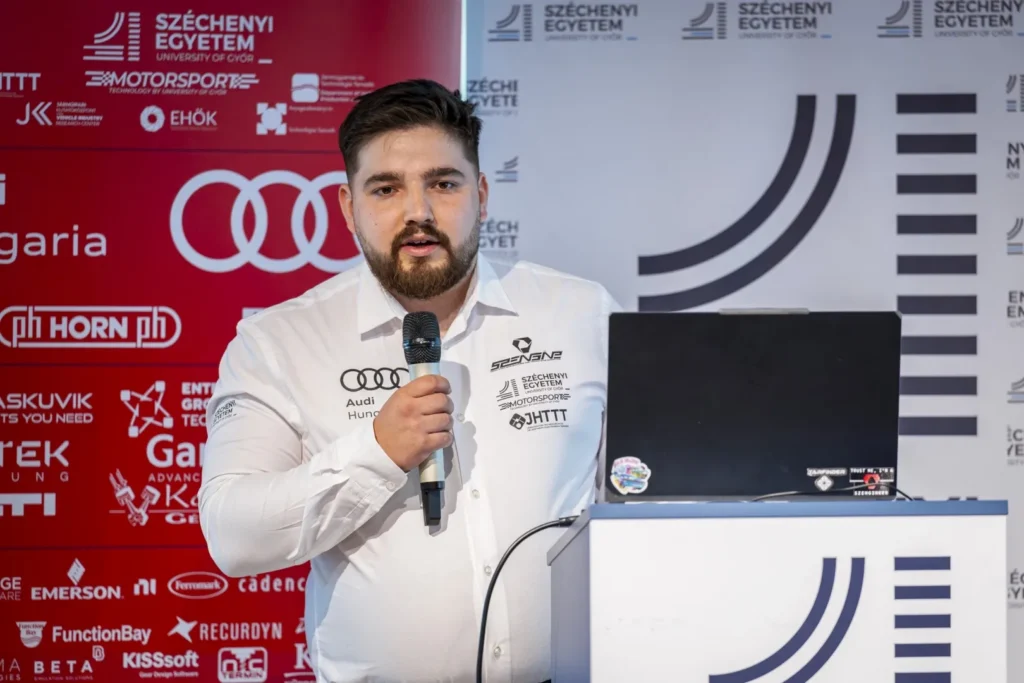
Gellért Ádám Gladics, Head of Vehicle Design, presented SZEngine’s first race car and its new hybrid powertrain. (Photo: Máté Dudás)
Team Leader Dóra Kádár highlighted that the number of sponsors supporting SZEngine has nearly quadrupled in recent months, demonstrating growing recognition from industry partners of the values represented by the team. She also stressed that gaining experience remains the primary objective, making extensive testing essential. To prepare for the upcoming season, the team will participate in the Formula Student Easter preparatory event at the ZalaZone proving ground before competing in the Czech Formula Student event.
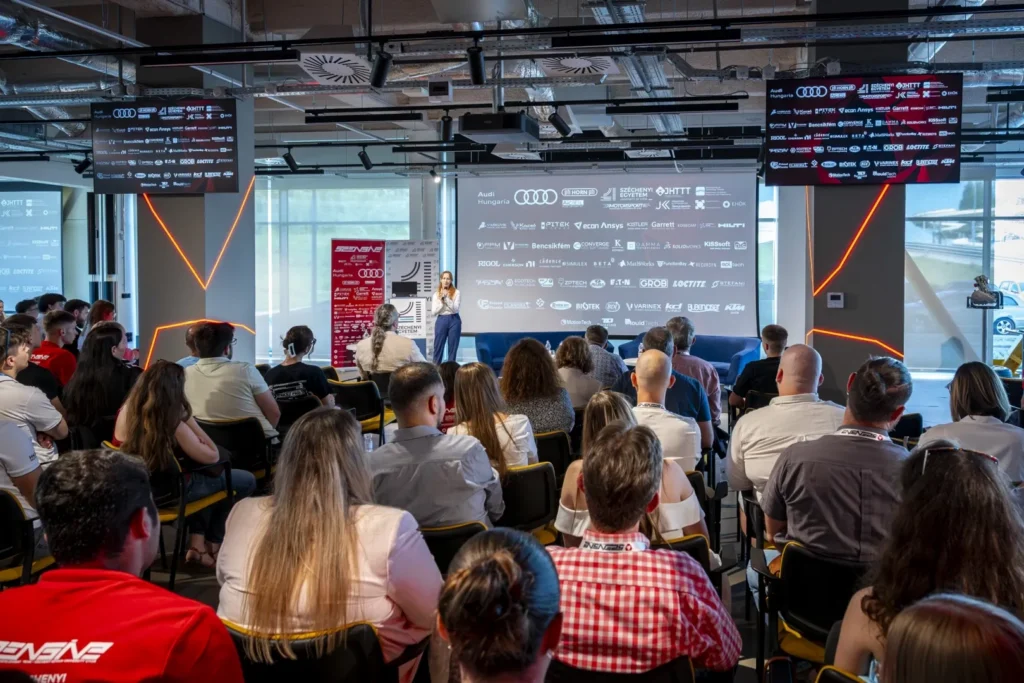
Team leader Dóra Kádár spoke about the upcoming competition season (Photo: Máté Dudás)
Following the unveiling, a panel discussion featuring Attila Gyuris, Olivér Posvancz and Gábor Szomszéd, moderated by Lilla Lugosi, reflected on the journey that led to the creation of the car. “We established three entirely new divisions responsible for the chassis, vehicle dynamics and aerodynamics,” recalled former Head of Vehicle Design Olivér Posvancz. “This year we recruited nearly thirty new members, enabling us to fully staff every department. Many joined specifically because they wanted to work with internal combustion engines.”
Gábor Szomszéd, responsible for thermodynamics, emphasized that drivetrain development remains at the core of the team’s identity. Building its own vehicle provides complete freedom to integrate any engine concept without compromise. “Once again, we have taken an ambitious approach. Apart from the cylinder itself, there is virtually no engine component we have left untouched. We invest more effort into engine development than anyone else in the field—that is our trademark, and we intend to preserve it in the future,” he said.
Attila Gyuris, who supported the project both as an alumnus and as a University staff member, underlined that the essence of Formula Student lies in learning and experimentation. “During our own student years, we explored extremely unconventional engineering solutions that would never have been possible in an industrial environment. I encourage every student to embrace creativity and pursue even the boldest ideas, because there will rarely be another opportunity like this later in their careers,” he advised.
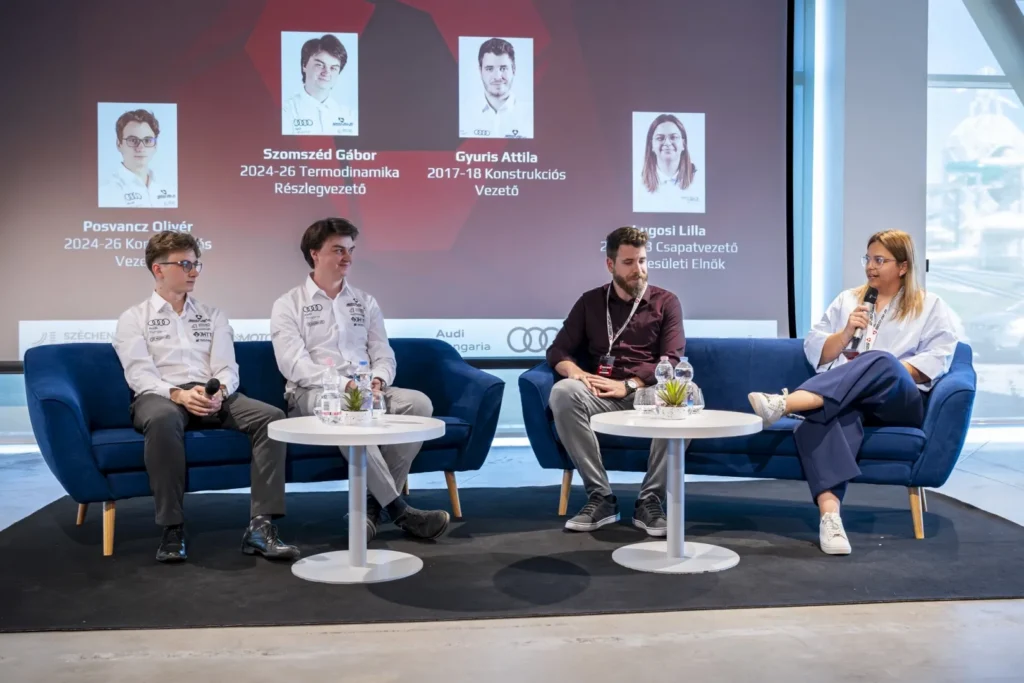
Participants of the round-table discussion (Photo: Máté Dudás)
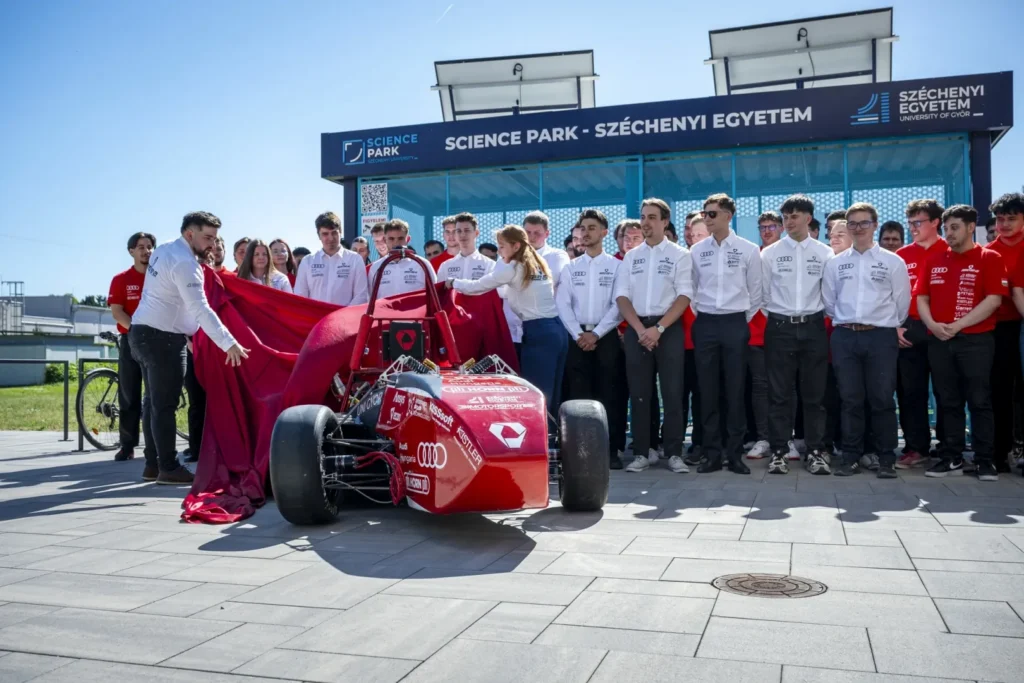
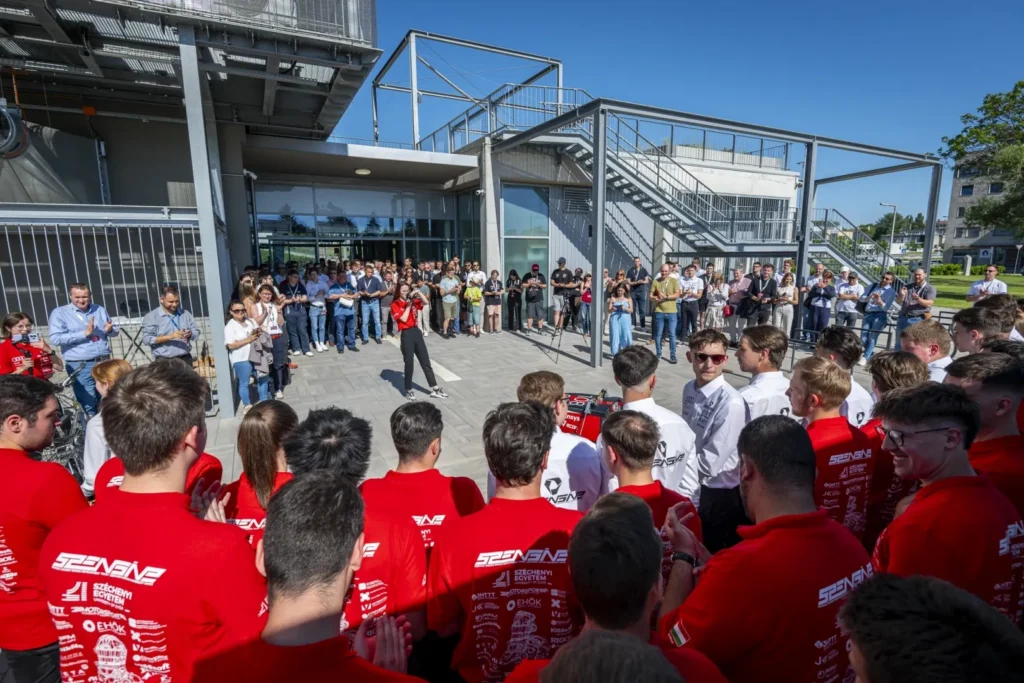
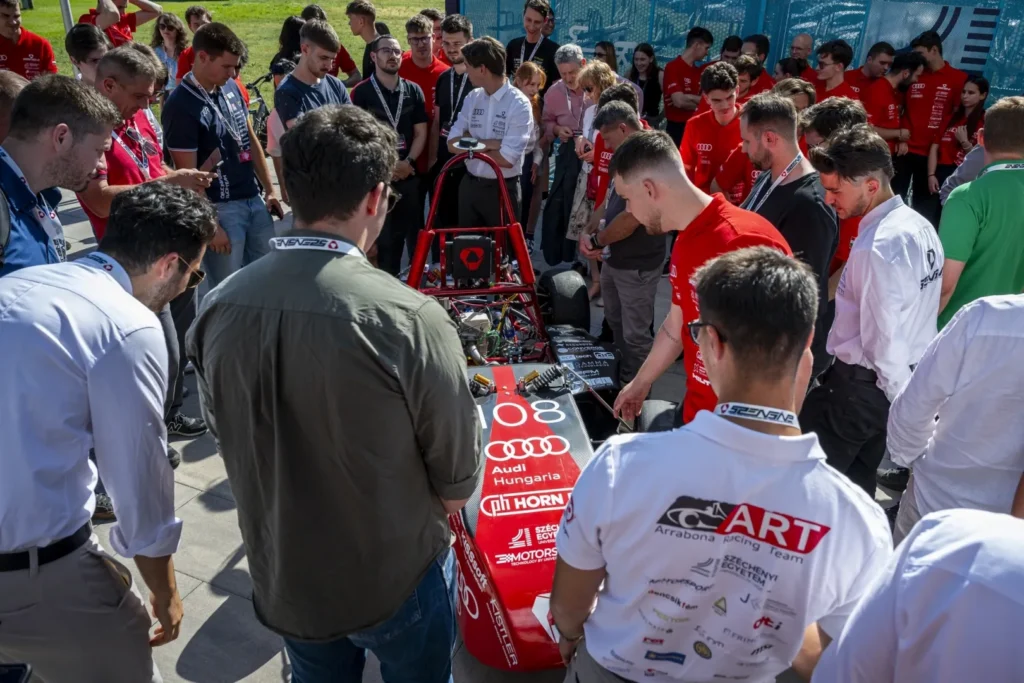
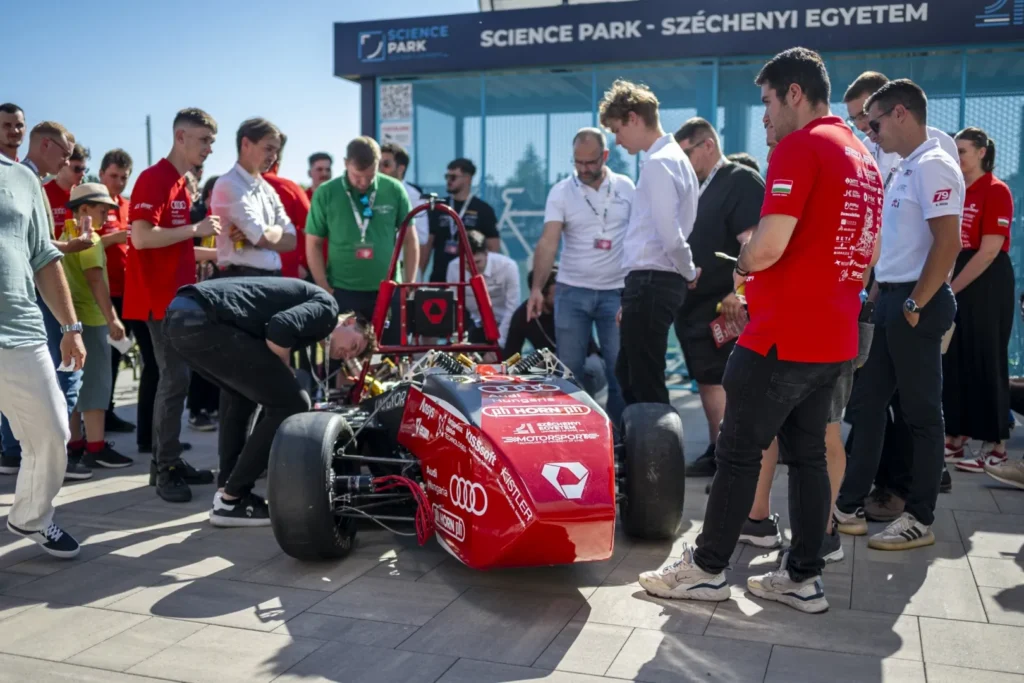
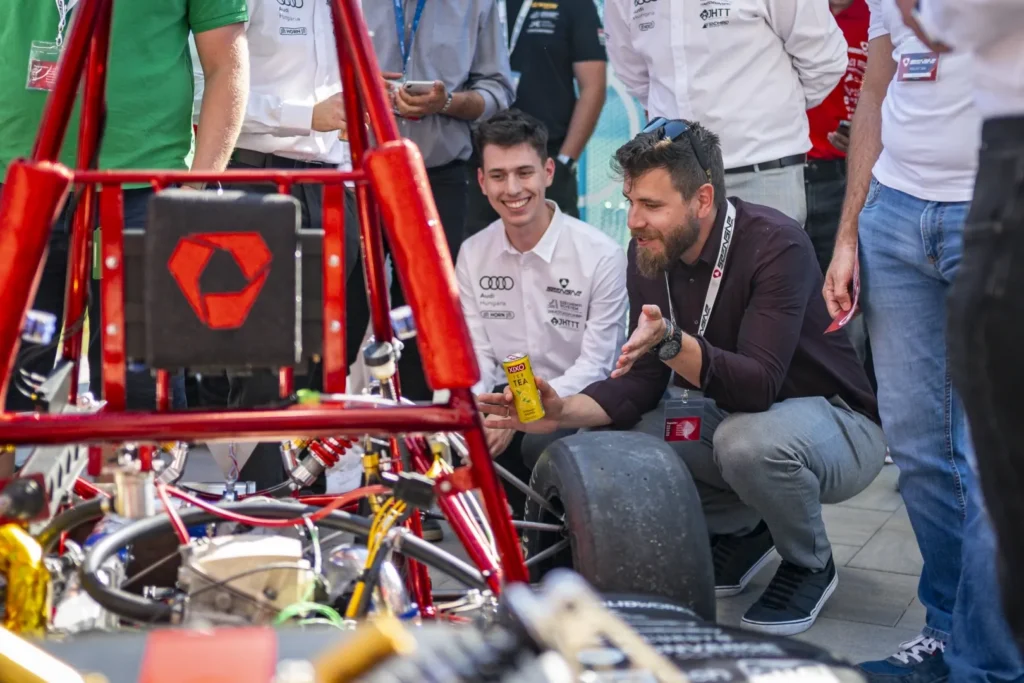
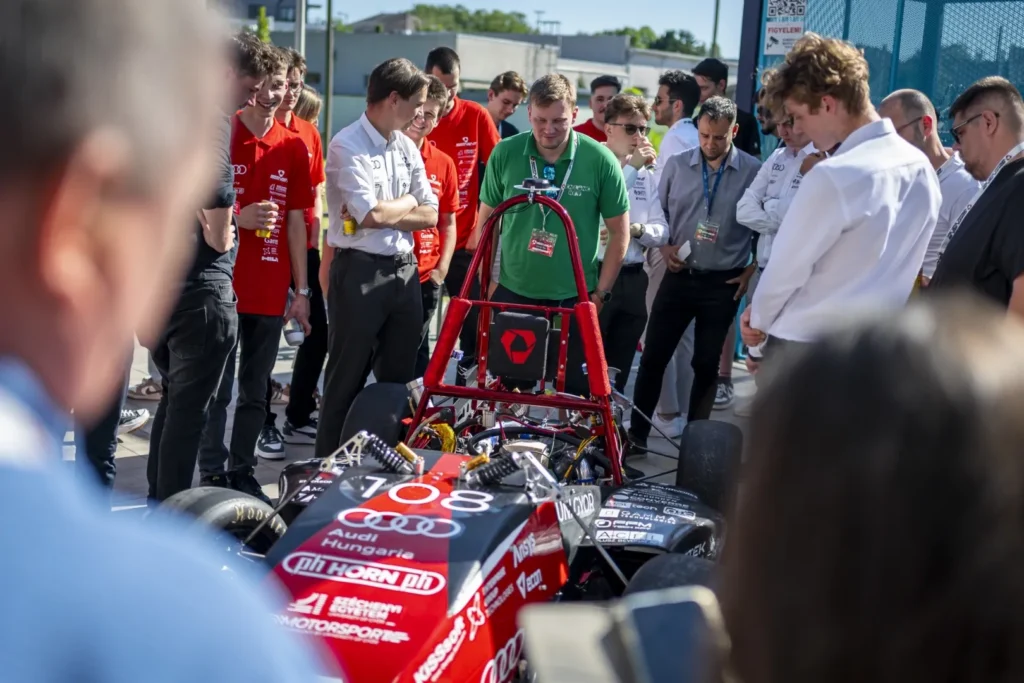
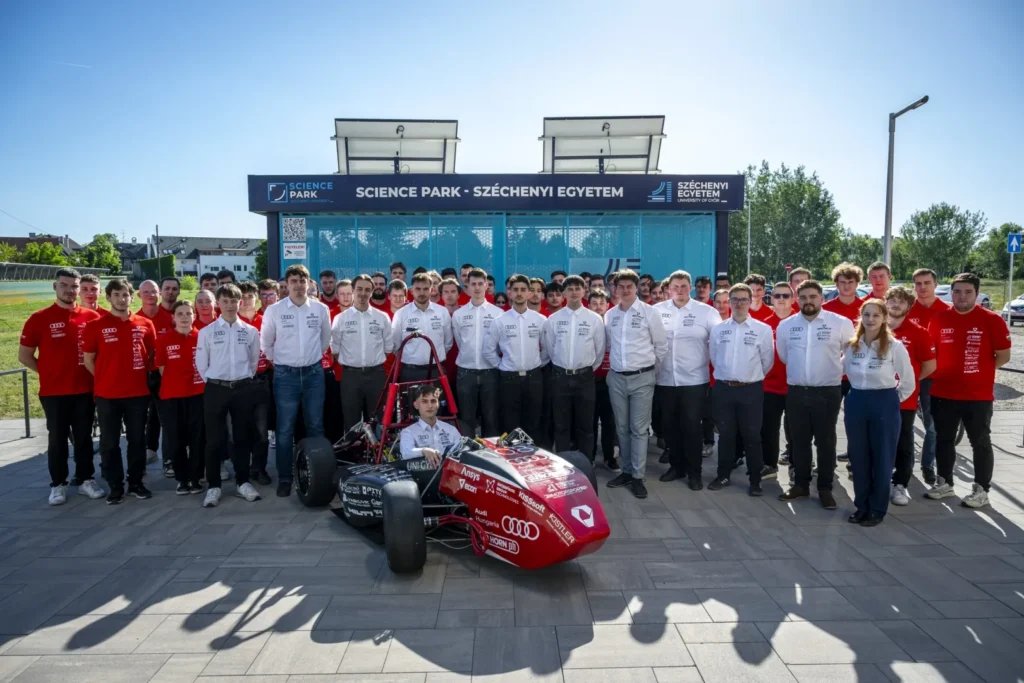
Photo gallery of the unveiling. (Photos: Máté Dudás)