
Created: 2026.07.01. 12:02
Four victories, four world records—this is the SZEnergy Team’s record over the past four years at the world’s largest energy efficiency competition, the Shell Eco-marathon. This year, the Széchenyi István University team aims not only to defend its title but also to surpass last year’s record; they recently presented their developments and their vehicle, already competing in Poland, at a rollout event.
Since 2022, SZEnergy has achieved an unprecedented run of success: the student team has won Europe’s largest energy efficiency competition four times in a row with their special vehicle, setting a world record on each occasion—three times surpassing their own previous achievements. Not only the victories but also their margin is remarkable: last year’s performance of 327 kilometres per kilowatt-hour was more than 30 per cent better than that of the second-placed team. This means the vehicle could have travelled 327 kilometres using just 1 kilowatt-hour of energy—equivalent to about thirty minutes of use of a hairdryer.
The team intends to continue this success, further optimising their vehicle, which has been continuously refined since its debut in 2019. In keeping with tradition, this year’s developments were unveiled at a dedicated event opened by Professor Dr Ferenc Friedler, Rector and Vice-President for Scientific Affairs of the University.
“The secret of SZEnergy’s success lies in continuous renewal. Each year, students modify the car, experiment with innovative technologies, and test new solutions. They are currently the best in the world in developing energy-efficient electric vehicles, enhancing the reputation of our institution while setting an example for their peers. They also demonstrate that the practice-oriented education at Széchenyi István University effectively prepares students for successful professional careers,” he said.
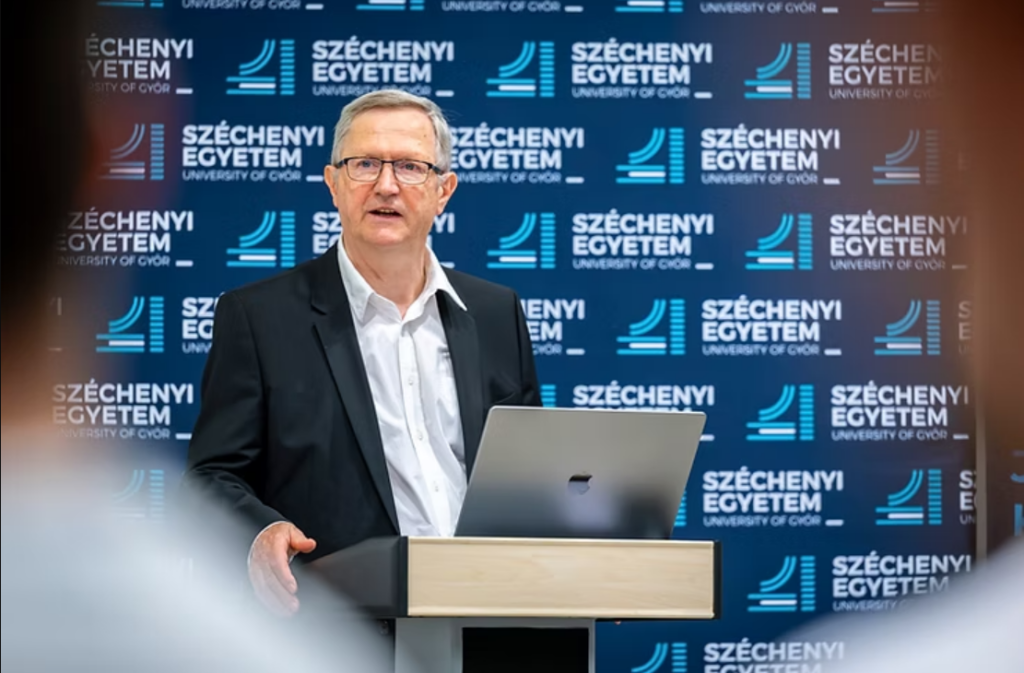
The SZEnergy Team indicates the success of practice-oriented education, said Dr Ferenc Friedler, Rector and Vice President for Scientific Affairs of Széchenyi István University. (Photo: Máté Dudás)
Team Leader Bence Novák introduced the concept of the Shell Eco-marathon, whose combined European and African competition is once again being held this weekend at the Silesia Ring in Poland. The competition features two main vehicle categories: the more freely designed Prototype class and the more restrictive Urban Concept class. Vehicles may be powered by internal combustion engines, electric propulsion or hydrogen fuel cells. The Győr-based team’s vehicle, named SZEmission, competes in the Urban Concept category with an electric powertrain.
„As in previous years, we will also compete in the Autonomous Challenge alongside the energy efficiency competition. In this event, the vehicle must complete a complex course entirely independently, without driver intervention. This includes avoiding obstacles, recognising STOP signs and stopping before the designated line,” he explained.
„On behalf of the entire team, I would also like to express our sincere gratitude to the university leadership, our academic mentors and the many sponsors who have supported us once again this year. Without their continued support, our annual developments would not be possible,” he added.
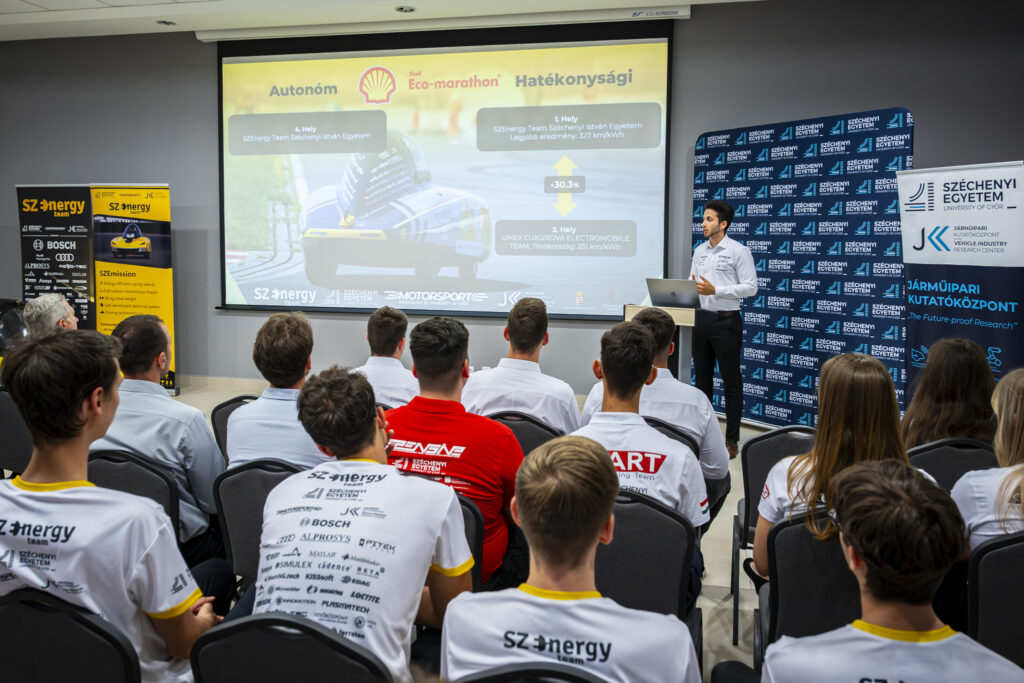
„Our goal is to defend our title and improve our own world record,” emphasised Team Leader Bence Novák (Photo: Máté Dudás)
As explained during the event, the team has implemented numerous improvements to ensure they remain at the forefront of the competition, resulting in a lighter vehicle with even lower energy consumption. The successive world records and continuous performance improvements achieved in recent years demonstrate that there is still untapped potential within the vehicle, which can be unlocked through carefully considered engineering modifications.
This year, the Mechanical Division focused on redesigning the suspension and steering systems, developing and manufacturing entirely new components. „We have also expanded our expertise in manufacturing technologies, which will prove valuable during the construction of our future Prototype vehicle,” noted István Madarász, Head of the Mechanical Division, referring to the team’s plans to enter the Prototype category of the Shell Eco-marathon for the first time in 2027.
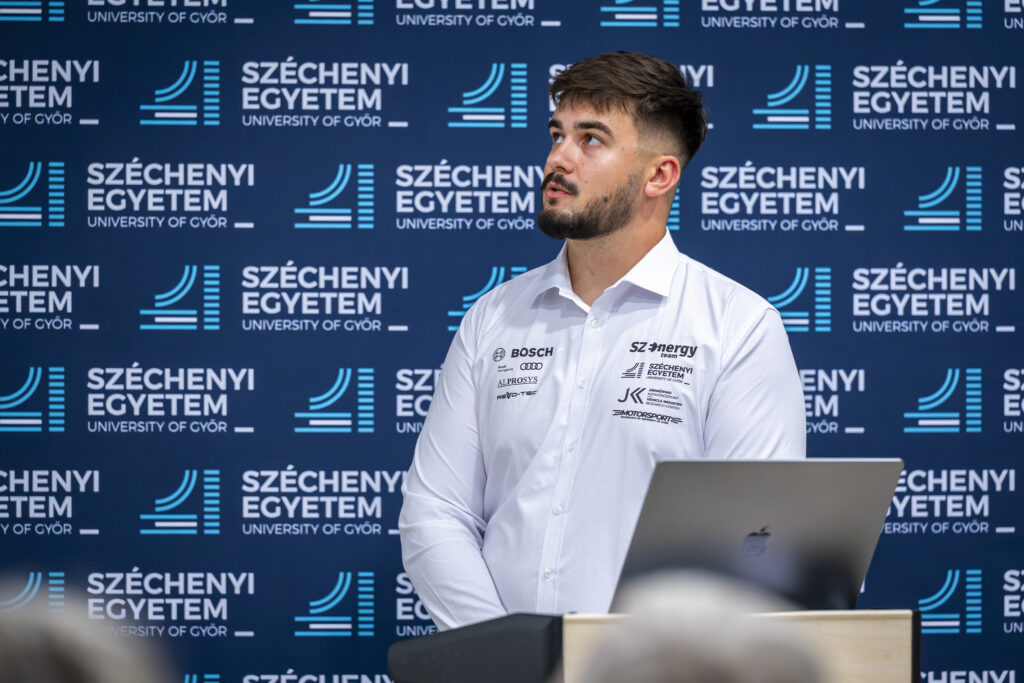
István Madarász revealed that the team is also testing a new clutch system and will choose between two design concepts (Photo: Máté Dudás)
The cornerstone of this year’s electronic developments remains the race optimisation algorithm, which models both the vehicle and the circuit to determine the ideal speed profile for maximum energy efficiency, providing significant support to the driver. This year, the system has been further enhanced: the vehicle is now capable of autonomously following the calculated racing line, with the driver taking control only when necessary.
„Alongside redesigning the new battery pack, one of our key tasks was to restructure the battery management system. This allowed us to save space on the printed circuit board, enabling us to completely redesign it to improve ease of assembly,” highlighted András Timár, Head of the Electronics Division.
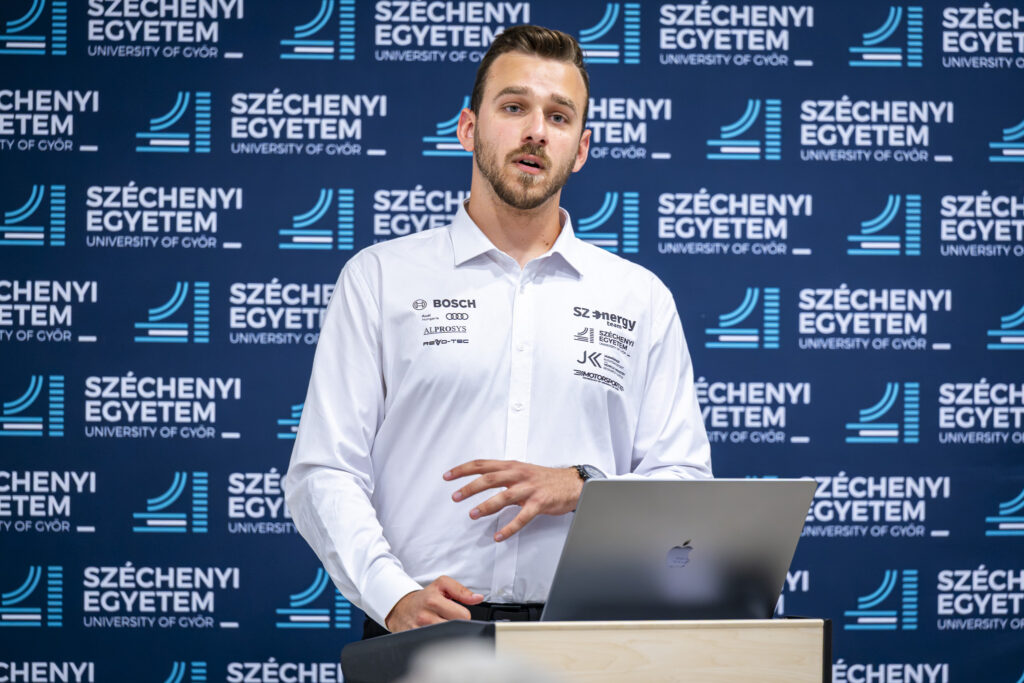
András Timár announced that, during this year’s competition, the vehicle’s live telemetry data will be available through the team’s website (Photo: Máté Dudás)
The team finished fourth in last year’s Autonomous Challenge and hopes to improve on that result this year. Consequently, substantial modifications have been made to the software responsible for the vehicle’s autonomous functions. „Previously, the vehicle divided everything it observed into two categories: drivable road surface and the surrounding environment. However, this approach prevented us from detecting features such as kerbstones at the edge of the circuit, which proved to be critical. This year, we introduced a multi-level segmentation algorithm that can now recognise not only the roadway but also the track boundaries,” explained Szabolcs Halir, Head of the Autonomous Systems Division.
Another significant change concerns the vehicle’s navigation system. Previously, the team relied primarily on a LIDAR sensor, which scans the environment and generates a point cloud, while the camera served only as a supplementary sensor. This year, the roles have been reversed: the vehicle now navigates primarily using camera imagery, while the LIDAR is employed mainly for obstacle detection. This approach not only provides a more accurate representation of the environment but also reduces energy consumption. „The computational requirements of our new solution are considerably lower than before. As a result, we now require only one Jetson processing unit instead of two, allowing us to achieve significant energy savings,” the division head added.
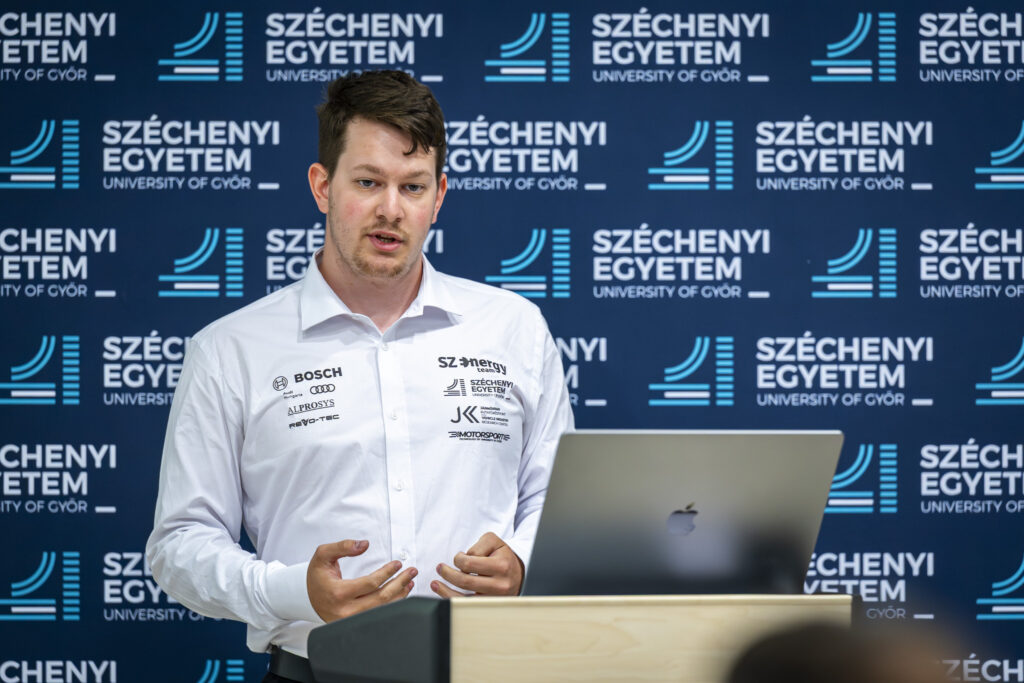
This year, the team hopes to improve its performance in the Autonomous Challenge, stressed Szabolcs Halir (Photo: Máté Dudás)
Veronika Végső presented the work of the Marketing Division. „From the very beginning of the design process through to the competition itself, we are documenting our journey in a video series that brings our followers closer to the team by giving them a behind-the-scenes look at our work. We have also redesigned our team shirts, featuring our black and yellow colours on a white base. This year, nearly fifty sponsors are represented on our clothing, something of which we are particularly proud,” she concluded.
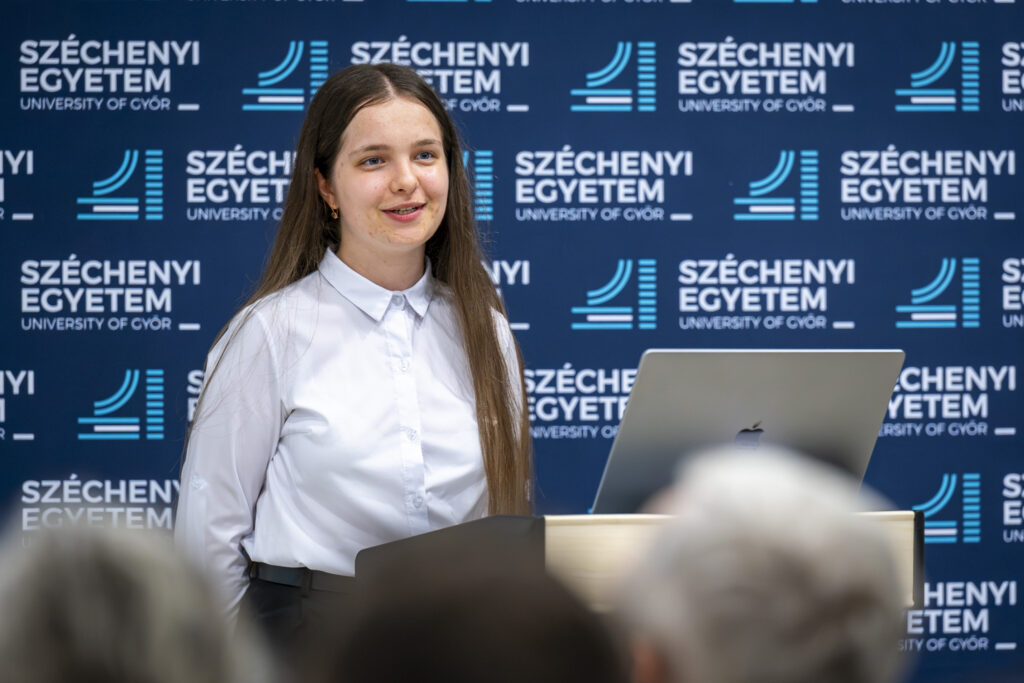
The team’s website has been completely renewed, resulting in increased visitor numbers, reported Veronika Végső (Photo: Máté Dudás)
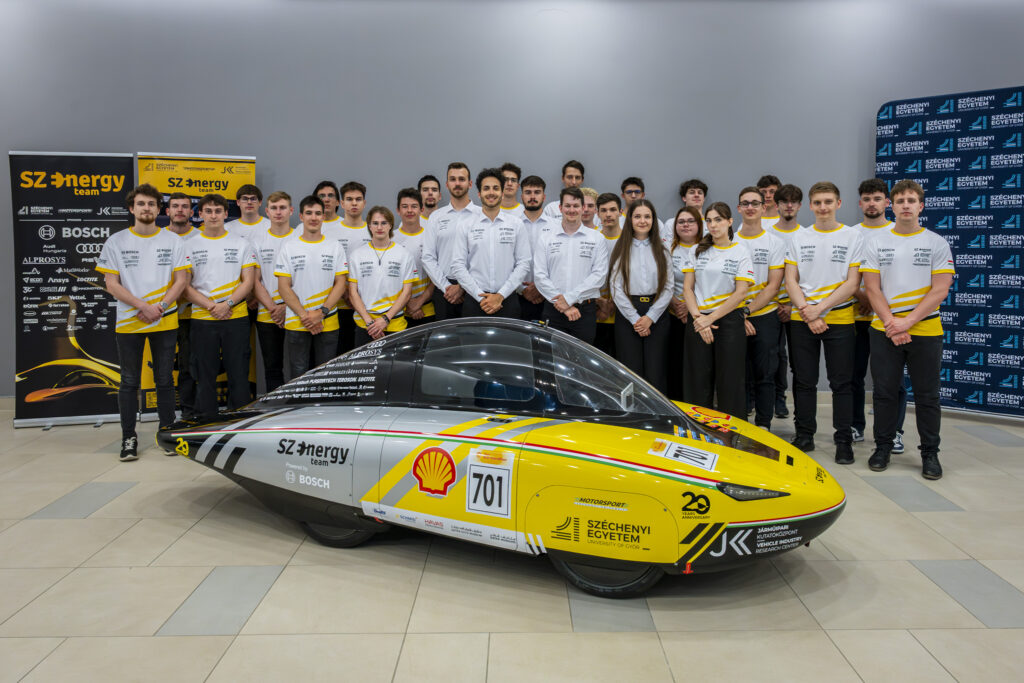
The SZEnergy team with its 2026 competition vehicle (Photo: Máté Dudás)