
Updated: 2026.11.10. 09:10|
As part of a partnership with the Western Transdanubian Region of the Hungarian Charity Service of the Order of Malta, the Colorolli set of inclusive creative tools – an intellectual creation of SZE developed by its student Anna Sára György – will also be tested in care settings for older people and people with disabilities. The aim of testing these products, which make drawing and painting easier, is to map their potential applications and develop a practical methodology for their use.
SZE student Anna Sára György has reached an agreement with the Western Transdanubian Region of the Hungarian Charity Service of the Order of Malta to test her internationally award-winning development, the Colorolli set of creative tools, in various care settings. The partnership was announced recently at the TEAM Professional Day in Győr, organised by the Western Transdanubian Regional Centre of the Hungarian Charity Service of the Order of Malta and the Regional Professional Support Centre for Győr-Moson-Sopron and Veszprém Counties, where the tools were also handed over. Representatives of two institutions maintained by the Hungarian Charity Service of the Order of Malta received a Colorolli set: Ágnes Pál Belancsicsné, Director of the Gondviselés Háza Aranytölgy Home for Older People in Zalakomár, and Gyöngyvér Gyenesey Kocsisné, Deputy Director of the Gondviselés Háza – Home for People with Disabilities and Older People in Ivánc, respectively. The product range is not yet commercially available, and its design will be further refined based on testing results and user feedback.
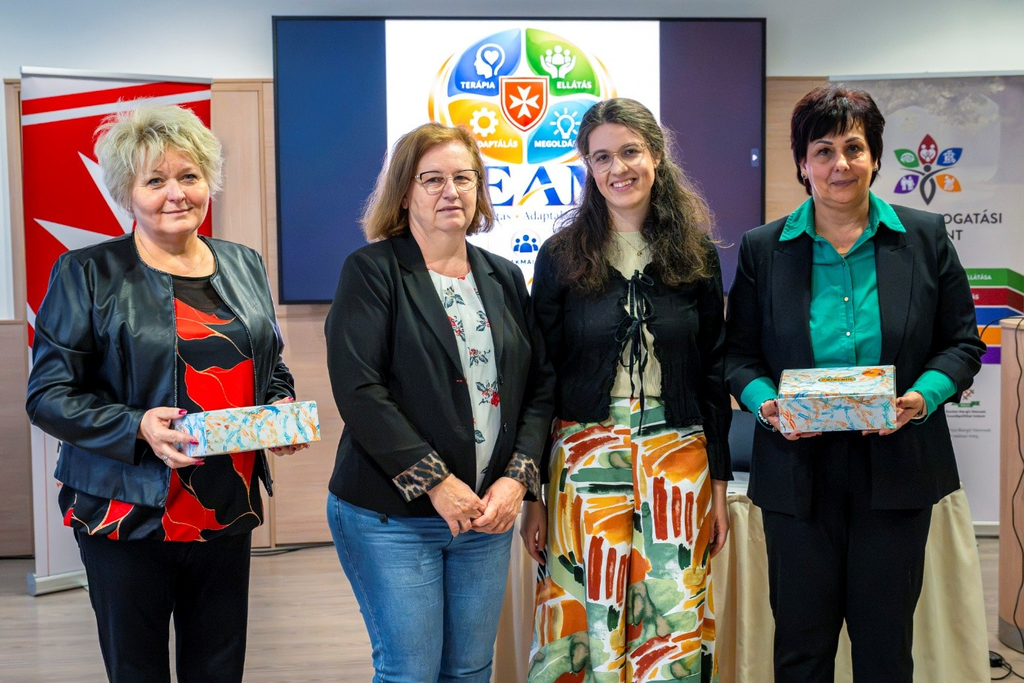
Ágnes Pál Belancsicsné, Director of the Gondviselés Háza Aranytölgy Home for Older People in Zalakomár; Teodóra Németh Ráczné, Regional Managing Director of the Western Transdanubian Region of the Hungarian Charity Service of the Order of Malta; Anna Sára György, SZE student and creator of Colorolli; and Gyöngyvér Gyenesey Kocsisné, Deputy Director of the Gondviselés Háza – Home for People with Disabilities and Older People in Ivánc, at the handover of the Colorolli set of creative tools. (Photo: Máté Dudás)
Anna Sára György, a master’s student in design at SZE, began working on the idea as part of her bachelor’s thesis. The inclusive set of creative tools, designed primarily for children with physical and multiple disabilities, is distinctive in that its interchangeable components can be combined to accommodate different types of grips. This makes drawing and painting easier for people who find conventional pencils or paintbrushes difficult to use. The young designer’s creation achieved significant international success this year: it was selected as one of the seven best entries in the iF Design Student Award competition and also received the HOTO Design Prize by iF special award.
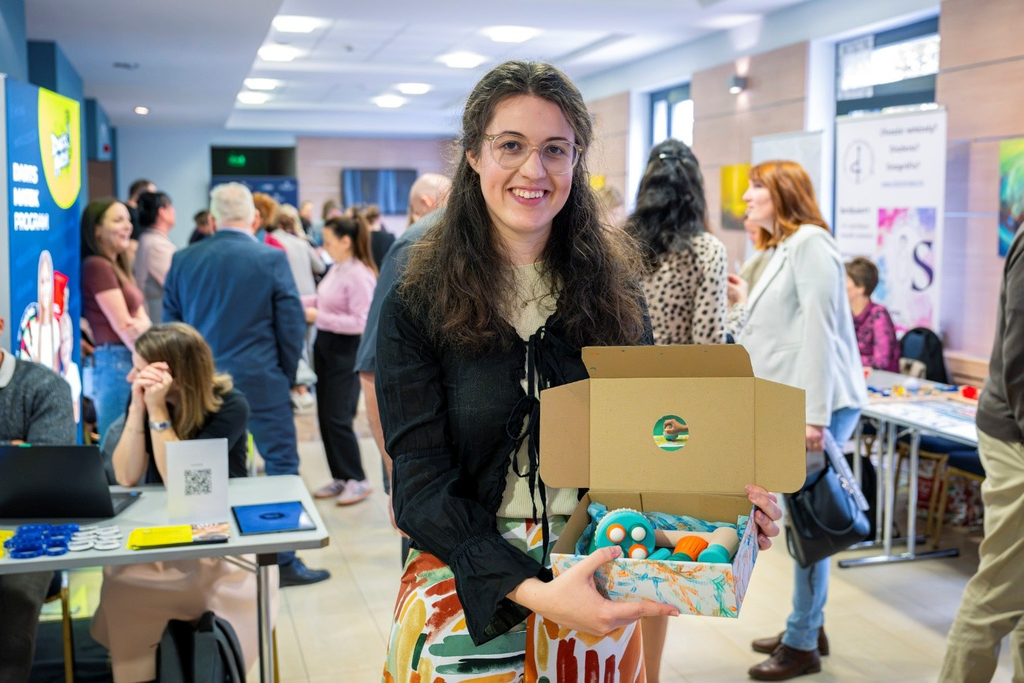
The TEAM professional day, organised by the Western Transdanubian Regional Centre of the Hungarian Charity Service of the Order of Malta and the Regional Professional Support Centre for Győr-Moson-Sopron and Veszprém Counties, brought together 190 participants, 23 speakers and 16 exhibitors. Among the exhibitors was Anna Sára György, a student at SZE, who presented her Colorolli set of creative tools. (Photo: Máté Dudás)
Nearly 200 people have tried out Colorolli so far, primarily in special education institutions. In addition to children of different ages, the testing has also involved adults who have had a stroke; experience with this group was gained through rehabilitation services at the University of Pécs. Anna Sára György has been awarded funding through the University Research Scholarship Programme (EKÖP) to further develop the set of creative tools. The scholarship will enable her to continue her research and creative work for ten months at the Department of Industrial Design within SZE’s Faculty of Design and Performance Arts, under the supervision of Fruzsina Keszei, designer and university lecturer. She will share her findings at a conference in November and also plans to present them at a National Student Science Conference in the spring.
“When I created Colorolli, my starting point was to make the joy of creating available to everyone, regardless of any mobility difficulties they may have. I would like as many people as possible to experience the freedom of self-expression, without the difficulties of using conventional drawing tools becoming a barrier. Our partnership with the Hungarian Charity Service of the Order of Malta is a great opportunity, as feedback from different user groups can provide new perspectives for further development,” said Anna Sára György.
In the institutions of the Hungarian Charity Service of the Order of Malta, people of different ages and with a range of needs receive care, meaning that Colorolli could prove useful not only for children but also for other groups. As part of the joint project, the ways in which the creative tools can be incorporated into the developmental and recreational activities at the individual institutions are being explored. Drawing on the experience gained, specialists will be able to develop a guide to help tailor the use of the tools to different needs.
“I am proud of our colleagues, who are not only open to new ideas but also actively seek out ways to improve the care we provide to those entrusted to us. Colorolli is a good example of this. We consider it important that innovation does not necessarily mean costly technology, as often simpler, ingenious solutions can also provide valuable assistance,” emphasised Teodóra Németh Ráczné, Regional Managing Director of the Western Transdanubian Region of the Hungarian Charity Service of the Order of Malta.
The Western Transdanubian Region of the Hungarian Charity Service of the Order of Malta has previously entered into a similar collaboration with the creators of another development associated with SZE, Marokbaba. Under the partnership, established in February this year, the potential uses of the tool, originally designed for children, are being explored in a range of care settings, including services for older people living with dementia, people with disabilities, and people with mental health conditions or addictions.