
Created: 2026.08.27. 13:53
Dr Hajdu Csaba, a researcher at Széchenyi István University, spent almost two months in Japan. During his professional visit, supported by the Pannónia Scholarship Programme, he joined the research activities of a research group at Nagoya Institute of Technology, where he conducted research in the fields of artificial intelligence and robotics, contributing to the development of a long-term Hungarian–Japanese collaboration.
Széchenyi István University provides its staff with numerous opportunities to gain professional experience abroad, expand their international research networks and participate in the work of research institutions in other countries. The Pannónia Scholarship Programme is one such initiative, enabling Dr Hajdu Csaba, a researcher at the University, to travel to Japan to participate in research at Nagoya Institute of Technology.
This summer, the researcher spent almost two months as a member of the research group at the institution’s Kato Laboratory.
The work carried out in the laboratory led by Professor Shohei Kato focused on artificial intelligence, robotics, and the structured representation of complex systems.
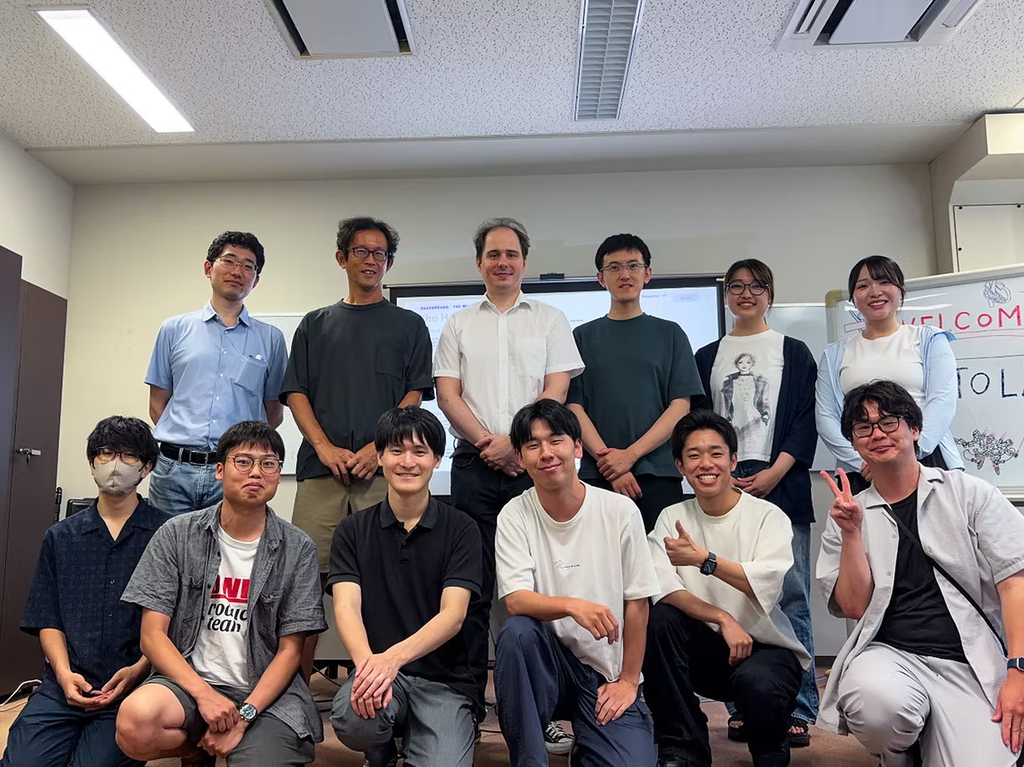
Dr Hajdu Csaba (centre, top row) spent almost two months working with the Kato Laboratory research group in Nagoya.
Dr Hajdu Csaba further developed his own framework, known as HyMeKo, and the research associated with it. At the beginning of the programme, he presented his findings to date and the research questions he intended to investigate at a seminar. Following an intensive period of experimental work, he reported on the results achieved in Nagoya and outlined new research directions in his final presentation. As part of the day-to-day activities of the Kato Laboratory, he also gained insight into a range of projects being conducted there, including research involving reinforcement learning, large language models, speech recognition and applications for elderly care.
“It was fascinating to see the diversity of the research topics and to experience a research culture in which students work on their own research problems, regularly present their findings and discuss each other’s work. I was not simply an observer of the laboratory; I had the opportunity to work as part of this professional research community,” said Dr Hajdu Csaba. He added that it was particularly valuable to be able to work together with the researchers there to test and further develop, in practice, the ideas he had brought with him to Japan.
The Hungarian–Japanese collaboration will continue following his return to Hungary.
The researcher from Győr and Professor Kato are continuing their joint work online. The next steps include new machine learning and robotics experiments, joint publications, and, in the longer term, the development of opportunities for student mobility and joint supervision of students.