
Created: 2026.06.11. 08:45
In May, the NATO Cooperative Cyber Defence Centre of Excellence (CCDCOE) hosted its Military Operations Planning in International Law course in Tallinn, Estonia. Dr Roland Kelemen, Head of the Department of Modern Technology and Cybersecurity Law at Széchenyi István University, became the first representative from Hungary’s civilian higher education sector to participate in the expert-level legal training.
A total of 29 participants from 17 NATO member states attended the programme in Tallinn. Representing Hungary, Dr Roland Kelemen was the first civilian participant from the country—that is, the first attendee not employed by a government institution or armed service—to take part in the course. He serves as Head of the Department of Modern Technology and Cybersecurity Law at the Deák Ferenc Faculty of Law and Political Sciences of Széchenyi István University.
His participation reflects a growing commitment to new forms of cooperation between defence organisations and civilian institutions. One of the key initiators of this approach in recent years has been Colonel Dr Ádám Farkas, a researcher at Széchenyi István University. As a result, the faculty has already become actively involved in several programmes organised by the NATO Cooperative Cyber Defence Centre of Excellence, which serves the Alliance’s 32 North American and European member states. Lieutenant Colonel Dr László Vikman contributed to the preparation of the organisation’s largest cyber defence exercise, while a team of law and computer engineering students from the University achieved a top-three finish in the Locked Shields Partner Run, the rehearsal event preceding the main exercise. Dr Roland Kelemen also participated as a faculty member of the team before successfully completing the Military Operations Planning in International Law course, which had previously been open exclusively to military and government professionals.
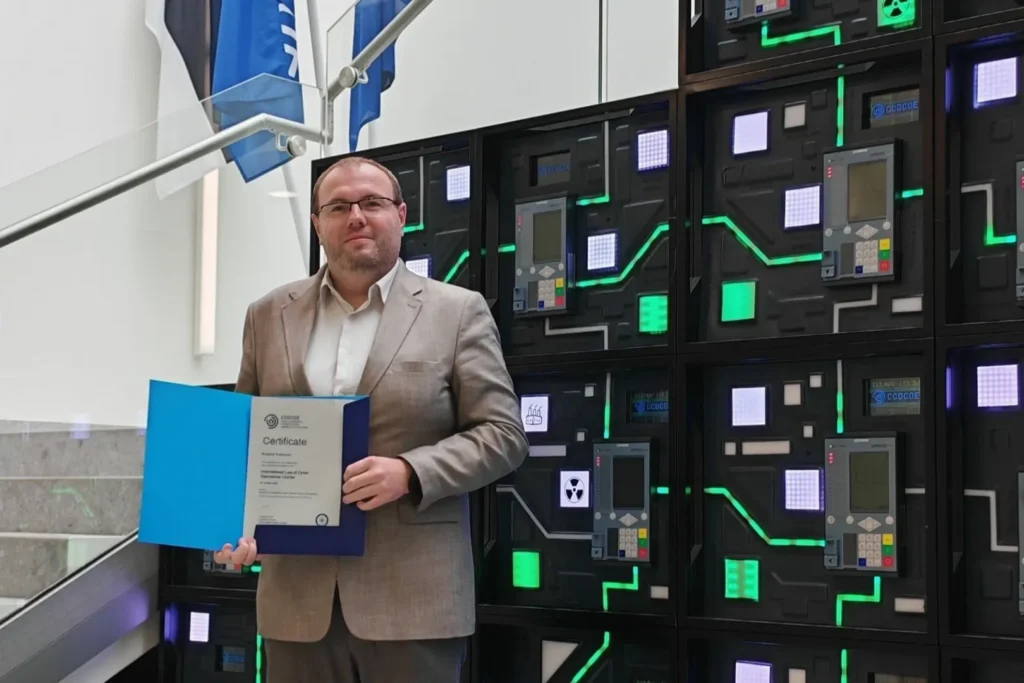
Dr Roland Kelemen, Head of the Department of Modern Technology and Cybersecurity Law at Széchenyi István University, became the first Hungarian civilian to complete the legal training programme of the NATO Cooperative Cyber Defence Centre of Excellence.
The intensive five-day programme combined expert instruction with practical team exercises, addressing some of today’s most pressing cybersecurity challenges, including state responsibility, the concept of sovereignty in cyberspace, and the legal limits on the use of force. Participants also examined the implications of artificial intelligence and explored the application of international humanitarian law in cyberspace, with particular emphasis on target selection, the protection of civilians, and the role of human rights during conflicts.
“The programme clearly demonstrated that cooperation between governmental, military and civilian organisations fosters outstanding results and forward-looking joint thinking,” said Dr Roland Kelemen. “The same principle is reflected in Győr, where our University carries out research and development activities in partnership with defence organisations and other public-sector stakeholders, bringing together academia and the defence community.” He also praised the structure of the training as a model of best practice, noting that gaining deeper insight into NATO’s cooperative framework was an especially valuable experience. “It was reassuring to see that the courses offered by our faculty follow a similar structure, combining theoretical knowledge with practical case studies. This confirms that our educational approach meets international standards,” he added. He also highlighted that the programme provided an excellent opportunity to build professional networks among participating member states and institutions.

Representatives from 17 NATO member states—including Latvia, France, Slovenia, Greece, Czechia, Germany and Ireland—took part in the legal training. Hungary was represented by Dr Roland Kelemen of Széchenyi István University (fifth from right). (Photo: NATO Cooperative Cyber Defence Centre of Excellence)