
Created: 2025.11.28. 13:57
A three-member delegation from the University of Siena in central Italy recently visited Széchenyi István University. The medical researchers learned about the institution’s scientific activities, its cooperation with the Petz Aladár University Teaching Hospital of Győr-Moson-Sopron County, and the operation of the University’s recently acquired Da Vinci surgical robot. In the future, the two institutions may cooperate in urological, gynaecological or other forward-looking medical technology research areas.
In recent years, Széchenyi István University has significantly expanded its global network of higher education partnerships. A new collaboration is now taking shape: representatives of the University of Siena visited Győr to reaffirm their commitment to joint work. The Italian institution is ranked 607th in the Quacquarelli Symonds (QS) World University Rankings, while the Times Higher Education ranking lists it in the 351–400 category.
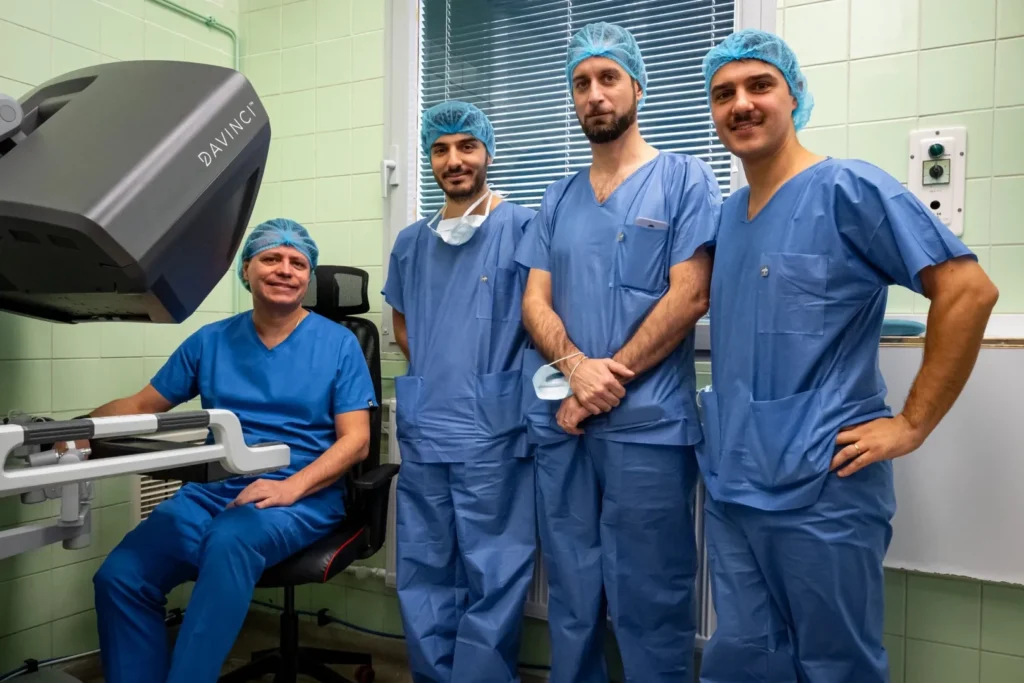
During their November visit, the three-member delegation gained insight into the University’s education, research and innovation activities. The specialists, practising in various fields of medical science, were given a detailed demonstration of the operation of the Da Vinci surgical robot, which the University uses in cooperation with the Petz Aladár University Teaching Hospital. The device is used not only in practical applications but also plays a role in academic research: the University’s experts are using artificial intelligence to advance healthcare services.
The guests toured the Győr campus, followed by an official meeting with representatives of the institution. At the discussion, Péter Németh, Scientific Secretary and Head of the HUN-REN University Centre of International Excellence at SZE, highlighted that Széchenyi István University now contributes to global higher education with more than 50 English-taught programmes, four doctoral schools, numerous competence centres, an interdisciplinary approach and a truly international environment. “We have five double-degree programmes, one of them with the Italian University of Cassino and Southern Lazio in the international Economics and Business Master’s programme,” he noted. He also drew attention to the MedTech Campus development, established on the site of the former hospital, the first phase of which has already been completed.
Professor Majid Movahedi Rad, Vice-Dean for Scientific Affairs at the Faculty of Architecture, Civil Engineering and Transport Sciences, presented the work of the Computational Mechanics Research Group he leads. He emphasised that their activities span numerous scientific fields, including medical and biomedical technologies. “We mainly examine the application of artificial intelligence and work with numerical modelling approaches to address various challenges—whether in agriculture, engineering or healthcare,” he explained. He also outlined the group’s current health technology projects, including AI-supported optimisation of drug delivery, 3D-printed biomechanical devices, durable and flexible bone replacement solutions, and numerical modelling for robot-assisted surgeries. On the latter topic, Milad Shafaie, a doctoral student of SZE, presented his own ongoing research.
Representing one of the institution’s key innovation-focused units, the Digital Development Centre, Zsuzsanna Iharos presented the University’s most successful health technology developments, including a surgical streaming platform, a sports dietetics application, a VR-based rehabilitation programme, a motion analysis device and a telerehabilitation software solution. She highlighted that, thanks to the Centre’s excellent infrastructure and expertise, it is able to support innovation processes from pilot project testing all the way to market application.
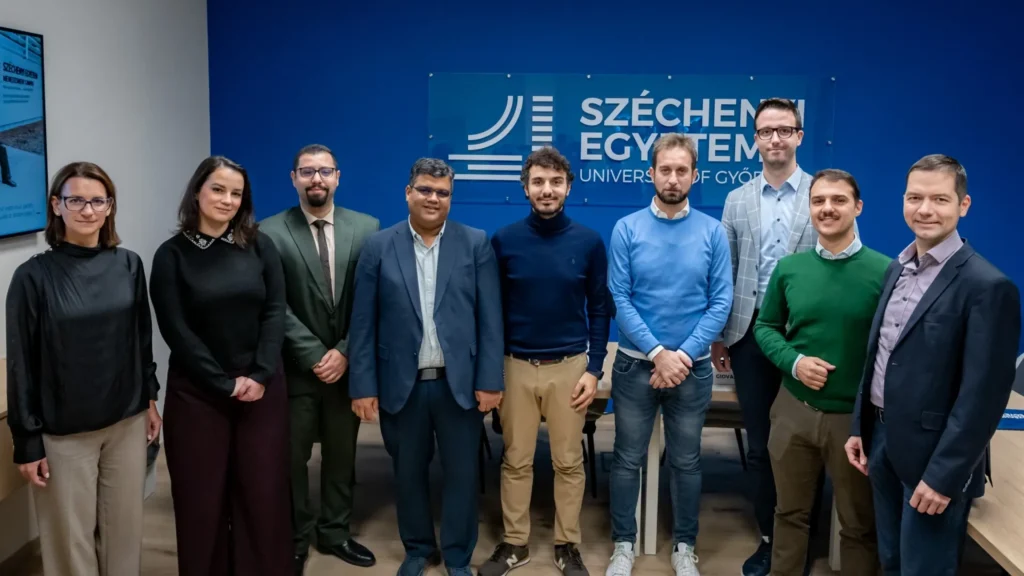
Participants of the meeting held at Széchenyi István University: Zsuzsanna Iharos (Digital Development Centre), Marcella Telek (Head, Centre for International Communication and Alumni), Milad Shafaie (doctoral student), Professor Majid Movahedi Rad (Vice-Dean for Scientific Affairs, Faculty of Architecture, Civil Engineering and Transport Sciences), Dr Francesco Giuseppe Martire and Dr Alberto Salvicchi (research physicians, University of Siena), Péter Németh (Scientific Secretary and Head of the HUN-REN University Centre of International Excellence), Dr Giovanni Tasso (research physician, University of Siena) and Dr Péter Törzsök (Vice-Dean for International Affairs, Faculty of Health and Sports Sciences) (Photo: András Adorján)
Dr Giovanni Tasso, research physician of the University of Siena’s Department of Urology, said that the experiences in Győr had inspired many ideas for collaboration. “Urology is a highly technology-focused field, and we can make significant progress in applying robotics, which can not only shorten recovery time but also ease wound healing. I see many inspiring possibilities for joint research where doctors and engineers could work together on developments that shape the future,” he said.
Dr Francesco Giuseppe Martire, research physician of the Department of Molecular and Developmental Medicine, emphasised that he was impressed by the modern campus of Széchenyi István University, where solving technological challenges is truly in focus. “As a practising gynaecologist, it was fascinating to see how robot-assisted surgeries work. Cross-border knowledge-sharing greatly supports the development of the field, including research on uterine cancer or endometriosis, which I also study. Artificial intelligence can contribute in many ways—whether in selecting optimal treatments or during surgical procedures,” he stated.
Dr Alberto Salvicchi, research physician at the Department of Respiratory Diseases, sees great potential in the outlined health technology projects. He explained that in thoracic surgery, the 3D-printed replacement of ribs or the sternum would represent a major innovation, offering a more flexible solution than the titanium implants currently in use.
Dr Péter Törzsök, Vice-Dean for International Affairs of the Faculty of Health and Sports Sciences at Széchenyi István University, stressed that combining the practical knowledge of physicians with the engineering and technology-focused mindset of University experts can lead to scientific results that may define the future of healthcare. He emphasised that cooperation with the University of Siena is not only a step towards global partnership-building but also a commitment to advancing medical technology through collaborative development.