
Created: 2026.08.18. 10:35
Széchenyi István University has launched a community initiative to save the monumental stone relief entitled Flow, located in the former Rába Restaurant on the site of the former Rába Vehicle and Machine Factory. In cooperation with the Győr-Moson-Sopron County Chamber of Commerce and Industry, the University is calling on the people of Győr, businesses in the region, the University’s alumni, and everyone committed to preserving the city’s industrial and cultural heritage to make a donation. The aim is to restore the artwork and give it a worthy new home on the University’s central campus.
Created by Munkácsy Prize-winning sculptors Bálint Józsa and Ferenc Kovács, the monumental marble relief was installed on the walls of the restaurant of the former Rába Vehicle and Machine Factory in 1979. Inspired by the flow of the Rába River, the work expressed the dynamism of the company while also representing an outstanding example of Hungarian abstract art of the 1970s. Its exceptional significance is further enhanced by the fact that the Józsa–Kovács artistic duo created only three reliefs of this scale.
The impending demolition of the restaurant building, which is still standing on the former factory site, has made saving the artwork an urgent priority. Rába Automotive Holding Plc. has donated the relief to Széchenyi István University, where it could find a new home on the façade of the University’s Inno-Share building. The restoration and relocation could be carried out with the involvement of the Hungarian National Gallery’s Advisory Board, the artists and an art historian. The entire process—from dismantling and restoration through transportation to reconstruction—is estimated to require an investment of approximately HUF 22 million. To help achieve this, the University has launched a fundraising campaign together with its key partner, the Győr-Moson-Sopron County Chamber of Commerce and Industry. The Chamber is making a significant contribution to this heritage-preservation initiative by mobilising businesses across the region.
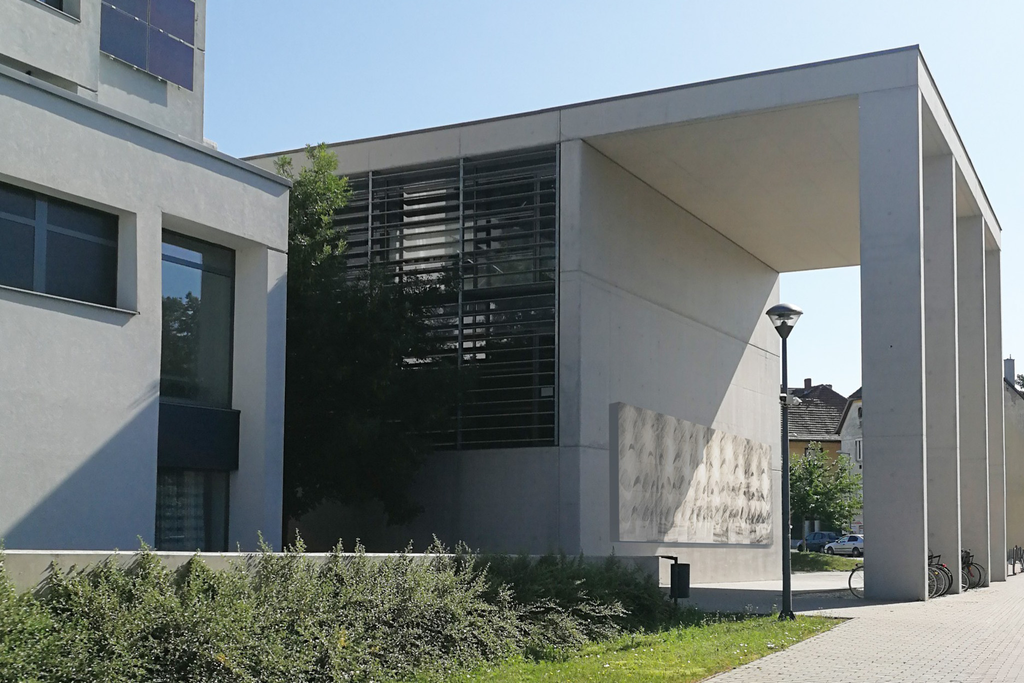
The stone relief could be installed beneath the arcade of Széchenyi István University’s Inno-Share building. (Visualisation)
“Eight years ago, I encountered the artwork Flow while visiting the former Rába self-service restaurant. I was struck by its grandeur and emotional power, yet saddened by the neglect it had suffered, which inspired me to work towards saving it. I first sought out the artists’ families and eventually managed to establish contact with Bálint Józsa, who enthusiastically helped develop the idea. We talked extensively about the work and its renewal. I also made a documentary report with him about the origins of the artwork, entitled Waves, which I warmly recommend to everyone, as the relief is one of the outstanding precursors of Hungarian non-figurative sculpture,” said Zsuzsanna Nagy, the initiator and professional coordinator of the campaign, an architect and interior designer and lecturer at the University’s Faculty of Design and Performance Arts. She noted that Bálint Józsa also passed away in March this year, making the restoration an opportunity to pay tribute to the memory of both Munkácsy Prize-winning sculptors.
She added that, from an architectural perspective, she believes it is essential to preserve as much of our heritage as possible for future generations. “This is why Széchenyi István University’s involvement is so important: it demonstrates what we can achieve for our culture when we work together. As educators, we also have an important responsibility to set a positive example for our students, who will be able to encounter the results of this heritage-preservation effort on a daily basis in the future,” she emphasised.

Zsuzsanna Nagy, architect and interior designer, lecturer at SZE’s Faculty of Design and Performance Arts, and initiator of the campaign. (Photo: András Adorján)
Zsuzsanna Nagy believes that the stone relief would thus be placed in an appropriate intellectual and cultural environment, while also becoming accessible and visible to the wider public. She also pointed out that works of art are often demolished together with the buildings that house them, making the success of this initiative a unique example in Hungary. “I would like to thank everyone who joins this worthy cause and contributes to saving a piece of our outstanding artistic heritage,” she stressed.
The artwork consists of 95 marble panels, which can also be symbolically adopted. The contribution required to adopt one marble panel is HUF 230,000; however, donations of smaller amounts are also warmly welcomed in support of saving the relief. Depending on the amount of their contribution, donors may have their names displayed on a commemorative plaque beside the artwork. The Universitas Győr Foundation is responsible for administering the donations. Those wishing to make a contribution are invited to indicate their intention by 31 August via alapitvany@sze.hu.
The initiators hope that, through the joint efforts of the community of Győr and the surrounding region, one of the outstanding works of the city’s industrial and artistic heritage can be preserved and passed on to future generations.