
Created: 2026.05.28. 08:37
The Sustainability Competence Centre of Széchenyi István University, together with the United Nations Association of Hungary and the Hungarian National Commission for UNESCO, recently organised the latest edition of the Majlis lecture series focusing on the values of the United Nations. Held at the Győr Innovation Park, the programme centred on sustainability in higher education, with renowned experts discussing the topic with Hungarian and international students of the University.
The Majlis lecture series, organised by the United Nations Association of Hungary, is a professional and public affairs event focusing on the values of the United Nations, international security policy, human rights, and global processes. Its aim is to examine the background to current challenges with the involvement of experts and diplomats. The latest event was hosted by the Győr Innovation Park of Széchenyi István University, as the event entitled “Sustainability in 21st Century Higher Education” was jointly organised by the University’s Sustainability Competence Centre, the Hungarian National Commission for UNESCO, and the association.
Within the framework of the United Nations, the term Majlis (Arabic for “sitting place” or “council”) refers to an official forum for open dialogue aimed at promoting cooperation and resolving global issues. The essence of the format lies in enabling members of the community to exchange ideas, settle disputes, and build consensus. The moderator of the Győr event was Brimo Widad, Secretary of the United Nations Association of Hungary. One of the panellists was Her Excellency Katalin Bogyay, Ambassador, Hungary’s 15th Permanent Representative to the United Nations, President of the 36th Session of the UNESCO General Conference, and President of both the United Nations Association of Hungary and the Hungarian National Commission for UNESCO, who was recently awarded an honorary doctorate by Széchenyi István University. Alongside this prominent figure of Hungarian diplomacy, Dr Eszter Lukács, Vice-President for International Affairs and Strategic Relations of the University, Head of the Institution’s Sustainability Competence Centre, and Presidium Member of the United Nations Association of Hungary, also delivered a presentation.
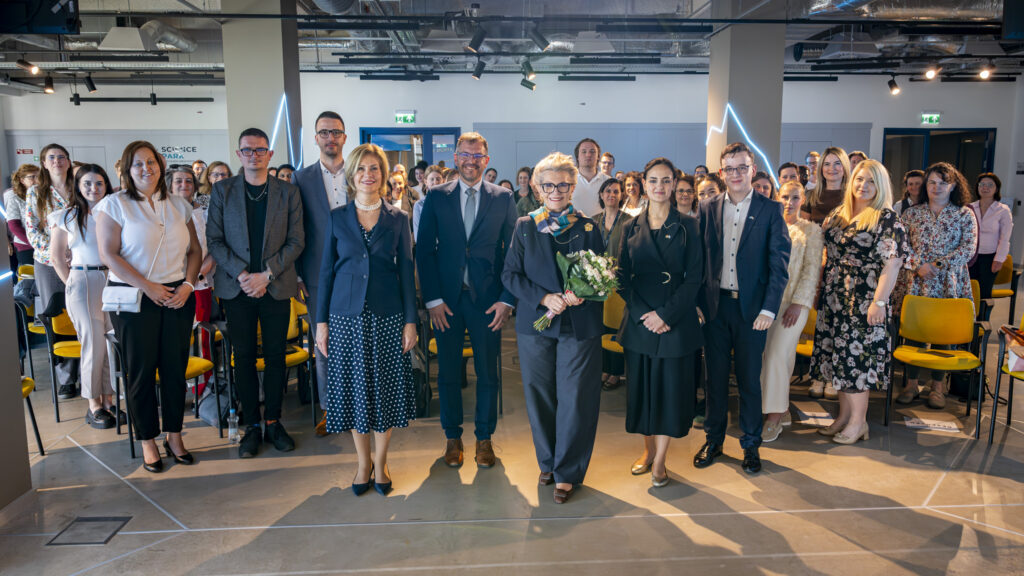
At the programme jointly organised by the United Nations Association of Hungary and Széchenyi István University, Eszter Lukács (first from the left in the front row) and Katalin Bogyay (centre) shared their thoughts on sustainability with the audience.
(Photo: Máté Dudás)
In her presentation, Katalin Bogyay emphasised that sustainability is a key concept in the work of the United Nations, accompanied by clearly defined goals and guidelines. “Years ago, 193 countries jointly established the Sustainable Development Goals, creating a common foundation for a better future,” she stated, referring to those objectives that also shape the strategy of Széchenyi István University. She noted that sustainability is a defining issue not only from an environmental perspective, but also from social, economic and community perspective.
Katalin Bogyay also spoke about the work of UNESCO, the United Nations Educational, Scientific and Cultural Organization, reflecting on the years she spent there. She stressed that sustainable development is of strategic importance in culture and, consequently, in education as well. “Challenges such as climate change require systematic and collaborative responses that extend beyond the boundaries of individual disciplines and make institutional engagement indispensable,” she remarked. She explained that higher education institutions have responsibilities extending beyond education alone, as sustainability goals must be implemented not only in theory but also in practice, and integrated into research and development projects as well as community programmes.
Dr Eszter Lukács likewise highlighted the role of universities in achieving the Sustainable Development Goals and presented the efforts of Széchenyi István University in her presentation. She explained that, in addition to the Department of Applied Sustainability, the institution’s Sustainability Competence Centre works to coordinate and continuously develop the University’s sustainability strategy on an ongoing basis. “This centre prepares our institution’s sustainability report, analyses the sustainability content of courses and research activities, records all sustainability-related events, and also supports grant-related activities,” she detailed. She pointed out that, out of Hungary’s 64 higher education institutions, only 12 possess a sustainability strategy, while universities’ sustainability practices can also be assessed through the relevant rankings of global evaluation organisations.
“The sustainability ranking of Quacquarelli Symonds primarily evaluates institutions according to ESG criteria widely recognised in the business world, while the similarly structured Impact Rankings by Times Higher Education assess institutions based on the normative framework of the United Nations. At the Sustainability Competence Centre, we analysed which Hungarian universities meet all three criteria – meaning they have a sustainability strategy and appear in both rankings. We identified six such institutions, one of which is Széchenyi István University,” she stated, demonstrating that the contribution of education to sustainability is measurable and tangible.
Many Hungarian and international students of the institution also attended the programme and had the opportunity to ask questions to the speakers. One Syrian doctoral student of the University was interested in the role that artificial intelligence could play in sustainability efforts. According to Katalin Bogyay, technology is unavoidable, but careful attention must be paid to maintaining the primacy of human oversight in order to ensure its ethical use. Another PhD student from Iran asked about the timeframe of sustainability plans, particularly regarding long-term strategy. In response, Katalin Bogyay emphasised that the Sustainable Development Goals are not rigid, unchangeable plans, but rather frameworks that can incorporate the experiences gained over time. She highlighted that the United Nations is already working on the next strategy, keeping the well-being of member states, communities, and individuals in mind.