
Created: 2026.02.26. 09:49
A senior delegation from the International Fencing Federation (FIE) recently visited Széchenyi István University to learn about the institution’s sports science programmes, its dual career model and sports ecosystem, and to explore the possibilities of a strategic partnership. The shared objective of the parties is to create an internationally recognised educational pathway for fencers that simultaneously supports sporting careers and the attainment of higher education qualifications.
In recent days, a multi-member FIE delegation travelled to Győr – led by Interim President Abdelmoneim El Husseiny, Secretary General Gulnora Saidova, Chief Executive Officer Nathalie Rodrigez, Secretary-treasurer Ferial Nadira Salhi, and Vice-President Henriette Tamás, who also serves as Secretary General of the Hungarian Fencing Federation – to visit Széchenyi István University and gain insight into its sports science programmes and the model through which the University harmonises academic studies with elite sport.
During the meeting, Dr Árpád Tóth, Chief Financial Officer of the institution, presented the University’s operations and strategic directions, while Dr Zoltán Alföldi, Head of the Department of Health Promotion and Exercise Science at the Faculty of Health and Sport Sciences – who has been named Coach of the Year in rowing on several occasions – provided a detailed overview of the sports science programmes, the coach education portfolio and the support system for student-athletes. He introduced the English-language Master’s programme in Specialist Coaching launching this year, as well as the planned Bachelor’s programme in Coaching, which integrates elements of sport sciences, health sciences, pedagogy and psychology, and organisational management. He also noted that the University is examining training formats that could be accessible to athletes studying across different time zones.
For the delegation, the so-called dual career model was of particular importance, as it enables athletes to pursue their studies under a flexible academic schedule while competing at a high level. “One of the strengths of Széchenyi István University’s sports science programmes is that we organise academic studies and elite sport in a mutually reinforcing way,” said Dr Zoltán Alföldi. “Through individual study arrangements, personal mentoring and targeted scholarships, we support our students, allowing them to be Olympic-level athletes and successful university students at the same time. Our aim is to ensure that they do not have to choose between sport and education.”
The operation of the model was illustrated with concrete examples of student-athletes, including Olympic competitors Kincső Takács and Dalma Sebestyén, cyclist Petra Zsankó, basketball player Réka Dombai, kayaker Gergő Rumi and rower Bence Szabó, all of whom pursued their studies at the University. It was also highlighted that the University’s programmes are relevant in the field of sports diplomacy. A notable example is Olympic champion fencer Emese Szász, who also earned her degree at the institution.
At the meeting, FIE representatives also spoke in detail about their own vision for the future. Secretary General Gulnora Saidova emphasised that the fundamental principle of the FIE Academy aligns closely with that of Széchenyi István University: the integration of sport and higher education. As she noted, the goal is not only outstanding sporting performance but also to ensure that fencers move forward with solid qualifications and long-term career opportunities. This ambition is reinforced by the fact that the Budapest Fencing Academy welcomed its first students in January 2026, launching intensive training for coaches and other professionals. At the same time, the FIE is not focusing solely on the European region but intends to strengthen professional fencing education globally, signalling its commitment to the development of international sports education and sports diplomacy – an area in which Széchenyi István University could become a strategic partner in the future.
“Coach education and the preparation of technical professionals are of key importance to us – as fencing is an extremely complex and equipment-intensive sport – alongside the development of refereeing, considering the specific characteristics of the three weapons, as well as the professionalisation of event organisation and administrative support. Based on today’s discussions, I believe we are well on our way to laying the foundations for a long-term partnership,” stated Dr Henriette Tamás, Vice-President of the FIE and Secretary General of the Hungarian Fencing Federation.
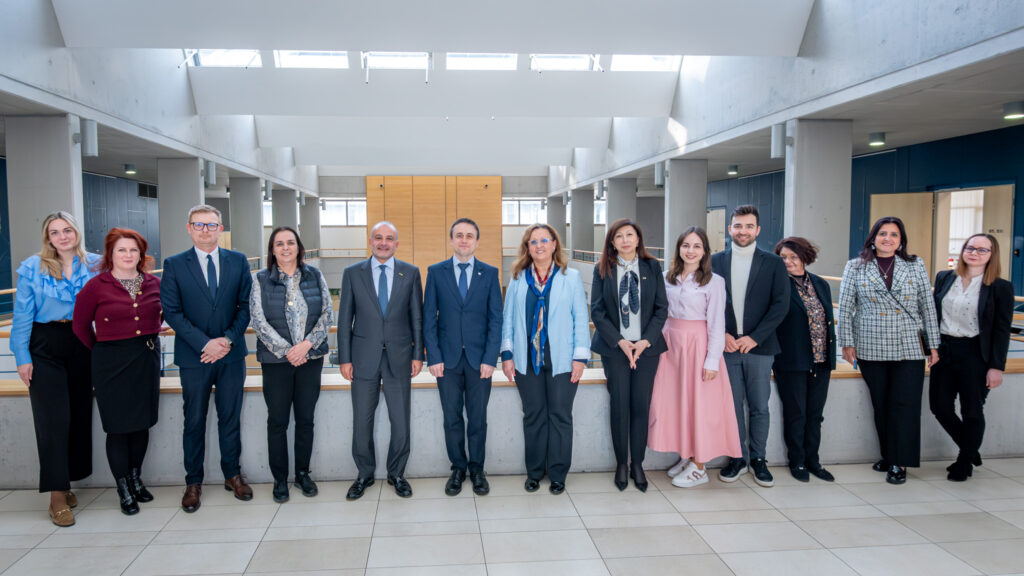
Participants in the visit to Széchenyi István University in Győr included: Júlia Vass, Strategic Manager of the University-owned Uni Pro Sport Ltd.; Dr Gertrúd Sipos, Head of the University’s Directorate for Legal Affairs and Portfolio Management; Dr Zoltán Alföldi, Head of the Department of Health Promotion and Exercise Science at the Faculty of Health and Sport Sciences; Ferial Nadira Salhi, Secretary-treasurer of the FIE; Abdelmoneim El Husseiny, Interim President of the FIE; Dr Árpád Tóth, Chief Financial Officer of the University; Dr Henriette Tamás, Vice-President of the FIE and Secretary General of the Hungarian Fencing Federation; Gulnora Saidova, Secretary General of the FIE; Réka Orosz-Barczi, International Director of the University; Dr Tamás Kolossváry, Head of the Győr Innovation Park of the University; Nathalie Rodrigez, Chief Executive Officer of the FIE; Samar El Sabee, Assistant to the Interim President of the FIE; and Rita Lenzsér-Balla, Administration Officer at the University’s Directorate of Education Management (Photo: András Adorján)