
Created: 2026.03.10. 09:36
The Albert Kázmér Faculty of Agricultural and Food Sciences at Széchenyi István University recently presented its research and development activities at the most significant food industry event in Central-Eastern Europe. At the SIRHA 2026 Budapest international trade exhibition, the institution also showcased joint developments with the Cibus Hungaricus Foundation and LogBord Ltd., including an automated convenience store that will soon be installed on the Mosonmagyaróvár campus.
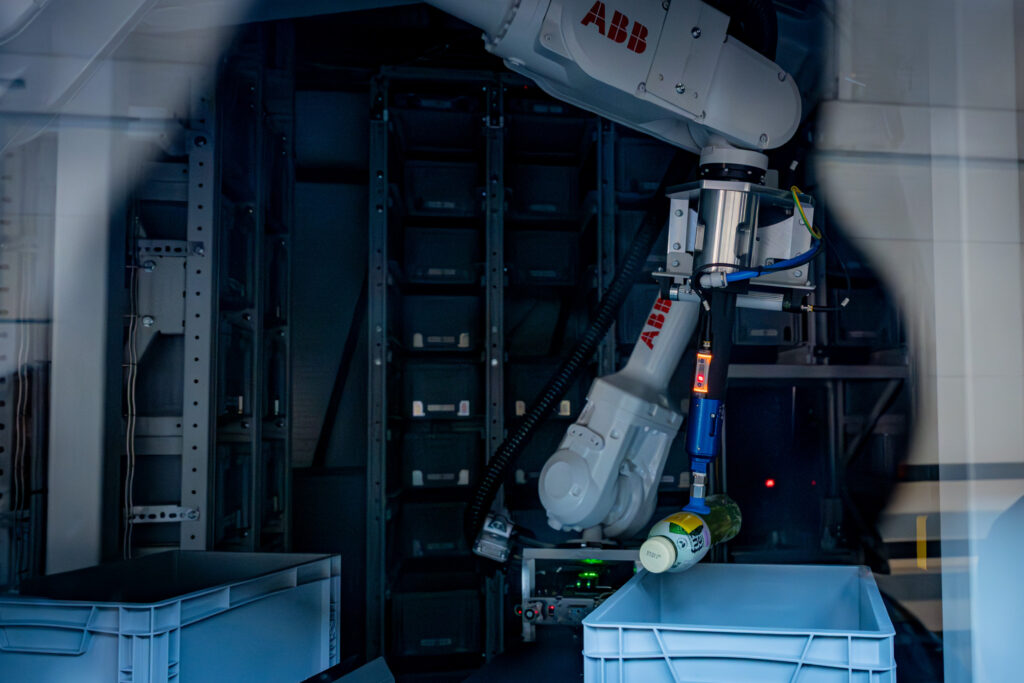
The SIRHA Budapest international food industry trade exhibition was organised for the seventh time, hosted in the pavilions of Hungexpo between 3 and 5 March. The programme covered an area of 30,000 square metres and welcomed visitors with more than 400 exhibitors, who could also visit the joint stand of Széchenyi István University, the Cibus Hungaricus Foundation and LogBord Ltd. Those attending the stand were introduced, with the help of experts, to a robotic automated convenience store, a device designed for the handover of refrigerated goods and a ready-meal vending machine. In cooperation with the foundation and with the support of the Ministry for National Economy, the University is implementing a project aimed at the practical application of these systems in real-life conditions and the dissemination and teaching of successful pilot solutions to all participants in the food supply chain.
Dr Tamás Tóth, research professor and dean of the Albert Kázmér Faculty of Agricultural and Food Sciences in Mosonmagyaróvár, explained that they had prepared for the exhibition by presenting their research, development and innovation activities, as well as their corporate partnerships, with a particular focus on developments in the food industry. “The most significant innovation presented at our stand is the automated container shop operated by robots, which will soon be installed in Mosonmagyaróvár, offering a new type of shopping experience for students, citizens of the town and local residents. This new development also contributes to strengthening domestic digital short supply chains, as it helps deliver local products – such as the Óvár cheese produced by our University – to consumers in a modern form. The solution ensures traceability and quality assurance in a state-of-the-art, automated way, while also providing sales opportunities for local producers – in our case, those from the Szigetköz region,” the dean explained. He also noted that the development involved not only the Mosonmagyaróvár faculty but also the University’s Digital Development Centre.
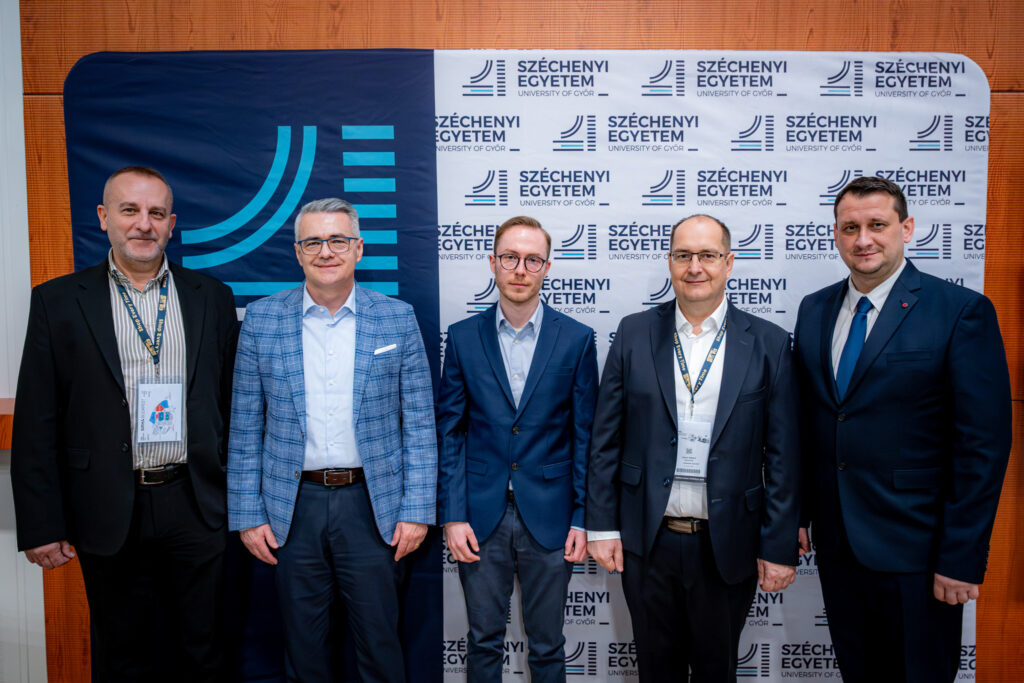
The automated convenience store will soon be installed on the Mosonmagyaróvár campus of Széchenyi István University, an agreement that was reached in a ceremonial framework. Participants of the event included Zsolt Óvári, Head of Logistics and Business Development at LogBord Ltd.; Dr Tamás Tóth, research professor and dean of the Albert Kázmér Faculty of Agricultural and Food Sciences; Dr Péter László Pőcze, CEO of Közért+ Zrt., a company owned by the University; Róbert László, Managing Director of LogBord Ltd.; and Dr Balázs Ásványi, Vice-Dean for Industrial Relations at the Albert Kázmér Faculty of Agricultural and Food Sciences in Mosonmagyaróvár (Photo: András Adorján)
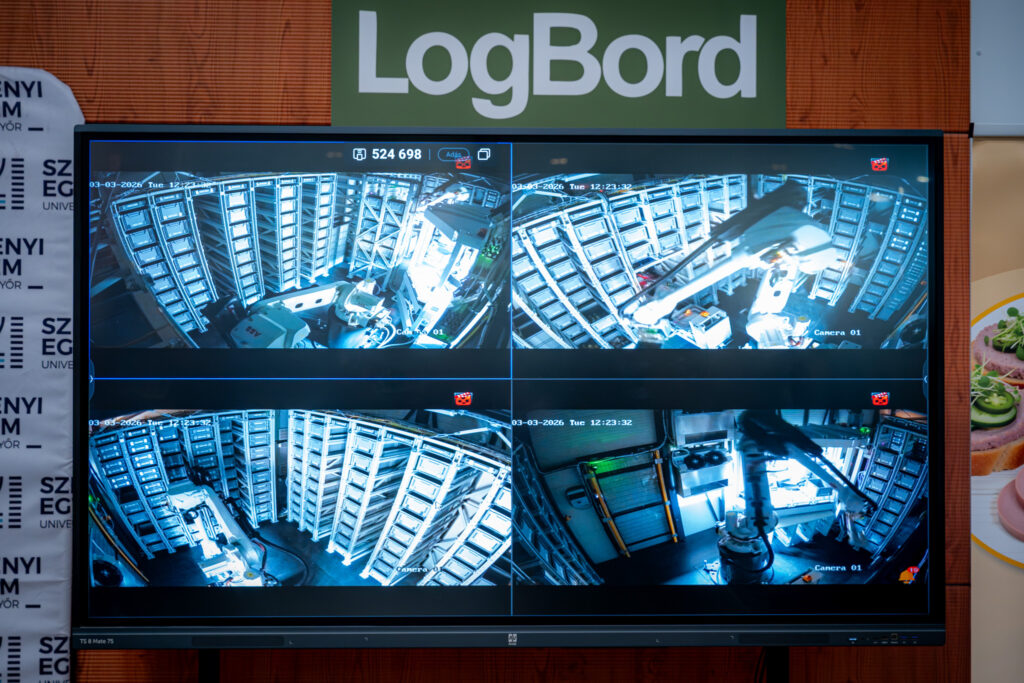
Péter Miklós Varga, Secretary General of the Cibus Hungaricus Foundation, added that the main mission of the joint project with the University is the integration of digitalisation into short supply chains, which combines the partners’ competences in an excellent way. A special feature of the innovation is that robotic arms assemble the package ordered via an application from storage units inside the shop, while restocking and stock management are also carried out by computer.
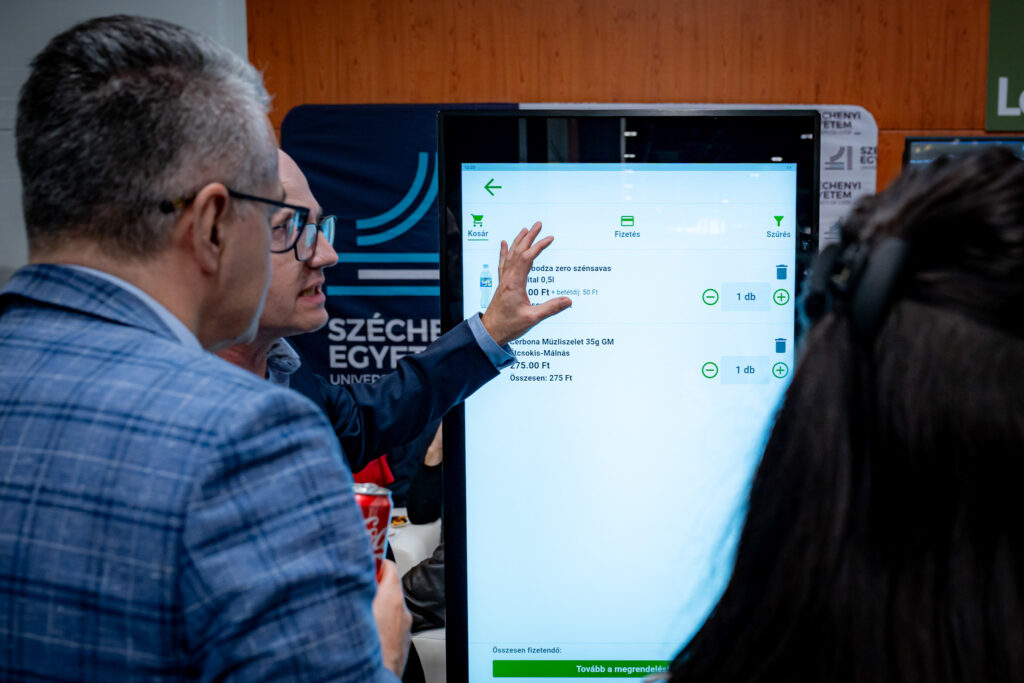
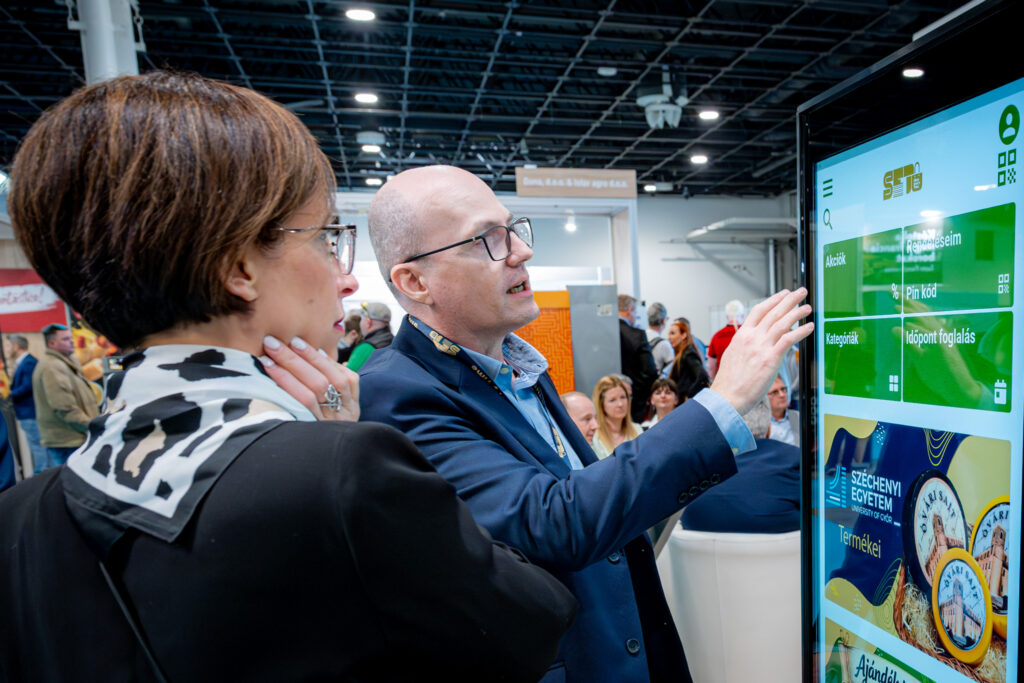
Consumers will be able to browse the products of the automated shop, which operates around the clock, through an application developed specifically for this purpose (Photo: András Adorján)
Róbert László, Managing Director of LogBord Ltd., explained that their company has been engaged in retail IT for twenty years and is committed to the development of innovations. “With our experience, we wanted to support an initiative that, while offering forward-looking solutions to consumer problems, is also beneficial for market development and for society,” he said. He added that the idea originated from the University and the foundation, fitting perfectly with the company’s business objectives, thus leading to a mutually beneficial cooperation.
The trade exhibition was opened by Dr István Nagy, Minister of Agriculture, who also visited the stand of Széchenyi István University. “I am proud that the University is engaged in such developments and, through its innovation, demonstrates the future of how a convenience store can operate around the clock and be accessible to everyone – providing an excellent service to students and citizens,” he said. He emphasised: “This is the 21st century, this is the future that in a few years’ time we will experience as something entirely ordinary. A university must radiate this kind of vision, and I am grateful to Széchenyi István University for setting such an example.”
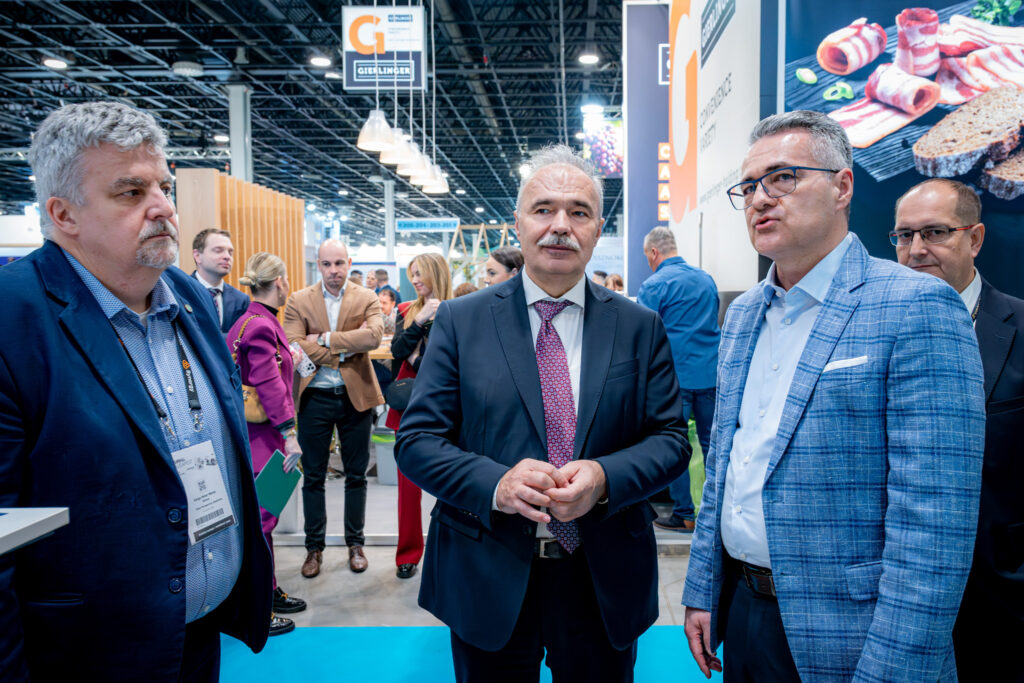
Dr István Nagy, Minister of Agriculture (centre), also praised the development, which he believes will become part of our everyday lives in the future (Photo: András Adorján)
Széchenyi István University contributed to enriching the SIRHA programme not only with its innovative products but also with professional round-table discussions. Over the three days, the institution’s stand hosted eight forums on topics related to short supply chains, including the digital food trade ecosystem, the role of producers in public catering, functional products, changing consumer demands, and educational and advisory needs. Participants in the discussions included researchers from the Hungarian higher education sector, company executives, representatives of public institutions and economic organisations, as well as renowned food industry experts.
At the beginning of the forum entitled “From Shelf to Platform: Automated Shops, Short Supply Chains and the Future of the Digital Food Industry”, Dr Gábor Mayer, Government Commissioner responsible for the complex development of the North-West Hungarian Economic Development Zone, spoke about the importance of connecting producers and consumers in a world where local, healthy and sustainable products are becoming increasingly popular, yet markets and market halls are less accessible for busy working people. “When we use big words such as ‘service-oriented’ or ‘entrepreneurial university’, this is exactly the type of tool we mean, and exactly what we need,” he pointed out regarding the value of the Széchenyi University project. “When academia and product development meet, and researchers step outside their laboratories, they will be able to create products that generate new value for both the business environment and private individuals.”


The development is being implemented within the framework of the tender entitled “Establishment of a Food Logistics Framework System in the Carpathian Basin Region for the Development of a Competitive Food Industry and Safe Commercial Instruments Supporting Public Health and Hungarian Agriculture”, as part of the project with the identification number NFPF/2005/2020-ITM_SZERZ.