Created: 2025.11.27. 11:39
An innovative meteorological station has been developed at the Albert Kázmér Faculty of Agricultural and Food Sciences of Széchenyi István University, which was recently presented to professional partners, resellers and farmers. The instrument, named Unisense, uses the latest technology to provide farmers with accurate data, supporting increased efficiency and minimised risks. Its distribution may begin in January.
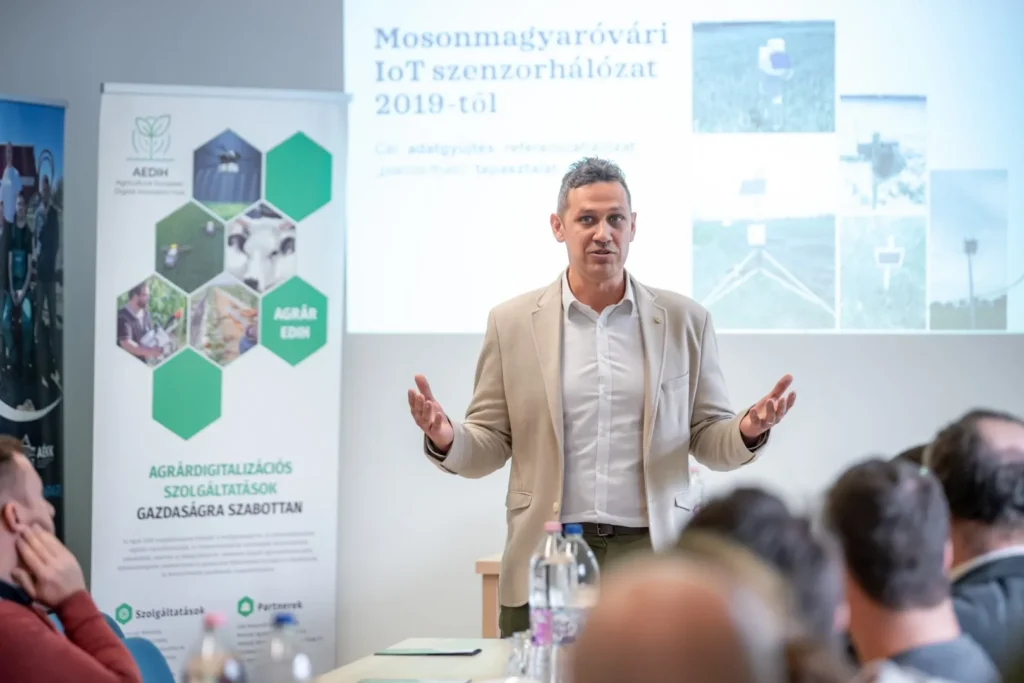
The meteorological station developed at the Albert Kázmér Faculty of Agricultural and Food Sciences of Széchenyi István University serves both research and the needs of farmers, contributing to more accurate, data-driven decision-making – it was highlighted at the presentation of the innovation, held recently at the University’s Smart Farm in Mosonmagyaróvár. During the programme, the University’s professional partners, prospective resellers and farmers were given a detailed insight into the development’s features, functions and the market package intended for commercialisation.

The Unisense meteorological station of Széchenyi István University (Photo: András Adorján)
At the event, Dean of the Faculty, Dr Tamás Tóth, emphasised that research related to precision farming goes back around thirty years at the Faculty. This laid the foundation for the establishment of the Department of Bioengineering and Precision Technology, which functions as a true professional workshop. He drew attention to Széchenyi István University’s interdisciplinary approach, which is also reflected in this development, as – in addition to the department’s staff – experts from the Digital Development Centre and the University’s technology-transfer company, Uni Inno Ltd., also played key roles in the project. “The fields in the focus of the institution – such as precision agriculture, digitalisation, data evaluation and artificial intelligence – all appear simultaneously in this innovation,” he emphasised.
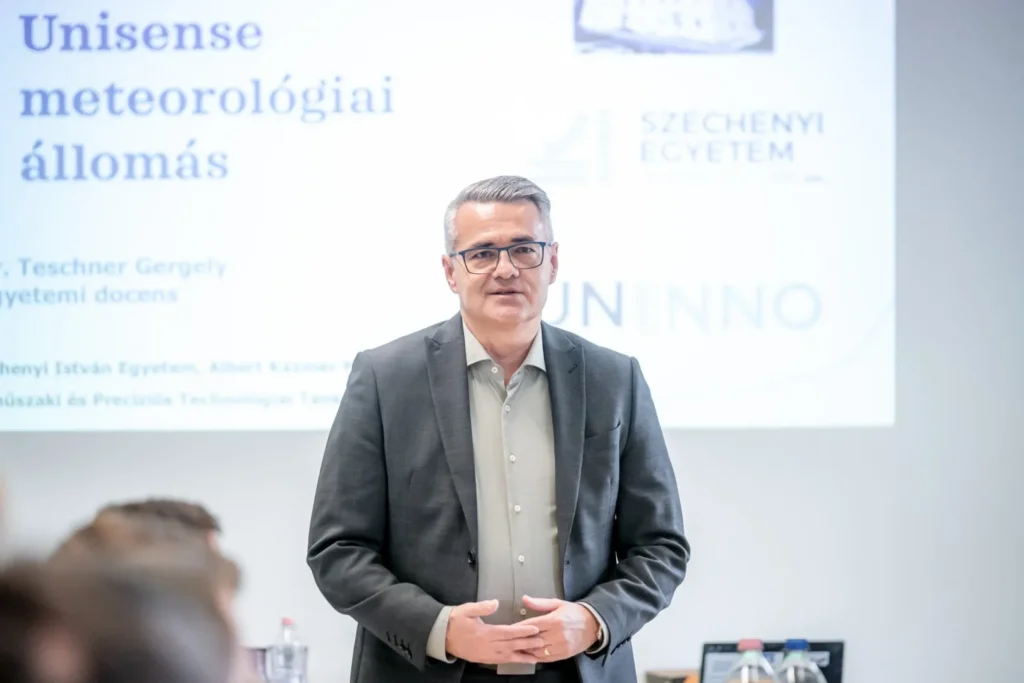
Associate Professor Dr Gergely Teschner explained that various IoT sensor networks have been used at the Faculty since 2019, and over the years they have gained extensive experience in data analysis. This provided the foundation for their own development activities. “The idea of a meteorological station that offers all the functions farmers need emerged a year and a half ago. Using various sensors, the instrument measures, among other things, soil moisture and soil temperature, wind direction and speed, solar radiation intensity, air temperature and humidity, air pressure, and leaf-surface moisture,” he listed.
He added that different data-transmission intervals can be set on the device, and with a 15-minute interval, the battery can operate for eight days in complete darkness, while it requires three hours of charging during summer. The internal memory of Unisense can store the data of 40 transmission cycles, which is significant if the server, for any reason, fails to receive the transmitted data.
The presentation revealed that the software background was provided by the University’s Digital Development Centre. The user interface was designed so that farmers can view each other’s data within a shared community. This is important from a cost-efficiency perspective and also provides farmers with an even more comprehensive picture of weather conditions. The data is accessible via a web and mobile application: the system handles historical data, sends error notifications, and will soon be complemented by plant-protection forecasts.
Uni Inno Ltd. will play a key role in the sales process. As stated, there is currently capacity to produce thirty stations per month, and the first orders are expected to be fulfilled by mid-January. Three packages have been created for market distribution, depending on sensor configuration, with prices ranging between HUF 380,000 and 550,000 (ca. EUR 950 – 1440).
Summing up, Dr Gergely Teschner said that Unisense is worth choosing because the development has a stable university background, and both manufacturing and product support are domestic, ensuring reliable servicing and spare-parts supply. He also highlighted the favourable value-for-money ratio, as well as the fact that the product’s development will continue in the future, allowing the platform to expand with additional functions. Further details about the innovation can be read here.