
Updated: 2026.10.26. 09:43|
Széchenyi István University’s Apáczai Csere János Faculty of Humanities, Education and Social Sciences recently hosted a scientific conference attended by 111 participants from 37 institutions in 23 countries. The four-day event focused on the connections between cross-border mobility, migration, logistics and geopolitics.
Széchenyi István University’s Apáczai Csere János Faculty of Humanities, Education and Social Sciences hosted the conference of the International Association for the History of Transport, Traffic and Mobility (T2M) from 14 to 17 October. Entitled Cross-Border Mobility: Migration, Logistics and Geopolitics, the event explored the historical, social, economic and technological dimensions of transport. It was the first time the conference had been held in East-Central Europe.
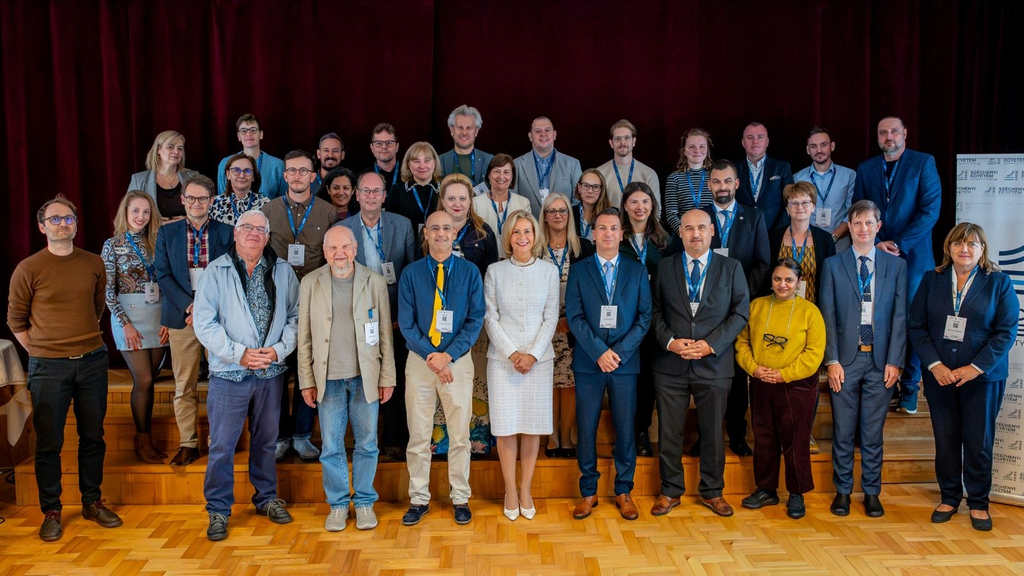
Organisers and speakers at the conference of the International Association for the History of Transport, Traffic and Mobility (T2M). (Photo: András Adorján)
At the opening ceremony, Professor Dr Eszter Lukács, Vice President for International and Strategic Relations at Széchenyi István University, explained that Győr’s geographical location and its role in transport and the economy made the city particularly well suited to discussions on mobility-related issues. She emphasised that improving scientific performance was a key objective of the University, supported by a comprehensive programme. As part of this initiative, the University provides access to scientific databases and academic literature, contributes to publication costs, and supports researchers through training, scholarships, mentoring programmes and opportunities to gain professional experience abroad.
„Organising international conferences is an important part of our research support system. We are particularly pleased that our Apáczai Faculty can welcome such distinguished researchers, whose participation may lead to new research ideas, joint publications and long-term collaborations,” she said. She added that researchers at the Faculty had contributed more than 100 Scopus-indexed publications to the University’s scientific output over the past three years.
Dr Hugo Silveira Pereira, President of T2M and Editor-in-Chief of the specialist journal The Journal of Transport History, emphasised the importance of expanding the organisation’s network in his welcoming address. „It is particularly important to us that the global academic community becomes more familiar with the achievements of researchers in Central and Eastern Europe, as well as the region’s transport and mobility history. The conference’s diverse programme brings together numerous approaches and fields of research,” he said.
Dr Csaba Sándor Horváth, Associate Professor at the Apáczai Faculty, Conference Chair and one of the principal organisers, highlighted the interdisciplinary nature of the event. „Alongside researchers in history, the social sciences, philosophy and international relations, specialists from other faculties of our University also took part in the programme. This provides an excellent opportunity for our academics to present their findings in this environment and establish new professional connections. These may subsequently lead to joint research projects and publications,” he emphasised.
The keynote presentations on the opening day reflected the diversity of mobility research. Professor Peter Adey of Monash University in Australia explored the relationship between electric motoring and technological nationalism, while Dr Nóra Horváth, Associate Professor at Széchenyi István University, examined the links between the development of seaside resorts in Normandy and the expansion of the railway network. Dr Ágoston Winkler, Associate Professor at the University, discussed issues relating to the development of urban public transport. Dr Tomáš Nigrin, Associate Professor at Charles University in Prague, examined the historical transformation of railway infrastructure in Central Europe.
The parallel sessions covered a wide range of topics, including cross-border labour mobility, migration, applications of artificial intelligence in transport, electric scooters, urban transport, student mobility, and the social and legal aspects of transport infrastructure. Researchers from Széchenyi István University were involved in 40 presentations.
Publication opportunities further enhanced the significance of the event. The T2M conference series collaborates with four Scopus-indexed academic journals, including the highly ranked Q1 journals Mobilities and The Journal of Transport History. The organisers aim to have as many of the studies presented as possible published in prestigious academic journals.