
Updated: 2026.10.26. 09:40|
Széchenyi István University has established a new Defence Mechatronics Laboratory with the support of the Ministry of Defence. Equipped with a quadruped robot, drones and advanced IT equipment, the facility, inaugurated on 20 October, will support education, talent development, and research for both civilian and defence purposes.
The Defence Mechatronics Laboratory was established through cooperation between Széchenyi István University and the Ministry of Defence. The Ministry provided HUF 50 million in funding for the necessary equipment upgrades. The new facility operates as a mobile robotics research and teaching laboratory within the Department of Defence Innovation and Critical Infrastructure. Its modern infrastructure enables students and researchers to investigate cooperation between ground robots, drones and humans, and to develop new solutions in the field of autonomous systems.
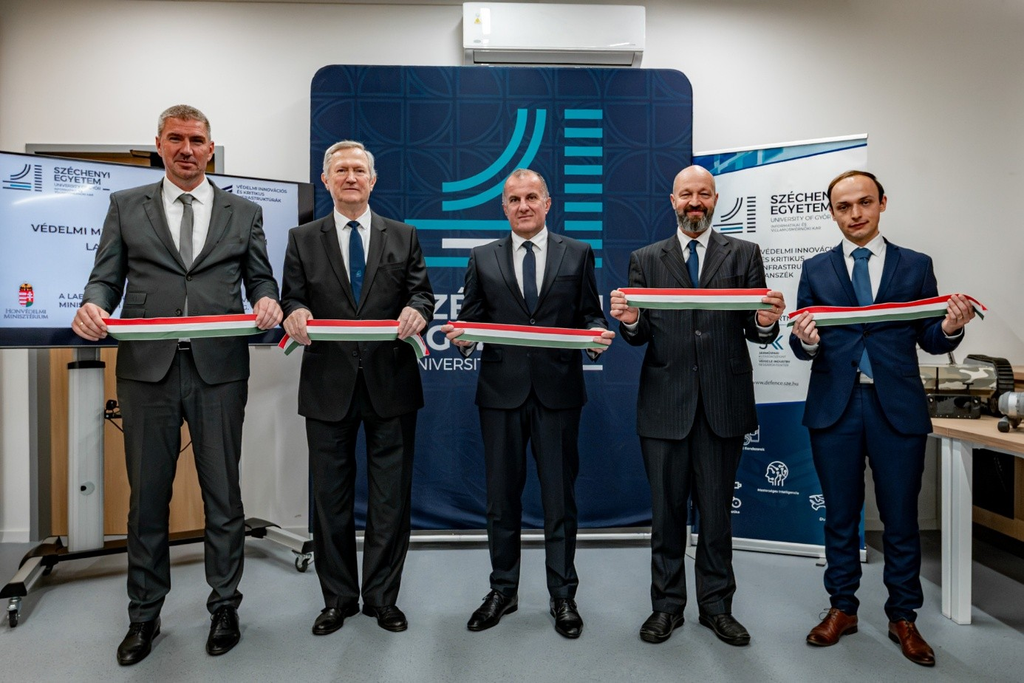
Dr Ferenc Szauter, Head of the Department of Defence Innovation and Critical Infrastructure at Széchenyi István University; Professor Dr Ferenc Friedler, Rector and Vice President for Scientific Affairs; Professor Dr László Kovács, Deputy State Secretary for Cyber Defence at the Ministry of Defence; Dr Áron Ballagi, Dean of the Faculty of Informatics and Electrical Engineering; and Rudolf Krecht, Head of the Mobile Robotics Laboratory, at the inauguration of the Defence Mechatronics Laboratory. (Photo: András Adorján)
„Széchenyi István University is at the forefront of technological research and development and the application of research results in education, both of which are also greatly needed in the defence sector. Cooperation with scientific centres whose research can contribute to strengthening our country’s security is particularly important to us. This is why we supported the establishment of the laboratory. We are confident that the results achieved here will benefit both the Hungarian Defence Forces and the defence industry. Our joint activities also offer young talents the opportunity to participate in research and potentially apply their knowledge in the field of national defence in the future,” emphasised Professor Dr László Kovács, Deputy State Secretary for Cyber Defence at the Ministry of Defence, in his welcoming address.
Professor Dr Ferenc Friedler, Rector and Vice President for Scientific Affairs at the University, explained that the new facility is an integral part of the institution’s research system. „An important element of our operating model is that individual organisational units can draw on the University’s entire knowledge base. The new laboratory also brings together expertise from a wide range of disciplines. The support of the Ministry of Defence and the dedication of our colleagues were essential to its establishment, and I would like to take this opportunity to thank them,” he said.
Dr Ferenc Szauter, Head of the Department of Defence Innovation and Critical Infrastructure, recalled that one of the main objectives of the department, established a year ago, was to bring together the University’s expertise to strengthen Hungary’s defence capabilities. „The new laboratory’s development activities focus on three areas: people, networks and robotics, which can be combined to create modern, collaborative systems. We aim to involve as many students as possible in our research, enabling them to gain practical experience working with real equipment as part of a team while still studying,” he highlighted.
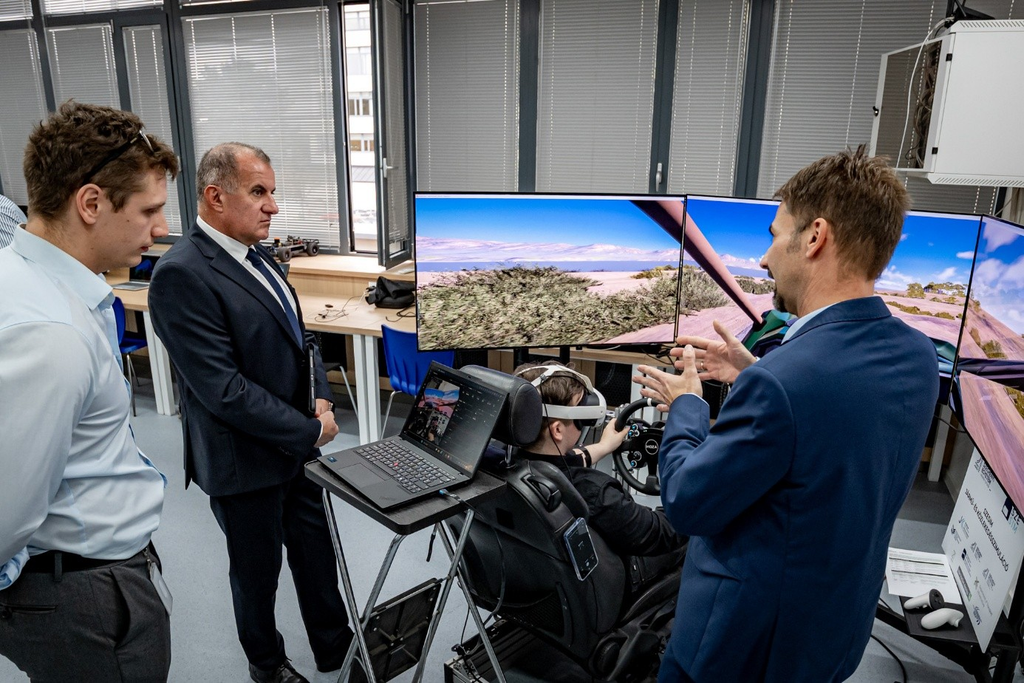
Following the official inauguration, participants were also shown the laboratory’s innovative equipment. (Photo: András Adorján)
Rudolf Krecht, Head of the Mobile Robotics Laboratory, demonstrated several devices available at the Defence Mechatronics Laboratory. One of the most striking was a quadruped research robot equipped with a depth camera, capable of navigating uneven terrain and moving inside buildings. The palm-sized aircraft in the research mini-drone swarm enable researchers to study coordinated movement, formation flying, collision avoidance and cooperation with ground robots.
Dr Viktor Zoltán Nagy, Head of the Vehicle and Transport Simulation Laboratory, demonstrated research capabilities that can also be applied in the defence industry. These include modelling driving scenarios and testing augmented reality solutions. Meanwhile, sensors are used to examine human behaviour and physiological responses.
The laboratory’s equipment also includes 5G onboard units and networking devices that support real-time communication, remote control and data processing for robots and drones. The autonomous driving development kit and its associated sensors support experiments in automated vehicle control and environmental perception. The laboratory has also acquired high-performance computers and laptops for programming, simulations and the evaluation of measurement data.
An important feature of the research is its potential for dual use, serving both civilian and defence purposes. In addition to defence applications, the technologies being studied here could also be used in disaster management, industrial facility inspections and even agriculture.