
Created: 2026.05.26. 13:26
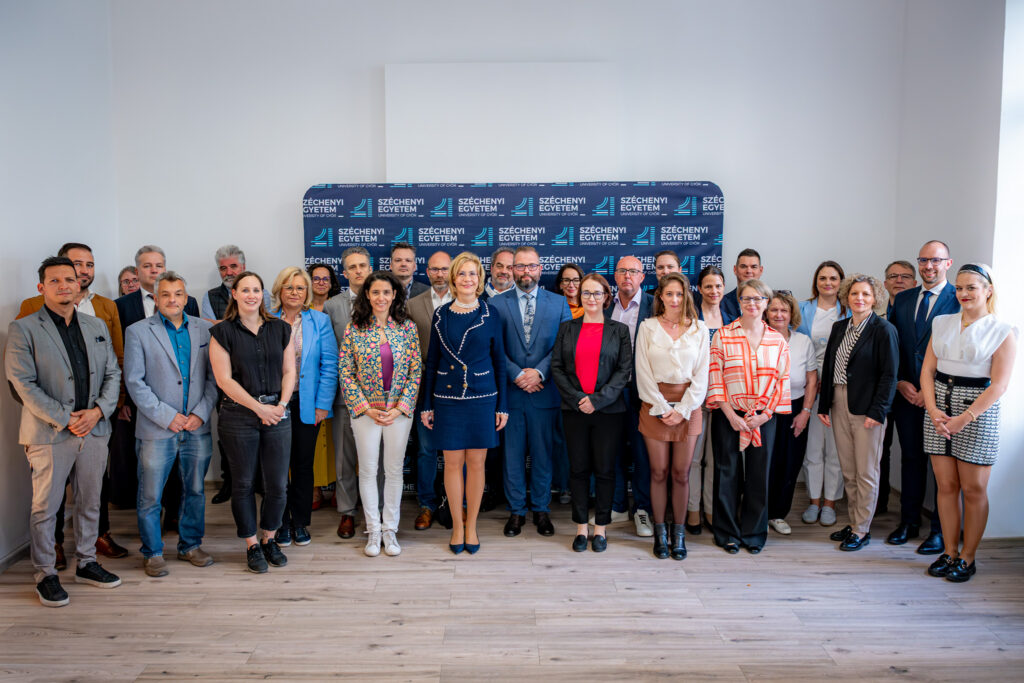
Mobility opportunities and research collaborations in Hungarian higher education were at the centre of the 21 May meeting of the Committee on International Affairs of the Hungarian Rectors’ Conference. The event, held at the Budapest Innovation and Training Centre of Széchenyi István University, also focused on expanding partnerships with China and Latin America.
The Committee on International Affairs of the Hungarian Rectors’ Conference – which brings together the international leaders of Hungarian higher education institutions – holds at least one in-person meeting every six months. The latest gathering was hosted by the Budapest Innovation and Training Centre of Széchenyi István University.
Dr Eszter Lukács, Chair of the Committee and Vice-President for International Affairs and Strategic Relations at the University, explained that one of the key topics was the review of the experiences gained so far with the Pannónia Scholarship Programme. In his presentation, Richárd Bodrogi, Director General of the Tempus Public Foundation, highlighted student-friendly elements, including automatic credit recognition, opportunities for short-term courses and group mobility, as well as the excellence programme supporting studies and research at the world’s top 250 universities.
“I consider the Pannónia Scholarship Programme to be an extremely successful initiative, which Hungarian higher education regards not as a replacement for the Erasmus Programme, but as a complementary scheme. While universities operating under the model-change structure continue to await their return to the Erasmus Programme, Pannónia has proven to be such a well-designed national programme that it is worth preserving in the long term and making available to all Hungarian higher education institutions,” stated Eszter Lukács.
Another major topic of the meeting was international research funding opportunities. Participants received information from Borbála Schenk, Head of the Department for International Cooperation at the National Research, Development and Innovation Office, regarding the organisation’s activities and its readiness to provide universities with tailored grant consultancy services. “Our shared goal is to involve colleagues in these projects who do not yet have experience in this field,” emphasised Dr Lukács.
During the online section of the meeting, participants were introduced to several new international cooperation opportunities. Neo Tan, Director of the China Office of the Global Cross Border Education Institute, stressed the importance of strengthening relations with Chinese higher education institutions and outlined new perspectives.
Latin American partnerships are also of great importance to Hungarian universities. Dr Lukács explained that the Hungarian Rectors’ Conference plans to sign a cooperation agreement with the Association of Colombian Universities and – thanks to the organisational efforts of Júlia Morován, Science and Technology Attaché in São Paulo – with the Rio de Janeiro State Research Support Foundation. At the meeting, Luisa Fernanda Villamizar represented the Colombian organisation, while Luis Cristovão Porto, Professor and Scientific Adviser, and Ana Beatriz Ramadas da Cruz represented the Brazilian organisation, presenting the opportunities offered by these partnerships. They also encouraged the establishment of direct contacts between universities.
Dr Eszter Lukács added that, beyond the professional programme, one of the greatest values of the committee lies in facilitating knowledge-sharing among internationalisation leaders. “These meetings go beyond the individual agenda items: they help universities strengthen the international presence of Hungarian higher education collectively by learning from one another’s best practices,” she noted.