
Created: 2026.06.03. 10:42
The relationship between sport and health, opportunities for performance optimization, and issues related to mental well-being were at the centre of the 23rd National Sports Science Congress, jointly organised in Győr by Széchenyi István University’s Faculty of Health and Sport Sciences and the Hungarian Society of Sport Science. The event brought together leading national and international experts, who presented their latest research findings in the field.
Held at Széchenyi István University over several days, the congress provided hundreds of professionals, researchers, and academics with an opportunity for scientific dialogue, the exchange of professional experiences, and the establishment of new collaborations.

Dr Gábor Szőts, Secretary General of the Hungarian Society of Sport Science; Dr Zoltán Alföldi, Head of the Department of Health Promotion and Exercise Science at Széchenyi István University; Dr Erzsébet Stephens-Sarlós, sensorimotor trainer and researcher at the University; Professor Ferenc Friedler, Rector and Vice-President for Scientific Affairs at the University; Dr Angéla Somogyi, Dean of the Faculty of Health and Sport Sciences; and Professor Miklós Tóth, President of the Hungarian Society of Sport Science (Photo: Gergely Nagy)
In his opening address, Professor Ferenc Friedler, Rector and Vice-President for Science at the University, highlighted that sporting achievements today are supported by increasingly complex systems whose effectiveness has become especially valuable in a rapidly changing world. “Success can no longer be attributed to a single factor. It is now evident that even outstanding individual performance is underpinned by teamwork,” he stated. He added that this approach is reflected in the University’s health technology developments, project-based educational programmes, and sport-friendly environment.
Dr Angéla Somogyi, Dean of the Faculty of Health and Sport Sciences, emphasised that the Faculty’s educational and research directions are closely aligned with the current challenges of sport science and aim to train professionals capable of providing innovative solutions to these challenges. “One of the key elements of the strategic development of our educational portfolio is the launch of our Master’s programme in Sports Coaching, which will begin this September in both Hungarian and English and will cover twelve different sports disciplines. The broad range of specialisations will enable the development of sport-specific knowledge and competencies while responding to the evolving needs of Hungarian sport and the labour market. In addition, we will launch a Master’s programme in Sport Mental Coaching, reflecting the growing importance of athletes’ mental preparation. Our offerings are further strengthened by programmes in Health Psychology and Nutrition Science with a special focus on Sports Nutrition,” she explained.

Sports science professionals discussed current issues and emerging challenges in the field at Széchenyi István University (Photo: András Adorján)
Professor Miklós Tóth, President of the Hungarian Society of Sport Science, expressed his appreciation to Széchenyi István University for the partnership that enabled the congress to be organised at such a high professional standard. He also noted that the Society is celebrating its 30th anniversary this year and emphasised that the three-day congress provided an opportunity both to review current issues in the discipline and to establish new professional connections among participants.
A key topic of the plenary session following the opening ceremony was the NIRSport2 brain imaging system, which supports cutting-edge neuroscience research at Széchenyi István University. In her presentation, Dr Erzsébet Stephens-Sarlós, researcher at the University and sensorimotor trainer specialising in the integration of infant reflexes, demonstrated how the technology can be used for applications ranging from the examination of cortical brain functions to performance optimisation.
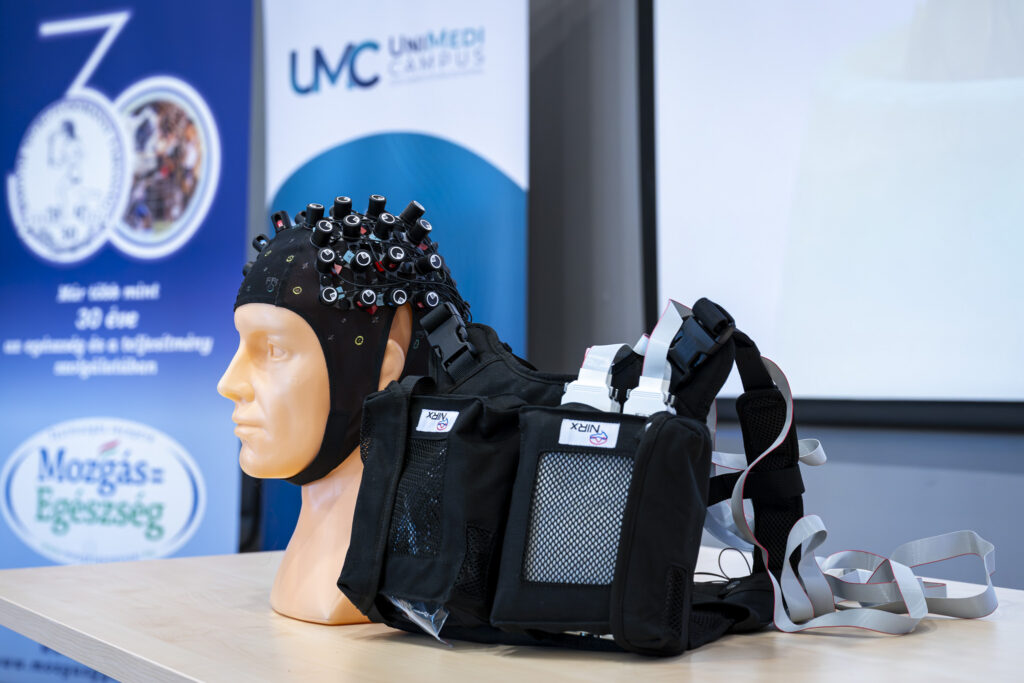
The NIRSport2 brain imaging system supports neuroscience research at Széchenyi István University (Photo: Gergely Nagy)
The pre-conference programme focused on sport psychology and mental well-being. The event’s international dimension was strengthened by the participation of António Ferraz, a specialist from the Sporting Clube de Lisboa Sports Organisation Centre, who presented methods for improving team-sport performance through the integrated analysis of physiological monitoring indicators.
Participants also learned about the role of regular physical activity as a potential antidepressant. Noémi Mónika Szeifert, Clinical Psychologist at the Department of Sports Medicine of Semmelweis University, together with Dr Xénia Gonda, Head of the Department of Clinical Psychology at the same institution, discussed the scientific background and mental health benefits of physical exercise. Two Associate Professors of Sport Psychology at Széchenyi István University, Dr Judit Boda-Ujlaki and Ágota Lénárt, presented international recommendations supporting athletes’ mental health and examined the impact of young people’s internet use on competitive sport participation. Dr Zoltán Alföldi, Head of the Department of Health Promotion and Exercise Science, outlined the sport psychology background of the Hungarian women’s national basketball team’s successful preparation for the FIBA World Cup qualifiers. As is well known, the team secured qualification for the World Cup after a 28-year absence, with several Széchenyi István University students among its players.

Noémi Mónika Szeifert, Clinical Psychologist at the Department of Sports Medicine of Semmelweis University, spoke about the impact of physical exercise on mental health (Photo: András Adorján)
The congress sessions covered an exceptionally broad spectrum of sport science topics, including child and athlete safeguarding, sport pedagogy, social issues, active lifestyles, and recreation. Researchers also explored subjects such as the relationship between physical activity and mental health, the effects of smartphone use on balance performance, discrimination in sport, and the legal protection of athlete data processed through artificial intelligence systems.