Created: 2026.07.06. 15:33
The joint development project of Oasis Technology Ltd., Virtualitica Ltd., and Széchenyi István University has reached another important milestone. The project integrates electricity generation and agricultural cultivation within a single intelligent system. This innovative solution was presented during a professional event organized as part of the GreenTech Plus European Union project at the Smart Farm teaching farm of the Albert Kázmér Faculty of Agricultural and Food Sciences.
Research supporting sustainability, digitalization, and agricultural innovation occupies a prominent place among the strategic priorities of Széchenyi István University. The GreenTech Plus project is another example of this commitment. Supported by the Interreg VI-A Austria–Hungary European Union programme, the initiative promotes the adoption of modern green technologies and digital solutions in agriculture while strengthening cross-border cooperation.
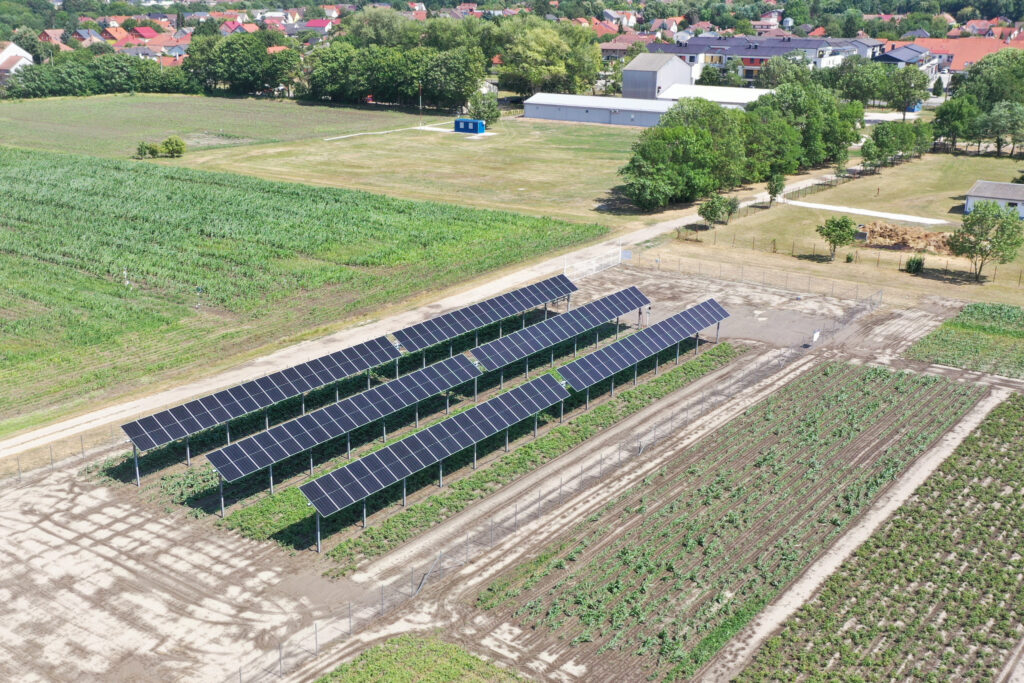
The professional open day, held on 2 July, focused on the Oasis Project, which enables electricity generation and agricultural production to take place simultaneously on the same land. Crops can continue to be cultivated beneath elevated, sun-tracking photovoltaic panels, while the system also provides irrigation, thereby supporting both sustainable farming and renewable energy generation.
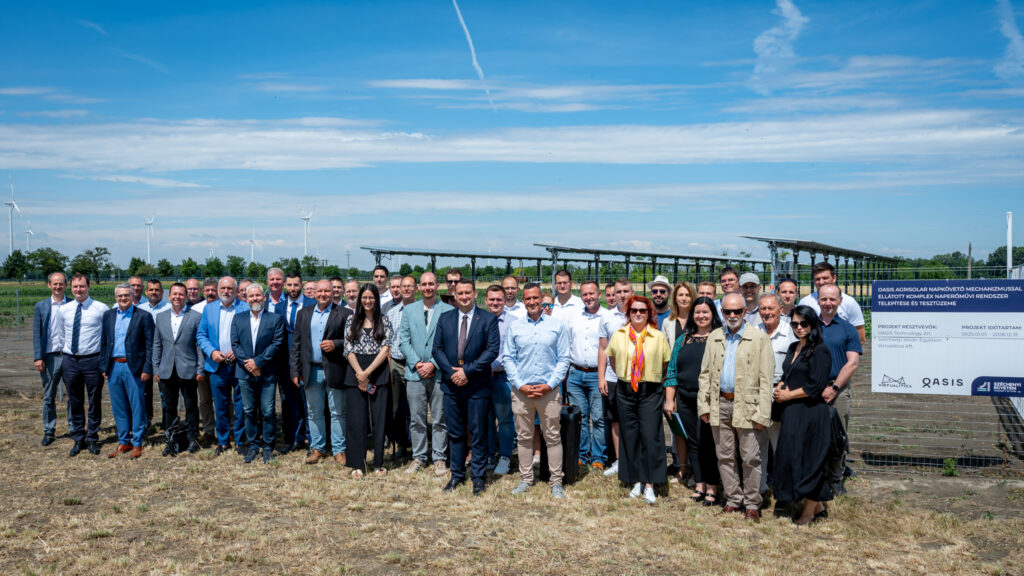
Participants of the professional open day at the innovative photovoltaic system installed at Széchenyi István University’s teaching farm in Mosonmagyaróvár. (Photo: András Adorján)
At the event, Balázs Lőrincz, Co-founder of Virtualitica Ltd. and Dr Balázs Ásványi, Vice Dean for Corporate Relations at the faculty, presented the development being carried out through the collaboration of Oasis Technology Ltd., Virtualitica Ltd., and Széchenyi István University. Their presentations highlighted that the innovation is expected to increase crop yields. To verify this, identical crops—sweet corn and potatoes—are being grown both beneath the solar panels and on a control plot, allowing precise comparisons of yields after harvest.
The system has been designed to accommodate conventional agricultural machinery, enabling traditional cultivation methods to remain in use. It was also explained that the cooling effect produced by evaporation from the irrigation system has a positive impact on the performance of the solar panels, allowing them to generate electricity more efficiently.
In the next phase of development, the partners intend to further enhance the system by incorporating a self-diagnostic function capable of predicting potential equipment failures. They also plan to apply precision agriculture methods to adjust irrigation according to the growth stage of the crops and anticipated rainfall. Another planned development is the installation of a rail system that will facilitate the use of agricultural robots, thereby reducing soil compaction caused by heavy machinery.
Speakers emphasized that the University’s experts contribute multidisciplinary expertise to the success of the project, ranging from the selection of suitable crop varieties and the development of the irrigation concept to meteorological data collection, the establishment of occupational safety regulations and practical field testing. Dr Tamás Tóth, Research Professor and Dean of the Albert Kázmér Faculty of Agricultural and Food Sciences, noted that the infrastructure investments made in recent years have created ideal conditions for combining the Faculty’s long-standing agricultural education traditions with emerging fields such as precision farming, sustainability, and digitalization. A key component of this vision is the Smart Farm teaching farm, where drones, remote sensing, robotics, and artificial intelligence play central roles.
As part of the programme, László Moldvai, a doctoral researcher at the Wittmann Antal Multidisciplinary Doctoral School of Plant, Animal and Food Sciences, delivered a presentation on digital agricultural solutions based on machine vision. He explained that one of the primary objectives of these developments is the accurate identification of weeds, enabling targeted spraying and thereby significantly reducing the use of plant protection products.
Participants also had the opportunity to view the innovative photovoltaic system on site. During the practical demonstration, they were introduced to the University’s in-house developed UniMetSense metereological station. By continuously monitoring environmental parameters, the innovative device supports the intelligent control of the sun-tracking photovoltaic panels and the irrigation system.