
Created: 2026.05.26. 09:04
Recipients of the University Research Scholarship Programme and the Cooperative Doctoral Programme presented their scientific work at a conference held at Széchenyi István University on 20 May. Attendees had the opportunity to listen to more than sixty presentations ranging from innovations in the automotive and health technology sectors, through research related to artificial intelligence, to new opportunities in healthy food production.
Each year at Széchenyi István University, successful students and academic staff of the University Research Scholarship Programme (EKÖP) and the Cooperative Doctoral Programme (EKÖP KDP) present their research findings at a conference. This year, attendees had the opportunity listen to a total of 62 presentations across eight sections covering the fields of transport and vehicle development, mechanical engineering, materials science and social sciences, agriculture and environmental protection, information technology, economics, civil engineering, as well as management and organisational sciences.
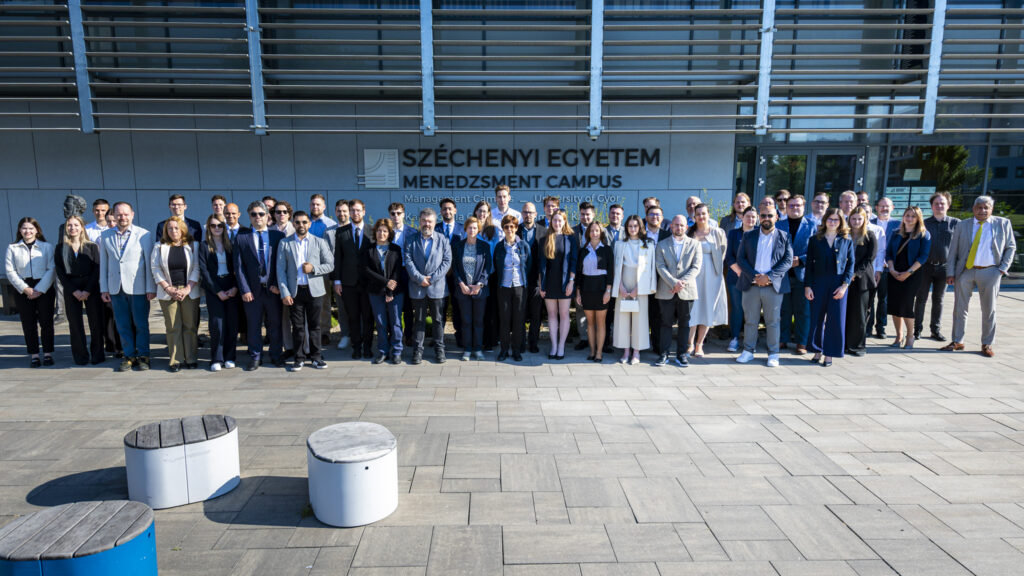
At the conference of Széchenyi István University, 62 young researchers presented their research topics (Photo: Gergely Nagy)
In his welcoming speech, Professor Dr László Varga, Chair of the University Doctoral Council, explained that the New National Excellence Programme had been launched ten years ago, and since last year has continued in the form of EKÖP and EKÖP KDP. “The former aims to contribute to strengthening the next generation of Hungarian researchers and creative artists by supporting individual excellence, providing opportunities for undergraduate, master’s and doctoral students, as well as young lecturers and researchers. The latter supports doctoral candidates engaged in research and development projects with tangible practical applications within the framework of university–industry cooperation,” he stated. He added that during the current academic year, the University was able to allocate more than HUF 90 million to EKÖP and nearly HUF 150 million for EKÖP KDP from the National Research, Development and Innovation Fund.
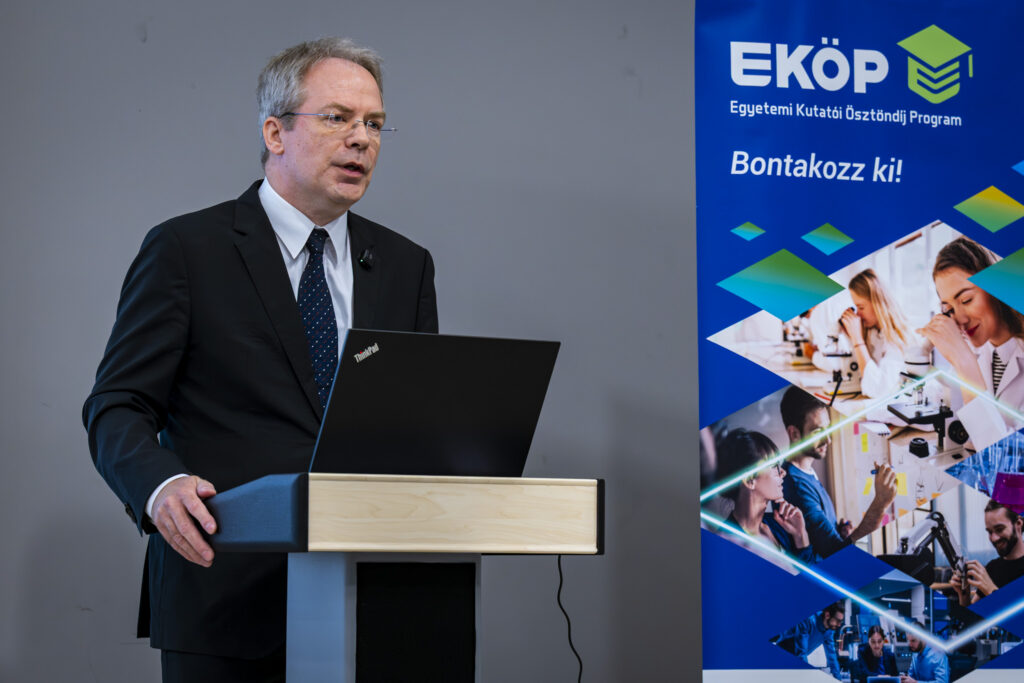
Professor Dr László Varga, Chair of the Doctoral Council of Széchenyi István University, opened the event (Photo: Gergely Nagy)
The opening presentation of the conference was delivered by László Attila Moldvai under the title “Application of Machine Vision and Artificial Intelligence in Precision Crop Production”. In his doctoral presentation, he introduced a technology capable of the precise, automated identification of crops and weeds. This makes it possible to apply herbicides not across the entire field, but specifically and exclusively to weeds, thereby increasing sustainability and cost efficiency. He also highlighted that machine vision enables the continuous monitoring of crop conditions, allowing for rapid intervention if, for example, disease appears within a plantation.
Artificial intelligence (AI) is becoming increasingly present not only in agriculture, but in almost every area of life, and consequently numerous research topics also addressed the subject from various perspectives. Doctoral student Dr Viktória Verebélyi examined the possibilities and impacts of applying AI in legislation. “I sought to answer how the use of AI in legislation affects classical constitutional frameworks, particularly legislative responsibility. I wished to demonstrate that this is not merely a technological issue, but also a regulatory one,” she summarised. She emphasised that there are many international examples where AI supports and improves the efficiency of various processes. This could also be applied to parliamentary decision-making and in the work of offices operating alongside national assemblies. “Examples include the categorisation of large numbers of amendment proposals or the application of chatbots designed to respond quickly to large volumes of citizen enquiries. AI therefore has many positive applications, but it is important that all this takes place within regulated frameworks and that human oversight remains part of the system,” she stated.
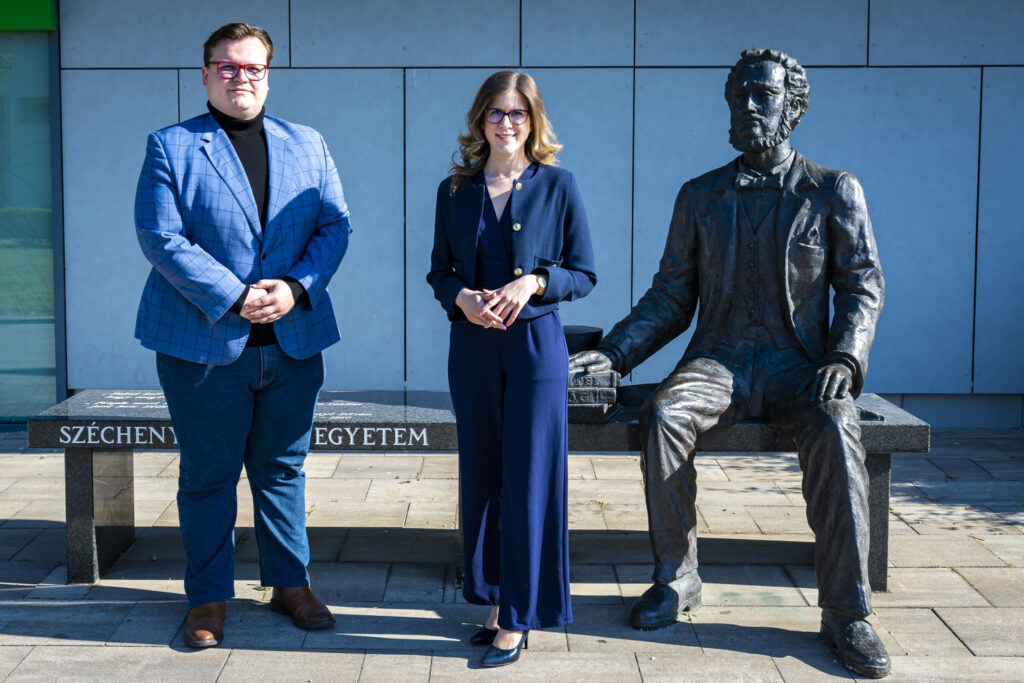
Macher Gergely Zoltán spoke about the social issues surrounding asbestos contamination, while Dr Viktória Verebélyi presented on the role of artificial intelligence in legislation. (Photo: Gergely Nagy)
The diversity of research conducted at Széchenyi István University is also demonstrated by the work of Gergely Zoltán Macher, whose work has gained unfortunate relevance due to asbestos contamination affecting several settlements in Western Hungary. The lecturer of the Department of Applied Sustainability gave a presentation entitled “System-Level Examination of the Dynamics of Municipal Asbestos Removal Transitions through the Adaptation of the Isenberg Ecosystem Framework”. The young researcher has long studied the environmental and social impacts of asbestos-containing materials, and in the research presented at the conference he introduced the adapted application of a framework known originally developed for entrepreneurial ecosystems. The model examines the role of public policy, financing, human capital, support infrastructure, culture and markets in relation to potential solutions. “Problems related to asbestos raise global issues that require complex responses. In addition to its harmful effects on human health, environmental impacts, economic factors and even legal aspects all present significant challenges. Although there are positive international examples in the field of asbestos removal, achieving real, long-term results requires a comprehensive programme in which social awareness plays a key role,” he emphasised. He added that recent events are likely to have a significant influence on these developments in this field as well.