
Updated: 2026.11.05. 19:05|
An exhibition showcasing the history and achievements of SZE’s SZEnergy Team opened on 4 November at the Liszt Institute, Hungarian Cultural Centre Stuttgart, in Germany. What makes the exhibition particularly special is that, alongside presenting the achievements and technological developments of the five-time world-record-breaking team, it also offers visitors a glimpse into the creative process behind its engineering accomplishments. The event also featured a chamber exhibition on the life and work of Béla Barényi, the world-renowned Hungarian-born engineer, and a concert by students of the University’s Faculty of Design and Performance Arts.
The SZE SZEnergy Team has won its category at the Shell Eco-marathon, Europe’s largest energy-efficiency competition, for five consecutive years, setting a world record on each occasion. The team, established in 2005 to develop vehicles, won the international competition at its very first appearance in 2008. At this year’s event, it set another record, achieving 332 kilometres per kilowatt-hour. This time, the engineering expertise behind the team’s success and the progress it has made over the past two decades were showcased in Stuttgart, one of Germany’s most important automotive centres.
The exhibition, entitled Invisible Energy, opened on 4 November and is being hosted by the Liszt Institute, Hungarian Cultural Centre Stuttgart. Open to visitors until mid-January, it tells the story of the SZEnergy Team’s 20-year history and presents its competition vehicles and technical developments. The exhibition panels, vehicle models and components not only showcase the team’s competition results but also illustrate how students turn an idea into a working prototype. In this way, the exhibition also offers an insight into SZE’s practice-oriented education and talent development activities.
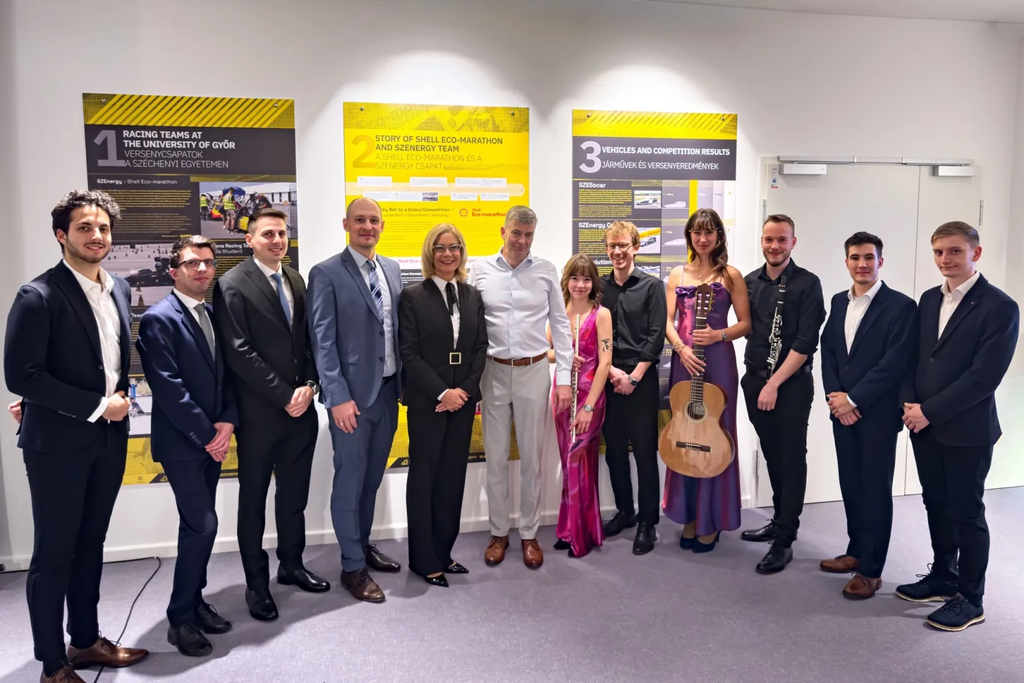
The SZE delegation at the exhibition. (Photo: Viktor Kocsis)
The opening remarks were delivered by Dr Dezső B. Szabó, Director of the Liszt Institute, who welcomed the guests. He explained that the Institution’s aim was to showcase the diversity of Hungarian culture, sometimes going beyond the traditional scope of cultural policy activities. “This also means that we do not focus solely on our beautiful capital, Budapest, but also want to showcase the strengths and opportunities of other regions – in this case, the beautiful city of Győr and its university,” he said.
Speaking on behalf of the Hungarian Consulate General in Stuttgart, Consul General Dr András Izsák highlighted the role of Hungarian science and engineering expertise in shaping the future. “When we talk about the automotive industry and innovation, we are talking about developments and decisions that have shaped our lives across generations. For me, this is the most important message: the future does not begin at some point later; it is already taking shape in the present,” he emphasised.
Professor Dr Eszter Lukács, Vice-President for International Affairs and Strategic Relations at SZE, emphasised that Győr has always had close ties with the German cultural sphere throughout its history. “The University, however, is now a truly international institution, with 1,600 international students from nearly 90 countries, 64 degree programmes taught in English alongside 200 in Hungarian, and partnerships spanning several continents,” she noted. She also pointed out that, thanks to Audi, Győr has been an important base for the German automotive industry for more than three decades, and that the University maintains exceptionally strong ties with the company.
She described the SZEnergy Team’s achievements as an outstanding example of practice-oriented education and talent development. “Team members design, build and develop their vehicles themselves, while learning to think as a team, take responsibility and put their knowledge into practice. All this is also highly valuable in terms of training the next generation of professionals for the automotive industry,” she said.
She noted that the team’s presentation in Stuttgart also provided an opportunity to further strengthen Hungarian–German higher education ties. “It is a great pleasure that Hungary is once again a full participant in the European Union’s Erasmus+ programme. Our University currently has Erasmus+ partnerships with 34 German higher education institutions, from Hamburg to Passau and from Berlin to Mainz. We remain open to establishing joint student mobility programmes, educational programmes and research projects with German universities in the future,” Professor Dr Eszter Lukács added.
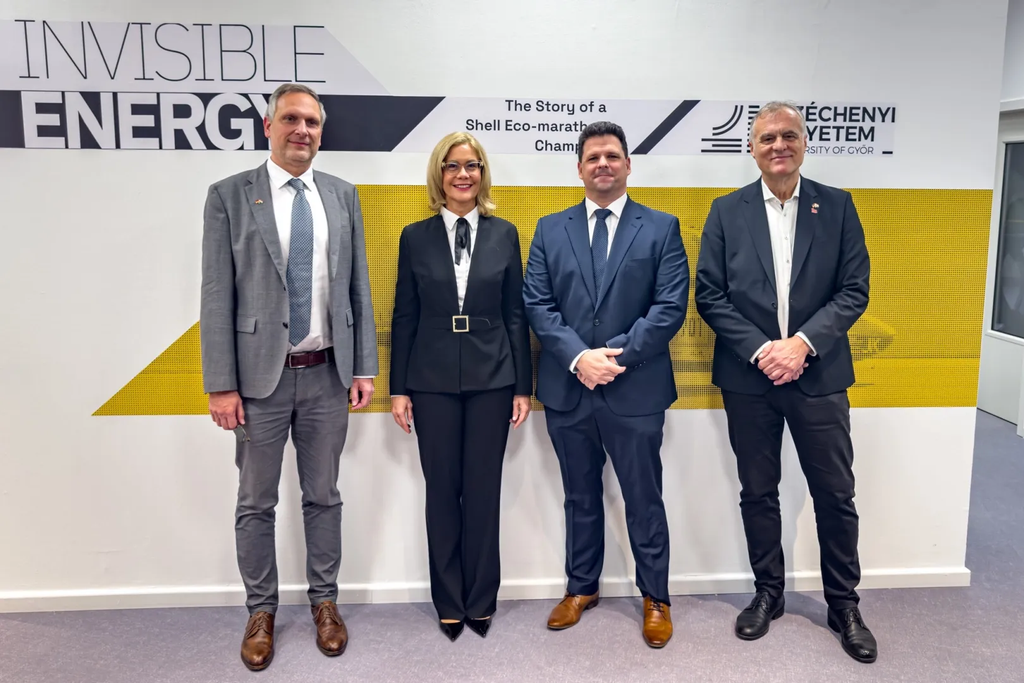
Krisztián Komma, Attaché for Scientific and Technological Relations at the Hungarian Consulate General in Stuttgart; Professor Dr Eszter Lukács, Vice-President for International Affairs and Strategic Relations at SZE; Dr András Izsák, Consul General of Hungary in Stuttgart; and Dr Dezső B. Szabó, Director of the Liszt Institute, Hungarian Cultural Centre Stuttgart. (Photo: Viktor Kocsis)
As part of the professional programme, Dr Zoltán Pusztai, a staff member of the University’s Automotive Industry Research Centre and former team leader and mentor of the SZEnergy Team, presented the team’s history. He recalled how, in the early days, a handful of students built the team’s first vehicle, a three-wheeler, using parts from electric scooters. The team went on to win the “Solar” category of the Shell Eco-marathon in 2008. His presentation also explored how competing became an integral part of the University’s research activities and engineering education. The current team leader, Bence Novák, outlined the work and future plans of the group, which brings together around 50 students. He also presented a new three-wheeled prototype being developed for the 2027 competition season, which the team hopes to enter in a category different from those in which it has competed so far.
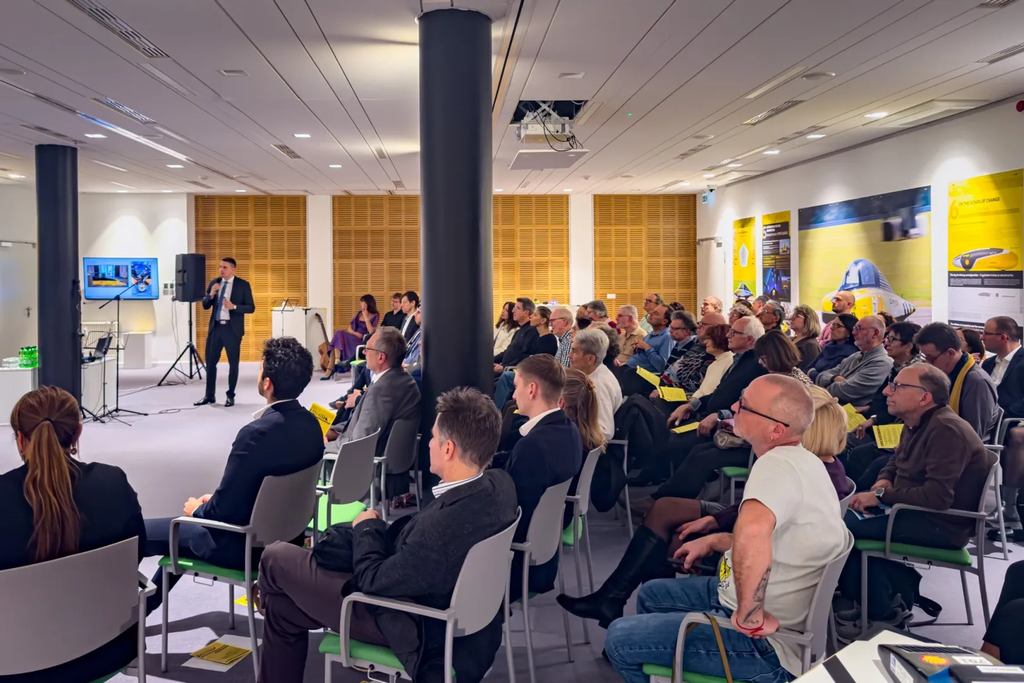
Dr Zoltán Pusztai spoke to a large audience about the history of the SZEnergy Team. (Photo: Viktor Kocsis)
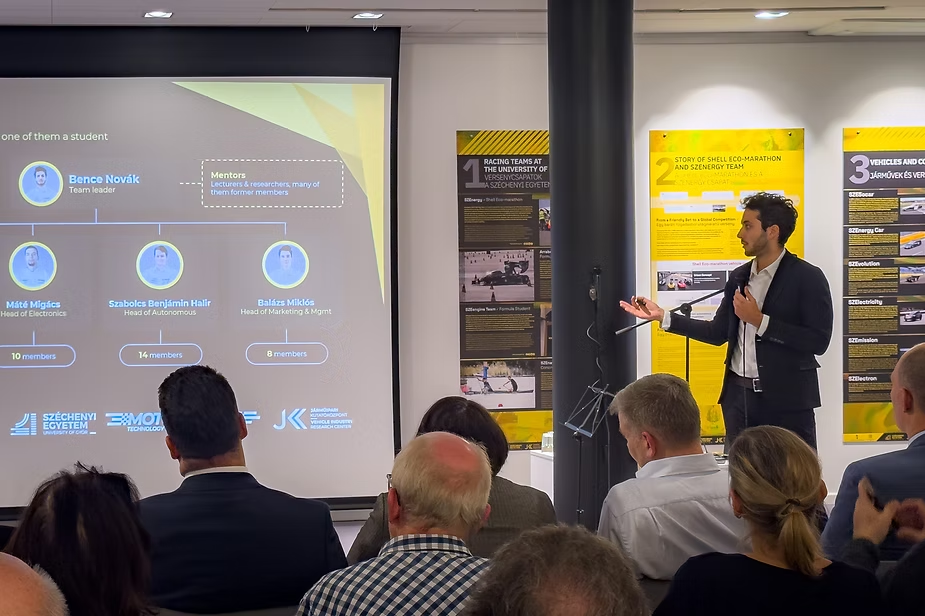
Bence Novák, leader of the SZEnergy Team, outlined the team’s plans. (Photo: Viktor Kocsis)
A special feature of the Stuttgart event was the accompanying exhibition, Béla Barényi – Hungarian Vision, Global Impact, which showcased the life and work of the world-renowned Hungarian-born engineer. The former head of development at Daimler-Benz was associated with some 2,500 patent applications and played a key role in the development of modern vehicle safety solutions, including crumple zones and the passenger safety cell. Using original sketches and patent documents owned by SZE, visitors can gain an insight into the engineering mindset that fundamentally transformed the automotive industry.
At the opening of the exhibition, Siegfried Wacker, a safety engineer and former colleague and friend of Béla Barényi, also shared his memories of the engineer honoured by the exhibition and their work together. “I was incredibly fortunate to meet this Hungarian-Swabian genius in person at the factory at the very beginning of my career. I was given the opportunity to file and produce the first model and prototype components for him by hand. As a young apprentice, I also had the chance to witness with my own eyes some of the earliest crash tests in automotive history,” he recalled. He added that, later on, he had the privilege of accompanying the Hungarian engineer to Detroit, in the United States, for his induction into the Automotive Hall of Fame. “It was the culmination of our wonderful friendship, a solemn and deeply moving moment,” Siegfried Wacker said.
Students from the University’s Faculty of Design and Performance Arts rounded off the opening event. Rebeka Kata Komócsin on flute, Marcell Ónodi on piano and Benedek Tóth on clarinet performed a programme featuring works by various composers, while Deniz Haimayer provided musical accompaniment on guitar during the reception. The event thus gave the German audience an opportunity to learn about the achievements of both the University’s engineering and arts programmes.
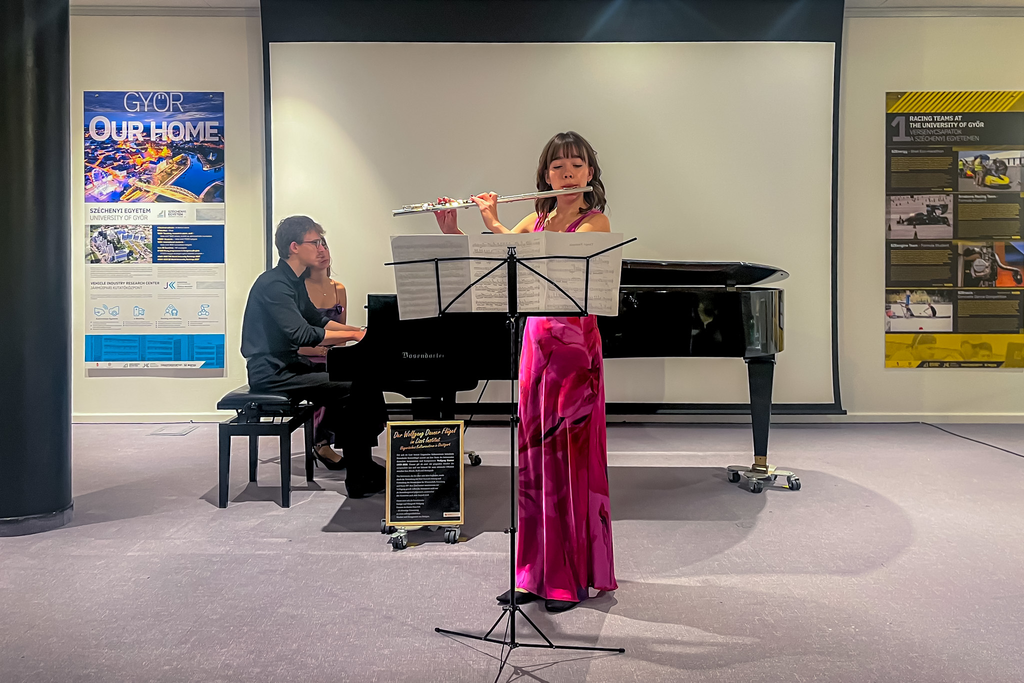
Students from Széchenyi István University’s Faculty of Design and Performance Arts also took the opportunity to introduce themselves to the audience. (Photo: Széchenyi István University)