
Created: 2026.09.07. 10:41
The education counsellor and second secretary of the Embassy of the People’s Republic of China in Hungary recently visited Széchenyi István University to discuss further opportunities for cooperation building on the existing partnership. In addition to the educational and cultural activities of the Confucius Institute at the Győr-based institution, the meeting also covered research and development opportunities, student and staff exchange programmes, and building the Chinese community in the region.
Opening up towards China is a key priority for Széchenyi István University, and in this spirit it established Hungary’s seventh Confucius Institute this January. The university’s Confucius Institute, which is responsible for Chinese language teaching and cultural programmes, is headed by both a Hungarian and a Chinese director. Its new Chinese director, Dr Yu Fengping, a lecturer at Jiaxing University, arrived in Győr last week to begin his work in person. Later in the week, the university also welcomed a delegation from the Embassy of the People’s Republic of China in Budapest.
Education counsellor Yang Xiuhua, who took up his post in March, and second secretary Sun Liwei visited Győr to deepen the already well-established relationship between the university and the embassy. In addition to educational and cultural cooperation, the discussions addressed the growing number of Chinese students, the popularity of the Confucius Institute’s language courses and the strengthening of the partnership between the two countries.
Yang Xiuhua stressed his commitment to supporting Széchenyi István University, noting that the institution not only carries out outstanding work in higher education relations but, as the host of the country’s newest Confucius Institute, also plays a significant role in promoting the values of Chinese language and culture to a wide audience. He highlighted the Institute’s distinctive industrial and business focus, under which its programme will also include a Chinese language-for-specific-purposes course related to technology, making its work particularly valuable in strengthening Chinese economic relations.

Participants in the meeting: Lilla Katona-Kelemen, Communications Officer at Széchenyi István University; Shen Zhi, staff member of the Confucius Institute; Réka Orosz-Barczi, Hungarian Director of the Institute; Yang Xiuhua, Education Counsellor at the Chinese Embassy in Budapest; Dr Eszter Lukács, Vice-President for International Affairs and Strategic Relations at the University; Dr Yu Fengping, Chinese Director of the Confucius Institute; Sun Liwei, Second Secretary at the Embassy; Natasha Borbély-Bailey, Head of the University’s Centre for Languages and Culture; and Beáta Gősi, staff member of the Confucius Institute. (Photo: András Adorján)
The counsellor, who has more than thirty years of experience in education, revealed that, owing to the quality and popularity of the language courses, the Chinese Ambassador Scholarship incentive programme will also be opened to students in Győr. From this academic year, the Institute will be able to nominate up to ten outstanding students for the award. He noted that, making the extension of the initiative to the Győr Institute a sign of long-term commitment.
Another important topic at the meeting was the development of student exchange programmes and mobility opportunities between Hungary and China. Yang Xiuhua was very pleased to note the existence of the dual Civil Engineering degree programme between Széchenyi István University and Jiaxing University and encouraged the development of further joint programmes with other institutions. The counsellor also invited the leadership of Széchenyi István University to China’s three most significant international forums – the World Digital Education Conference, the World Vocational and Technical Education Development Conference and the World Chinese Language Conference. Notably, it was at the latter that the agreement establishing the Confucius Institute in Győr was signed last year.
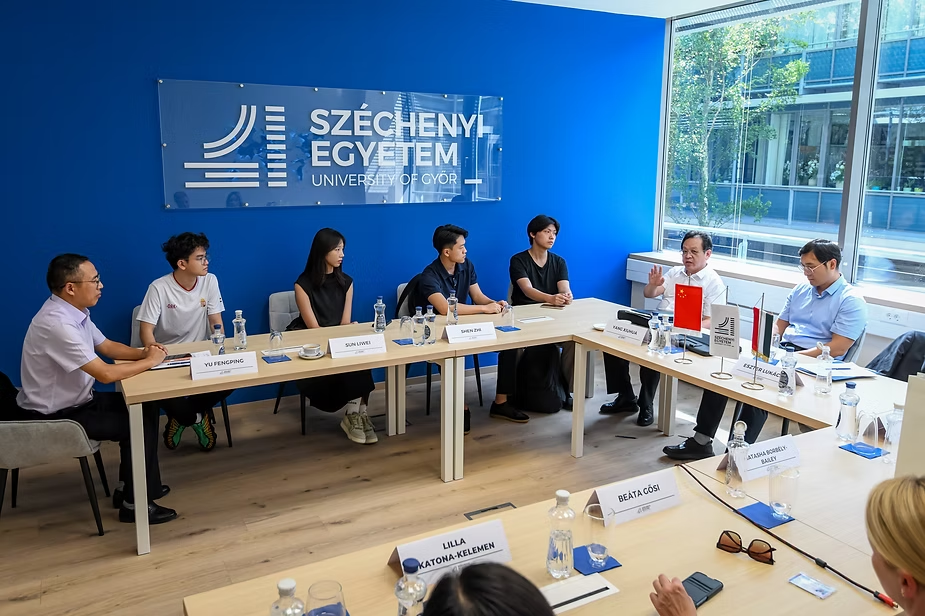
The two-member delegation also met Chinese students at Széchenyi István University. (Photo: András Adorján)
At the meeting, Dr Eszter Lukács, Vice-President for International Affairs and Strategic Relations at the University, stated that China is a global education powerhouse, as demonstrated by the worldwide significance of the Shanghai Ranking of higher education institutions. She explained that, like other European institutions, Széchenyi István University aims to gain a place on this prestigious list by developing its research and scientific collaborations. This ambition is also supported by the striking growth in the number of international students: more than 12,000 applicants from abroad applied for the academic year now beginning, of whom nearly 1,500 from 80 countries will commence their studies.
Speaking about the Confucius Institute, the Vice-President said that, alongside an industrial and business focus aligned with the University’s strategic partnerships, the younger generation is also of enormous importance. For this reason, the University considers it important to promote Chinese language and culture among children from as early as kindergarten and primary-school age. The Institute, which operates in close partnership with Jiaxing University, aims to build on the foundations of language teaching to maintain a thriving Chinese cultural and economic centre in the region over the long term.