
Created: 2026.07.01. 12:07
The SZEnavis team, made up of students from Széchenyi István University, took part as the only Hungarian entrant in the 20th German Concrete Canoe Regatta, where 70 university teams from eight countries competed. The Győr-based team achieved its greatest success to date: in the mixed doubles category, they reached the second step of the podium, while their men’s and women’s pairs also finished among the leading teams.
The concrete canoe team of Széchenyi István University, SZEnavis, was founded in 2012 to allow students to apply their engineering knowledge in practice, create as a team, and gain valuable experience through real competitions. Over the past decade, the team has come a long way: while their first boat weighed 380 kilograms, at the 2024 German Concrete Canoe Regatta they entered one of the lightest vessels in the field, weighing just over 12 kilograms. Since 2017, the university’s students from Győr have regularly participated in this prestigious biennial German regatta. At this year’s event, recently held in Brandenburg, they achieved one of their main goals: securing a place on the podium in a large international field.
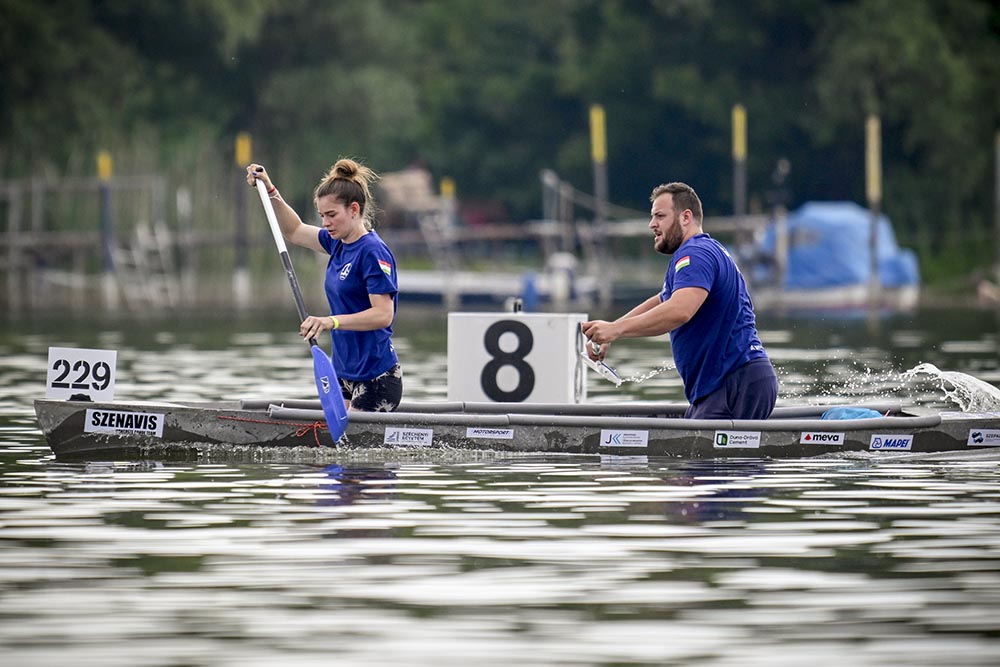
Gutta Petra and Albert Kamil, students of Széchenyi István University, finished in second place at the German Concrete Canoe Regatta (Photo: IZB / Sascha Steinbach)
“We have been preparing for this for a long time and have invested a great deal of energy into it. Concrete canoe racing is far more complex than simply paddling to the finish. First, the boat must be designed and built. Every property of concrete must be taken into account so that it is lightweight, manoeuvrable, and shaped in a way that best supports speed. Today, we have reached the point where we also belong among the international elite in this respect,” said Albert Kamil, team leader and the male member of the mixed pair that finished second. The civil engineering student added that this time they built an 85‑kilogram vessel, whose transportation to the venue also posed a professional challenge. Concrete is a rigid and brittle material, so it had to be transported in an essentially vibration‑free environment.
The team leader forms a well‑coordinated duo with Petra Gutta, the female member of the mixed pair. At last year’s Kraków Concrete Canoe Challenge, they received a special award for their perseverance after one of their paddles broke in the final, forcing them to finish in sixth place using one paddle and both hands.
“Back then, we were not fortunate, and although we encountered difficulties this time as well, we managed to overcome them and finish second. However, this is not only our achievement but that of the entire team. Everyone put in tremendous work to make our boat so competitive,” Petra Gutta pointed out. She added that one of SZEnavis’s greatest strengths lies in its unity and sense of community. “It was the good company that first drew me here, but I was also fascinated by the challenge of creating a boat from concrete that can float on water and even be suitable for racing. It may sound strange at first, but we gain a great deal of professional experience through it,” emphasised the civil engineering student.
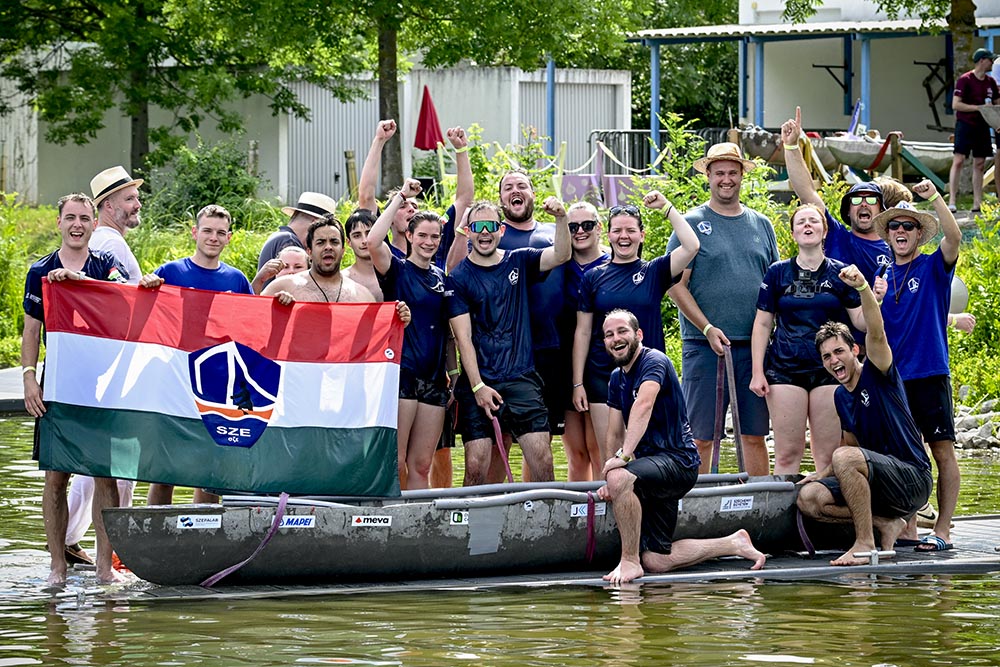
The success of SZEnavis was a collective achievement of the entire team (Photo: IZB / Sascha Steinbach)
In addition to the silver medal in the mixed doubles, the university’s women’s pair, Luca Dibusz and Vanda Viola László, finished 10th out of 61 competitors. The value of their result is further enhanced by the fact that the composition of the pair had to be changed shortly before the race due to an unexpected situation. In the men’s field of 70 boats, Flórián Horváth and Dávid Korcsmáros finished in 13th place.
“We are extremely proud of the entire team. This is a great success not only for the current members but also for former ones—that is, for the entire SZEnavis community,” said András Pollák, founder and mentor of the team and head of the university’s Laboratory for Construction Materials Testing and Building Physics. He highlighted that the value of their success is further increased by the fact that they do not have trained canoeists; instead, those who compete are engineering students involved in building the boats themselves. He also pointed out that alongside their studies and work, the young people often spend long evenings in the laboratory, perfecting their vessel and preparing for competitions. He added: “Their enthusiasm is also demonstrated by the fact that they promote the engineering profession. Most recently, they presented their activities to participants of the Győr Children’s University, and they will next be present at the EFOTT Festival between 8 and 12 July.”