
Created: 2026.03.23. 15:28
A unique professional forum on the relationship between the creative industries and the business world was organised by the Design Campus Competence Centre of Széchenyi István University and the National Association of Entrepreneurs and Employers (VOSZ). At the conference held in the Győr Innovation Park, participants had the opportunity to listen to renowned speakers such as communication expert András Batiz, extreme sportsman Gábor Rakonczay, and businessman Levente Balogh.
Maintaining strong relationships with companies, as well as social and cultural organisations, is of key importance in the life of Széchenyi István University, as these significantly contribute to strengthening the institution’s regional, national and international presence. A prominent venue for this is the Győr Innovation Park, which, alongside the design programmes of the Faculty of Design and Performance Arts, is also home to companies and collaborations. The building also houses the Győr-Moson-Sopron County centre of VOSZ, which, among its many activities, serves as a bridge between local entrepreneurs, businesses, and higher education.
The close partnership between the association and the University has already supported numerous successful initiatives, and the Design + Business conference—organised for the first time—was launched with the intention of becoming a tradition. The aim of the event was to demonstrate how creative knowledge and an innovative design mindset create value in the economy and in business operations. To this end, the organisers invited professionals who could shed light on the topic through their enterprises, research, or personal experiences.
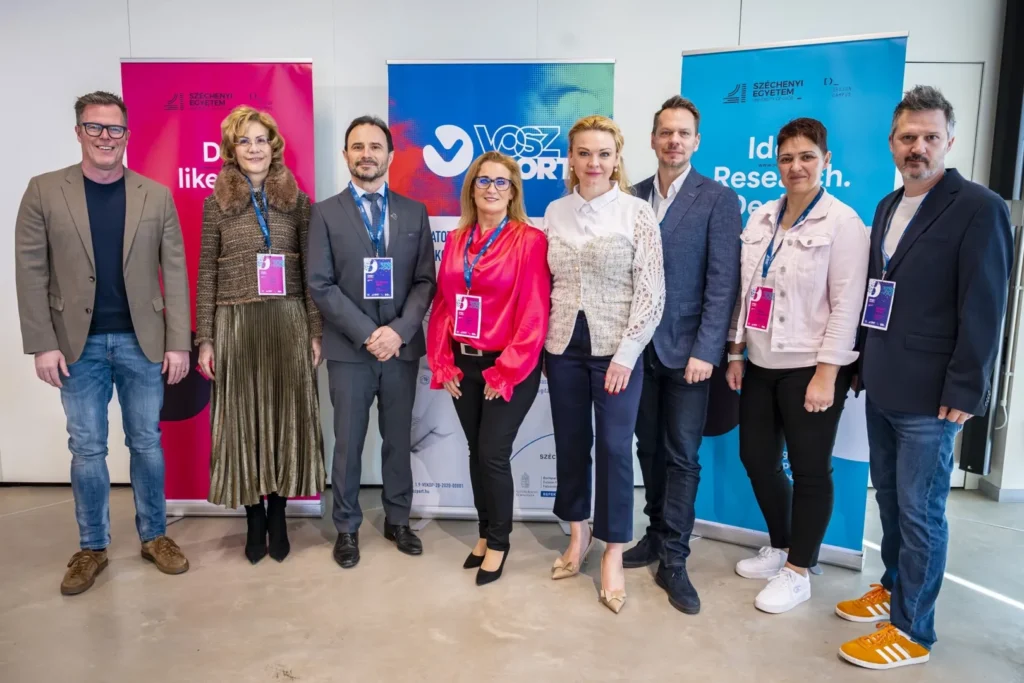
András Batiz, founder of the Europion research platform; Dr Eszter Lukács, Vice-President for International Affairs and Strategic Relations at Széchenyi István University; Dr Péter Kovács, President of VOSZ Győr-Moson-Sopron County; organiser Ágota Ivánné Flender, advisor at the VOSZ Business Development and Széchenyi Card Programme Office in Győr; Beáta É. Gál, Communications and Marketing Director of VOSZ; Tamás Barabás, Co-President of VOSZ and Managing Director of VOSZ Business Development Ltd.; organiser Bernadett Ágota, Operative Leader of the University’s Art and Design Campus Competence Centre; and organiser András Gosztom, Head of the Competence Centre (Photo: Gergely Nagy)
At the opening of the event, Dr Eszter Lukács, Vice-President for International Affairs and Strategic Relations of the University, emphasised that the institution believes the creative industries are not only a cultural field but also a factor of economic competitiveness. “Alongside our music programmes, our design courses—built on real market demands—are becoming increasingly popular at our Faculty of Design and Performance Arts. Future creative professionals can study architecture, industrial design, and graphic design at both undergraduate and postgraduate levels. The Design Campus, which coordinates these programmes, currently has more than 170 students, and we are particularly pleased that many of them will obtain valuable degrees in our English-taught MSc in Design programme,” she explained. She added that the Art and Design Campus Competence Centre connects academic knowledge with economic and social stakeholders, facilitating the creation of new products, services, and innovative solutions. She highlighted that the centre works closely with the departments of the Design Campus, supports University projects, and provides students with opportunities to participate in experimental development.
According to Dr Péter Kovács, county president of VOSZ, the examples presented by the invited speakers are not only relevant from a business perspective but also offer valuable insights on an individual level. As he noted, a society’s success depends on individuals, and the event provides participants with solutions and guidance that can also assist them in their everyday tasks. “If life gives us lemons, let us make lemonade,” he told the audience.


Students, lecturers of Széchenyi István University, and entrepreneurs from the region attended the conference (Photos: Gergely Nagy)
The series of presentations began with communication expert András Batiz, founder of the Impact Works communications and consultancy agency established in 2007. As its leader, he has delivered more than a thousand training sessions and workshops in twenty countries across three continents, primarily for executives of international companies. At the Design + Business forum, he presented the opportunities inherent in market and opinion research as the owner of the Europion research platform. In his presentation, he emphasised that good design can directly contribute to sales, increase a product’s value, and even build trust among consumers, making it essential to understand the target audience.
Beáta É. Gál, Communications and Marketing Director of VOSZ, delivered a presentation on change and crisis management. She highlighted that corporate crises may arise from both external and internal causes, and their management requires thorough assessment, rapid intervention, transparent and clear communication, and support for adapting to new circumstances. “As entrepreneurs, we should step out of our comfort zones, push beyond our limits, take risks, and seek supporters. There are numerous opportunities to gain knowledge and experience—think of VOSZ or Széchenyi István University—let us draw courage from these and allow our instincts to guide us forward,” she advised.
Under the title “Answers to Tomorrow’s Challenges: Business Development in the Age of Robotics and AI”, Tamás Barabás, Co-President of VOSZ and Managing Director of VOSZ Business Development Ltd., spoke about currently available technological innovations. “What is the fundamental problem of Hungarian businesses today? Is it a lack of capital or labour? Rather, it seems we have reached a point where we can no longer become more efficient. We aim to break through this efficiency barrier, and higher education can play a significant role by enabling a new, innovative way of thinking,” he noted. His presentation placed strong emphasis on technological development support available to businesses, the workplace integration and application of artificial intelligence, and VOSZ’s efforts to increase productivity.
Extreme sportsman Gábor Rakonczay also highlighted the importance of decision-making and proper preparation. A multiple world-record holder, two-time Guinness World Record holder, and six-time ocean rower, he is also a designer-architect and recipient of the Hungarian Design Award, and was awarded the Hungarian Gold Cross of Merit on 15 March for his international achievements. In his presentation, he shared lessons from the past eighteen years of his career. He revealed that while near-death experiences initially motivated him as an extreme athlete, he later realised that achieving performance and real results requires thorough preparation and the appropriate application of technology to handle difficult situations. As he put it, success requires not only talent but also significant effort.
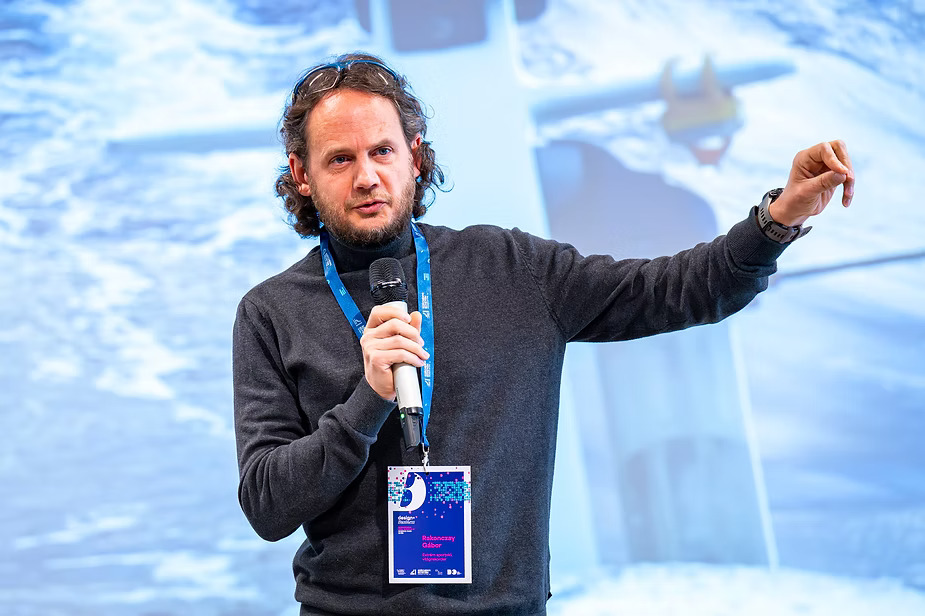
Following the conference, extreme sportsman Gábor Rakonczay delivered an additional full-house lecture for Hungarian and international students of the institution (Photo: Gergely Nagy)
Participants also gained insight into the Marokbaba enterprise—previously presented at the University’s Spinoff Club event series—through its founders, Dorina Bárdi and Lídia Kincses-Kádár, both students of the institution. “Marokbaba started almost exactly here; a few years ago, during one of our creative weeks, I was standing here with a measuring tape. This is also where I learned how to think conceptually,” recalled Lídia Kincses-Kádár. Dorina Bárdi added that the idea initially started as a home development tool, and the enterprise has since launched several charitable initiatives. “Marokbaba was not created alone—we sought the opinions of professionals, and ultimately thirty-three developmental disciplines became involved. Our goal is to showcase that Hungarian developmental pedagogy is outstanding and exceeds international standards,” she stated.
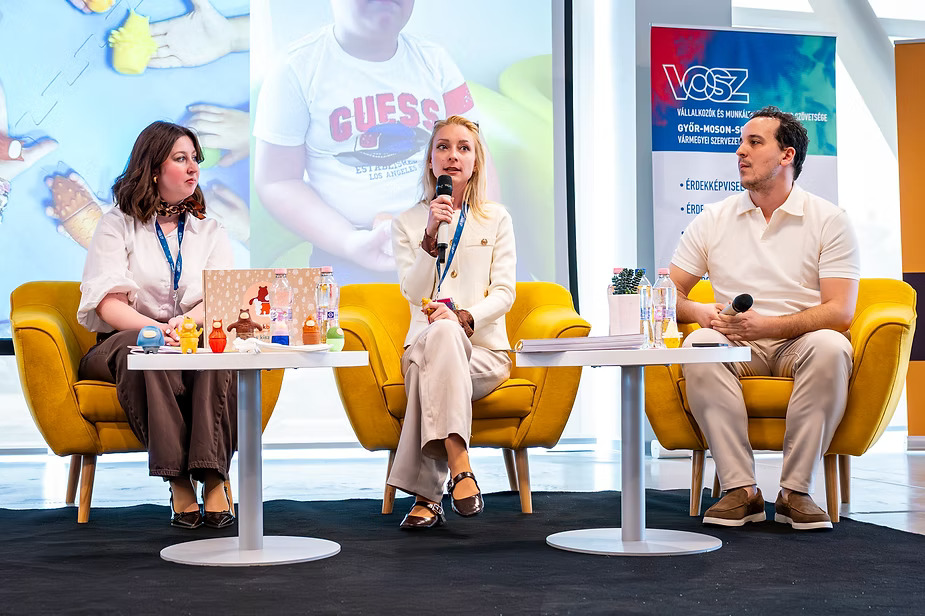
Dorina Bárdi and Lídia Kincses-Kádár, students of Széchenyi István University, presented the nationally recognised Marokbaba project together with PR and Communications Manager Kristóf Kádár (Photo: Gergely Nagy)
The Design Campus and its Competence Centre were represented by Dr Krisztián Palócz, Head of the Department of Industrial Design, and András Gosztom, Head of the Centre. While the former spoke about the design-based interpretation of complex urban systems, the latter addressed the future of products and collaboration-based creation.
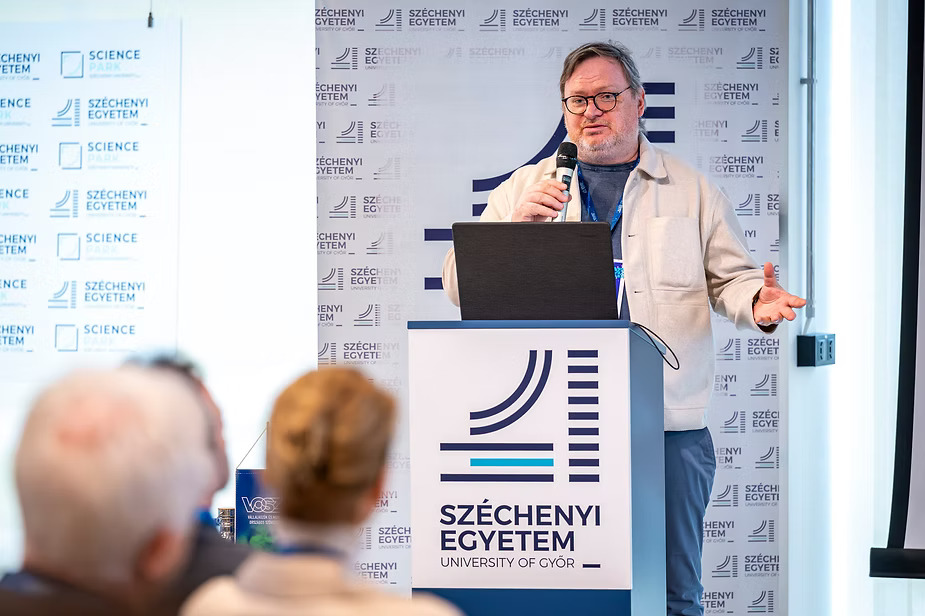
Dr Krisztián Palócz, Head of the Department of Industrial Design at the University (Photo: Gergely Nagy)
The closing presentation of the conference, titled “The Next Step with Levente Balogh”, introduced participants to the world of business development, career building, and marketing. The speaker, Chairman of Szentkirályi Magyarország Ltd., Managing Director of Vitapress Ltd., and a businessman known from the television programme Among Sharks, praised the University’s design programmes. “I am in a very good place, because throughout my life—much of which has been about brand building—I always wished to get to know a university like this. When I was building brands, such programmes did not yet exist, so I designed the bottles and the first Szentkirályi label myself,” he remarked. In his presentation, he emphasised the importance of recognising personality types at an early stage, spoke about his consultancy work, the importance of understanding products in creative work, and his belief that it is worthwhile to start working, take on internships, and gain experience from a young age.
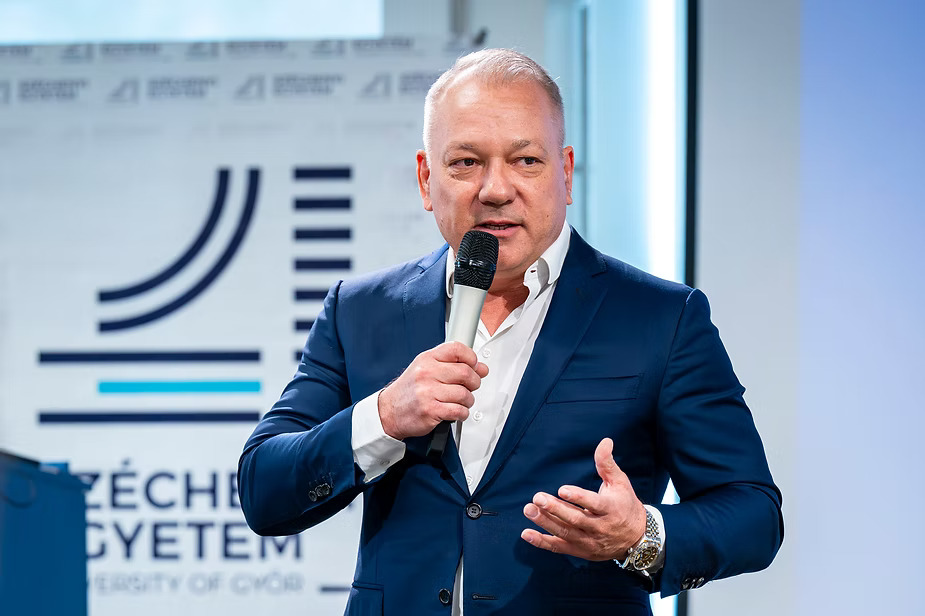
Levente Balogh, Chairman of Szentkirályi Magyarország Ltd., Managing Director of Vitapress Ltd., and a businessman known from the television programme Cápák között, shared his decades of professional experience with the audience (Photo: Gergely Nagy)