
Created: 2026.03.10. 14:36
The most exciting scientific results today are increasingly emerging at the boundaries between disciplines, says Dr Petra Aczél, Head of the Centre for AI and Future Strategies at Széchenyi István University, who has recently been appointed Vice-President for Frontier Sciences of the HUN-REN Hungarian Research Network. According to the professor, research built on collaboration between different disciplines can play a key role in enabling Hungary to join the world’s leading innovators.
As a key player in Hungarian research, the HUN-REN Hungarian Research Network brings together the work of more than five thousand researchers and professionals across 15 research institutes. Following the proposal of President Balázs Gulyás, the organisation’s governing body appointed new vice-presidents responsible for specific scientific domains as of 1 March. Their task is to promote cooperation and joint research projects among research institutes, thereby strengthening the international competitiveness of Hungarian science. One of them is Dr Petra Aczél, Professor at Széchenyi István University and Head of the Centre for AI and Future Strategies, who is responsible for the field of frontier sciences.
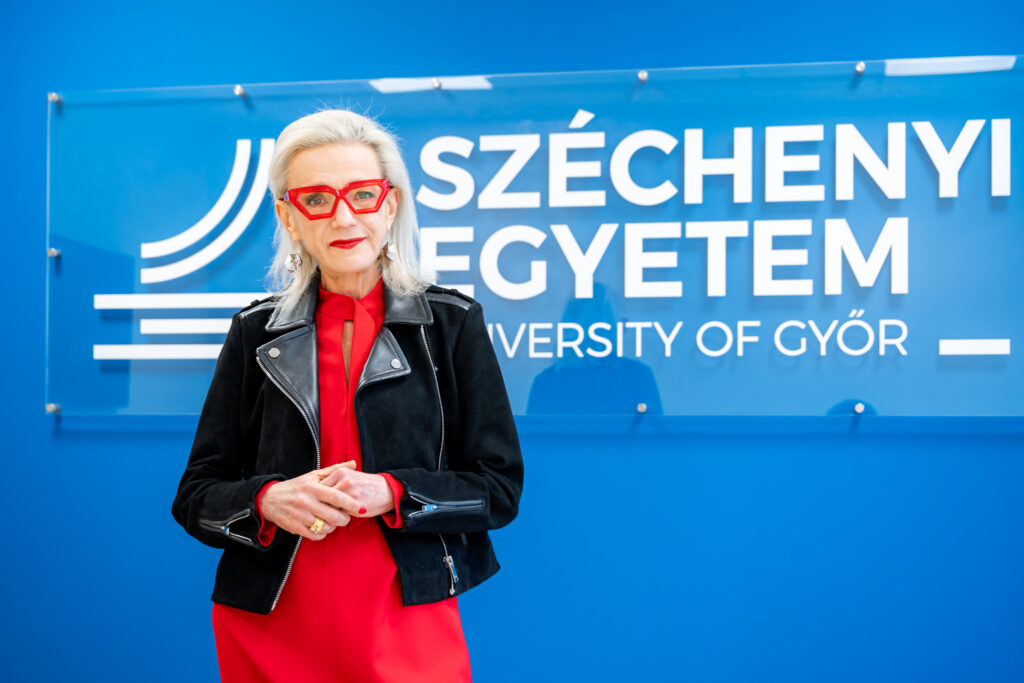
As Vice President of HUN-REN, Dr Petra Aczél, Professor at Széchenyi István University and Head of the Centre for AI and Future Strategies, will coordinate the activities of HUN-REN research institutes in the field of frontier sciences (Photo: András Adorján)
“Science today is no longer one-dimensional: there are no purely technical, technological or life-science challenges. In almost every issue, strong connections appear with other fields, such as the social sciences, psychology, economics or law,” emphasised Dr Petra Aczél. She added that frontier sciences do not simply represent the margins of individual disciplines, but also the intersections where new perspectives and approaches emerge. As Vice President, she therefore aims to identify and support researchers and research groups that explicitly build on this perspective. “This is one of the breeding grounds of innovation,” she pointed out.
According to the professor, this can contribute to launching research programmes that have a significant global impact, supporting Hungary’s ambition to join the international frontrunners in innovation performance. She highlighted that, alongside strengthening international relations, they also aim to create an attractive environment for outstanding Hungarian researchers currently working abroad, encouraging as many as possible to return home and establish new research groups and scientific communities.
She also emphasised the importance of being able to work as Head of the Centre for AI and Future Strategies at Széchenyi István University, as this field is closely connected to her responsibilities within HUN-REN: both focus on addressing the scientific and societal challenges of the future. “There is already close cooperation between the University and HUN-REN, and I hope that this connection can be further strengthened through my involvement,” added Dr Aczél.
Reflecting on her own career, she explained that her research has always been characterised by movement across disciplinary boundaries: alongside her background in linguistics, she works in communication studies, future skills, artificial intelligence and new media – fields that naturally evolve at the intersection of multiple disciplines. “We cannot talk about communication without communication technologies, and we cannot examine communication technologies without their economic or geopolitical contexts,” she noted as an example. In her view, scientific work often resembles an architectural project: the outcome can only be complete if experts from different fields work together on it.
Speaking about her new appointment, she described the nomination as a mark of trust: “As Madách writes, this has been entrusted to me as ‘advance payment’ – meaning that such trust must be earned.”