
Created: 2026.03.04. 11:02
Sports education and research can no longer be separated from intelligent technologies, a data-driven approach and multidisciplinary thinking – building on this recognition, Széchenyi István University is launching new research projects and academic programmes. The institution is working in close cooperation with the State Secretariat for Sport at the Ministry of Defence and the National Institute for Sports Medicine.
Széchenyi István University views sport not merely as performance and competition, but as a national resource and one of the foundations of the future of the younger generation. This approach shaped the professional event jointly organised by the University and the Ministry of Defence’s State Secretariat for Sport on 26 February at the VIP lounge of Győri ETO FC.
At the event, the University signed a strategic cooperation agreement with the National Institute for Sports Medicine. On this occasion, Dr Ádám Schmidt, State Secretary for Sport, emphasised that anyone who does not wish to fall behind in sport must engage with the various fields of sports science. He added that their continued objective is for Hungary to remain among the world’s leading nations in elite sport, while in community sport they must reach and retain as many young people as possible in the long term. However, he pointed out that data collection alone is not sufficient; data must also be analysed and interpreted. As he put it, a key task in sports science and sports healthcare is the coordination of all stakeholders’ work, and the agreement between the two parties serves precisely this purpose.
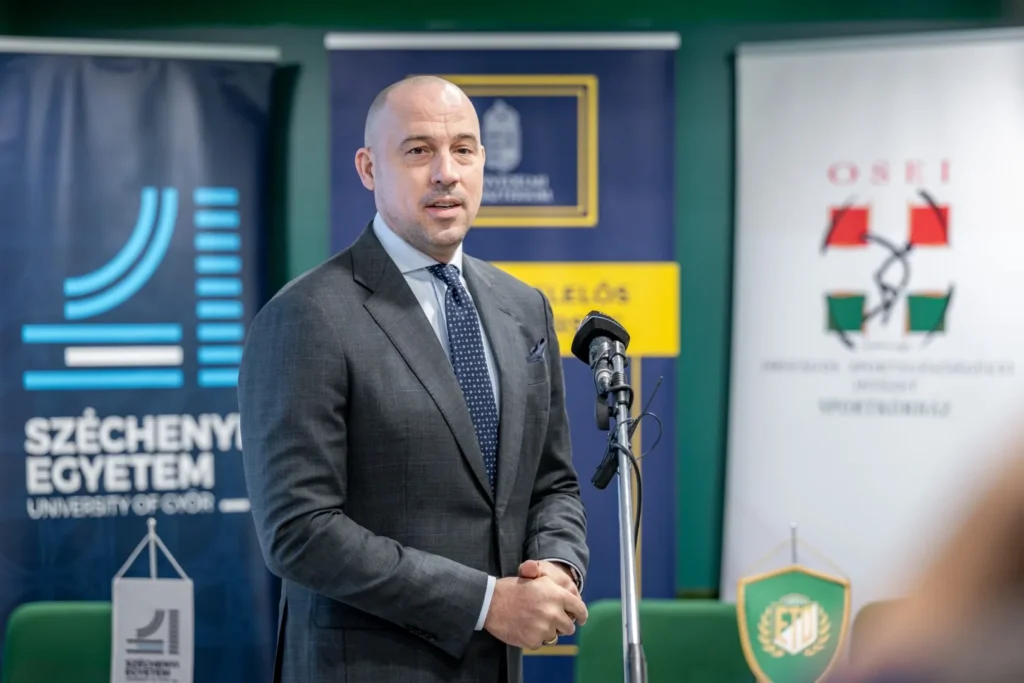
Dr Ádám Schmidt, State Secretary for Sport (Photo: András Adorján)
The professional significance of the strategic partnership was also highlighted by the leaders of the institutions involved. Dr Ágnes Soós, Director General of the National Institute for Sports Medicine, explained that their aim is to ensure that sports healthcare provision, research and higher education develop in a mutually reinforcing manner. She underlined that the cooperation is beneficial for both sides: their specialists can become involved in university teaching, while the institute can strengthen its activities by engaging students and university lecturers.
Dr Angéla Somogyi, Dean of the University’s Faculty of Health and Sport Sciences, stated that the future of sports education cannot be separated from intelligent technologies, a data-driven approach and multidisciplinary thinking. In this spirit, their strategy is based on the systemic integration of sport and health sciences.
The Dean announced that from autumn 2026 the University will launch a Master’s programme in Specialist Coaching in Hungarian and English, with 12 sport-specific specialisations. In addition, the Bachelor’s programme in Coaching is currently under accreditation in both Hungarian and English, and a Master’s programme in Sport Mental Training is also expected to commence. From September, postgraduate specialist programmes in sport psychology and sport dietetics will likewise be available. She noted that they are also planning to launch a sports physiotherapy programme, unique in Hungary, jointly with the National Institute for Sports Medicine, with which they also cooperate in the field of sport dietetics research.
Dr Somogyi also reported on research projects whose results are directly applicable in practice. The performance analysis and evaluation system developed jointly with ETO FC is based on the processing of cognitive data, while the NIRSport2 programme examines the relationship between movement and neural activity, enabling the personalised development of attention, concentration and load tolerance.
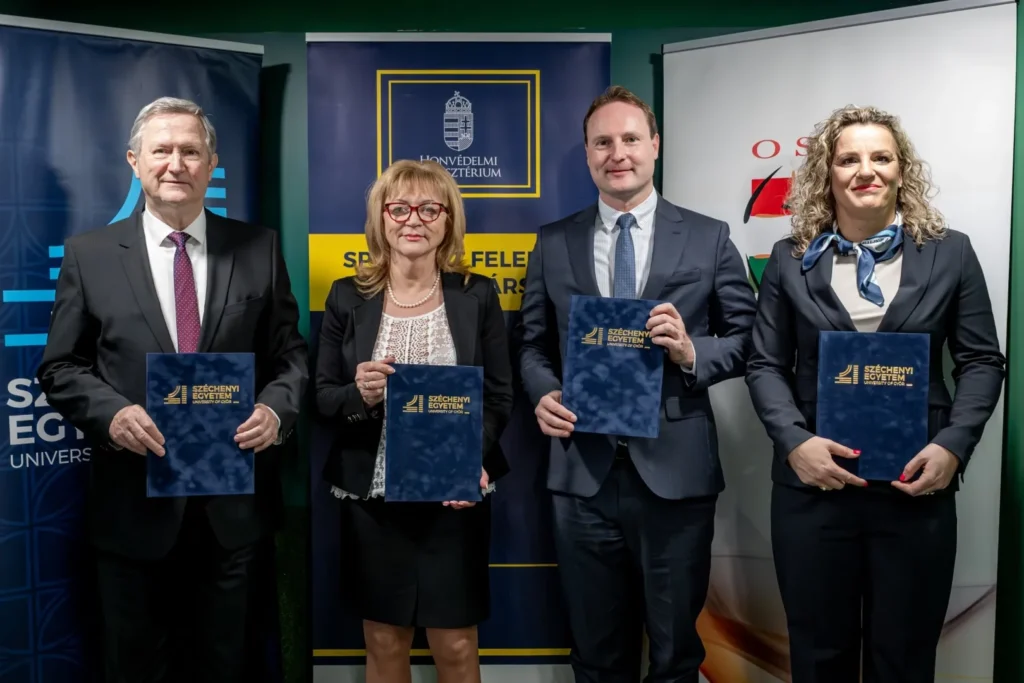
The cooperation agreement was signed in a ceremonial setting by Professor Ferenc Friedler, Rector and Vice-President for Scientific Affairs at Széchenyi István University; Dr Ágnes Soós, Director General of the National Institute for Sports Medicine; Dr Bálint Filep, President of the University; and Dr Angéla Somogyi, Dean of the Faculty of Health and Sport Sciences. (Photo: András Adorján)
Máté Havas, Director of Club Operations and Academy of ETO FC, emphasised that the club aims to create a model in which tradition and innovation form a unified whole. In this spirit, they are developing their data visualisation system, which ensures rapid data processing, supports personalised decision-making and identifies areas for development.
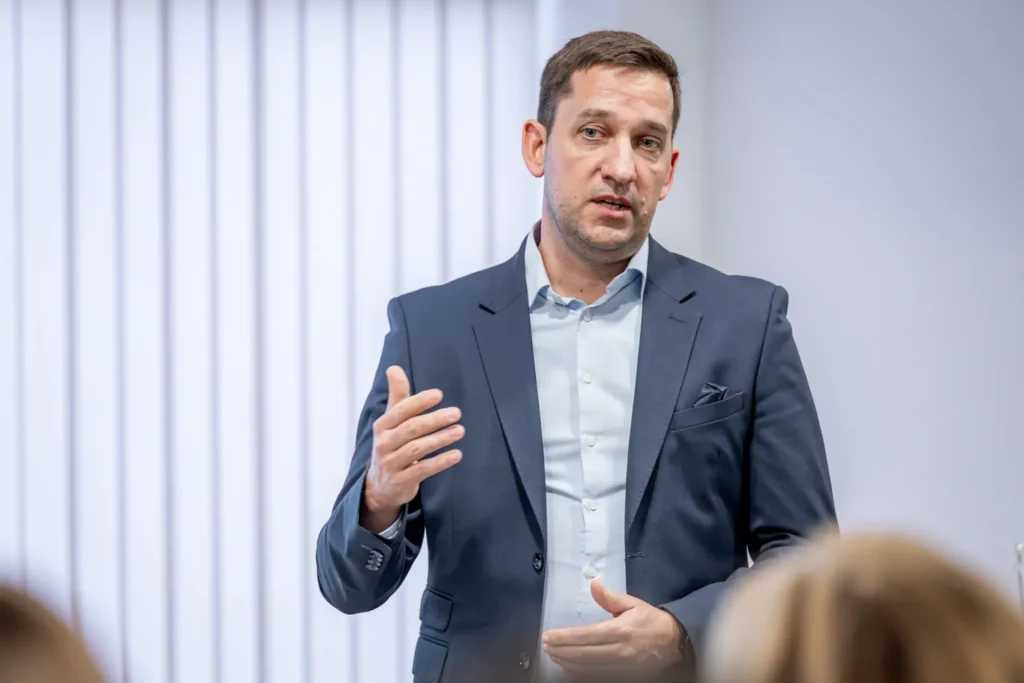
Máté Havas, ETO FC club’s Director of Club Operations and Academy (Photo: András Adorján)
At the event, Dr Petra Aczél, Head of the University’s Centre for AI and Future Strategies, presented the joint “Our Future AI Sport” project with the State Secretariat for Sport, highlighting that sport provides cohesion to our national culture, and therefore it is particularly important that technological development be integrated into its operation in a conscious and strategic manner. She explained that intelligent technologies are playing an increasingly significant role in athlete support, training and education, infrastructure, sport marketing and communication, as well as in sports science. As a first step of the initiative, they will assess how Hungarian sports organisations use intelligent information technologies and what attitudes characterise professionals working in the field. Following this situational analysis, the aim is to familiarise stakeholders in the world of sport with the available opportunities and to develop methodological innovations and training modules.
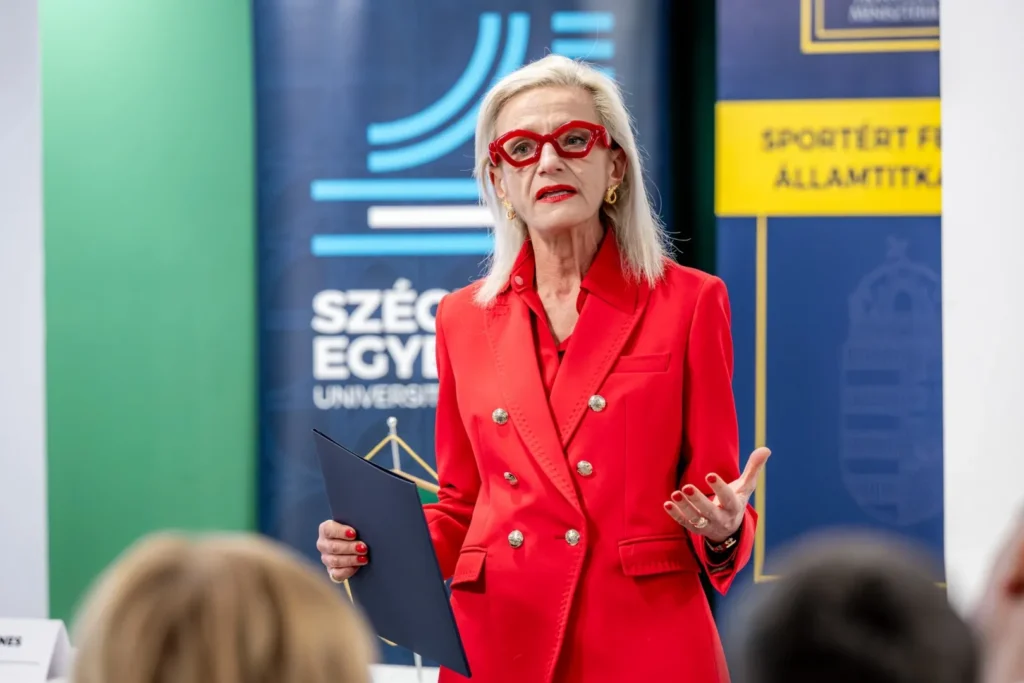
Dr Petra Aczél, Head of the University’s Centre for AI and Future Strategies (Photo: András Adorján)
In closing the event, Dr Zsolt Szelid, Head of the University’s Department of Sports Medicine and Digital Health Sciences and Chair of the Medical Committee of the Hungarian Football Federation, spoke about the recently held international conference “SPEED 2026 – Sport in a Health-Conscious and Digital Way”. He highlighted that the forum presented the latest results in sports healthcare, sports science and digitalisation, with particular regard to prevention, rehabilitation and the role of data-based solutions in performance optimisation. As part of the conference, the UEFA Get Trained, Save Lives programme was launched in Hungary, aiming to promote resuscitation skills within the world of sport.
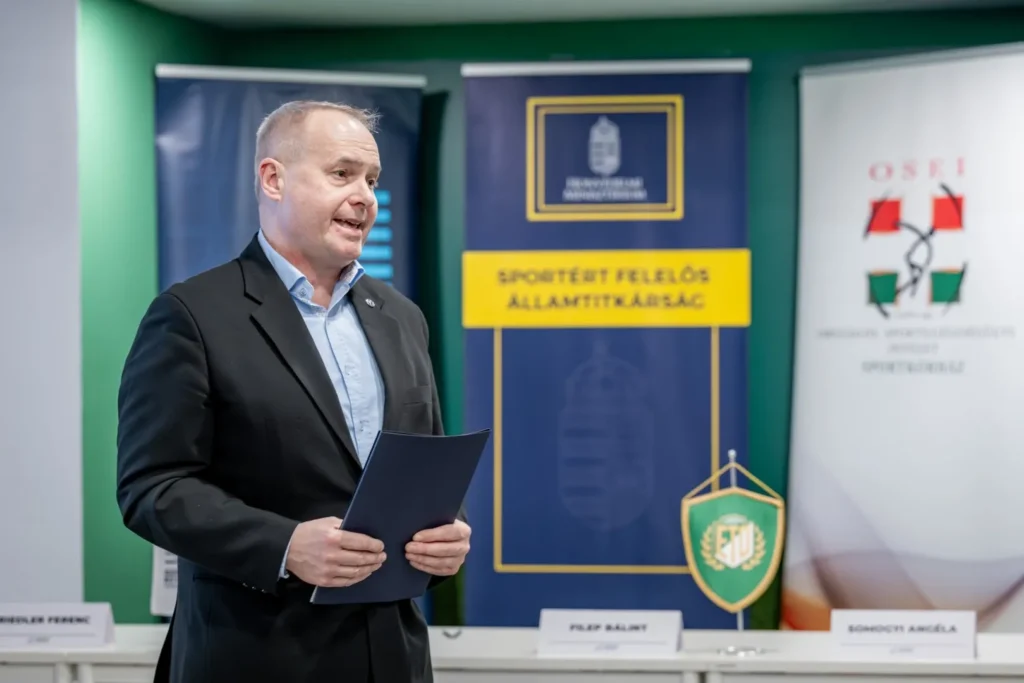
Dr Zsolt Szelid, Head of the University’s Department of Sports Medicine and Digital Health Sciences and Chair of the Medical Committee of the Hungarian Football Federation (Photo: András Adorján)