
Created: 2026.01.26. 09:33
The Confucius Institute of Széchenyi István University was inaugurated at a ceremonial event held on the Győr campus on 23 January 2026. The new organisation marks a milestone in Hungarian–Chinese cooperation in higher education, science, and culture.
In recent years, Széchenyi István University has seen a marked strengthening of its relations with China. The community of students from the Asian country in Győr continues to grow, Chinese visiting professors regularly arrive at the University, and more than a dozen cooperation agreements now link the Győr-based institution with Chinese partner universities.
Language education has also gained new momentum: Chinese language courses are now available for all age groups, while community programmes – such as celebrations of the Lunar New Year and the Mid-Autumn Festival – are attracting an increasingly wide audience. Academic cooperation is likewise expanding: the joint double-degree programme in civil engineering with Jiaxing University is progressing successfully, and the first student graduated with distinction last year.
It is precisely the partnership with Jiaxing University that forms the foundation of the Confucius Institute at Széchenyi István University, inaugurated on the Győr campus on 23 January. At the event, the series of welcome addresses was opened by a video message from Zhao Lingshan, Vice President and Secretary-General of the Chinese International Education Foundation. “We are convinced that, building on the academic strengths of the two universities, the Confucius Institute will regard Chinese language education as its starting point, applying the “Chinese language plus new technologies” model, and further developing as a technology-oriented institution, nurturing talents in support of Chinese–Hungarian friendship,” he emphasised.
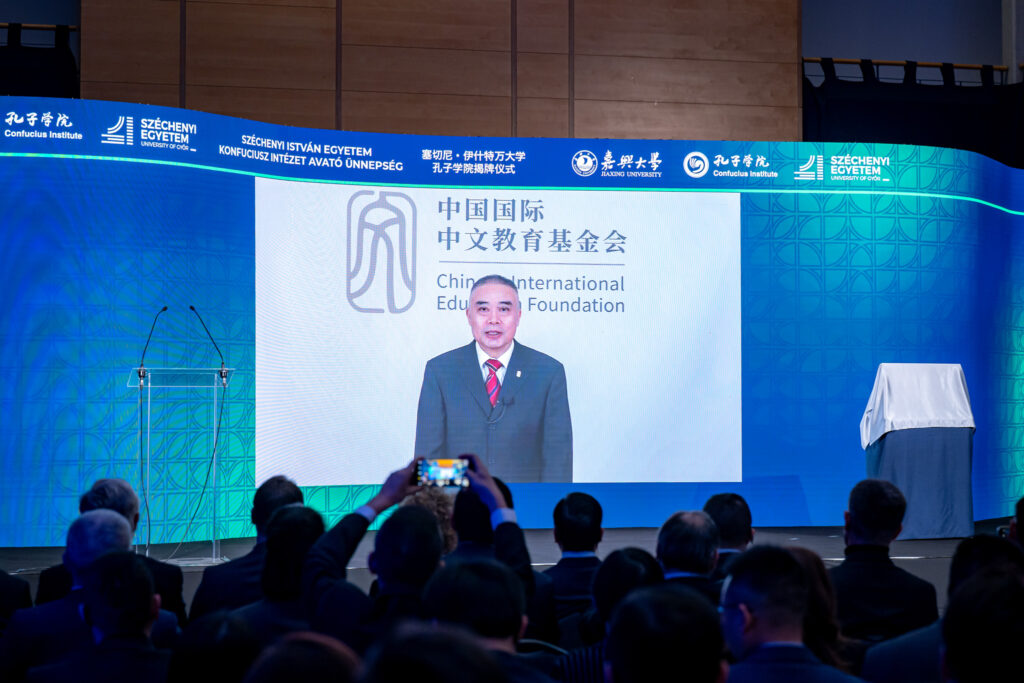
Zhao Lingshan, Vice President and Secretary-General of the Chinese International Education Foundation, welcomed the establishment of the Confucius Institute in Győr in a video message (Photo: András Adorján)
At the event, Mei Deqing, President of Jiaxing University, delivered a speech. As he put it, “civilisations grow closer through mutual understanding, and friendship is deepened through mutual learning.” He pointed out that although Jiaxing and Győr are geographically distant, their shared values—openness, inclusiveness, and confidence in the future—provide a solid foundation for cooperation. He emphasised that the Institute is not only a forum for teaching the Chinese language, but also for gaining insight into each other’s cultures, thereby giving new momentum to joint programmes, research activities, and exchange initiatives.
On behalf of Széchenyi István University, Dr Eszter Lukács, Vice President for International Affairs and Strategic Relations, explained that the establishment of the Institute represents the tangible outcome of a long-term process. She emphasised that the University’s openness is well illustrated by the fact that the number of English-taught programmes has increased from five in 2019 to 63 today, while the number of international students has grown from 66 to 1,186 over the past ten years.
“We regard China as a priority, as we are speaking of a strategic country and one of the driving forces of the global economy. There is growing interest among Chinese students in our educational programmes, and in our research activities, China is our second most important partner—almost a quarter of our scientific output is achieved in cooperation with Chinese universities. In our Győr Innovation Park, we openly welcome Chinese companies,” she noted, adding that bilateral relations can only be truly sustainable if they are accompanied by cultural and linguistic understanding.
“For this reason, we consider it a key task to promote Chinese language and culture among companies, educational institutions, as well as young people and the wider public. Between 2012 and 2025, nearly six hundred people studied the Chinese language at our University, and more than one hundred participants are currently enrolled in our Chinese language courses,” she underlined.
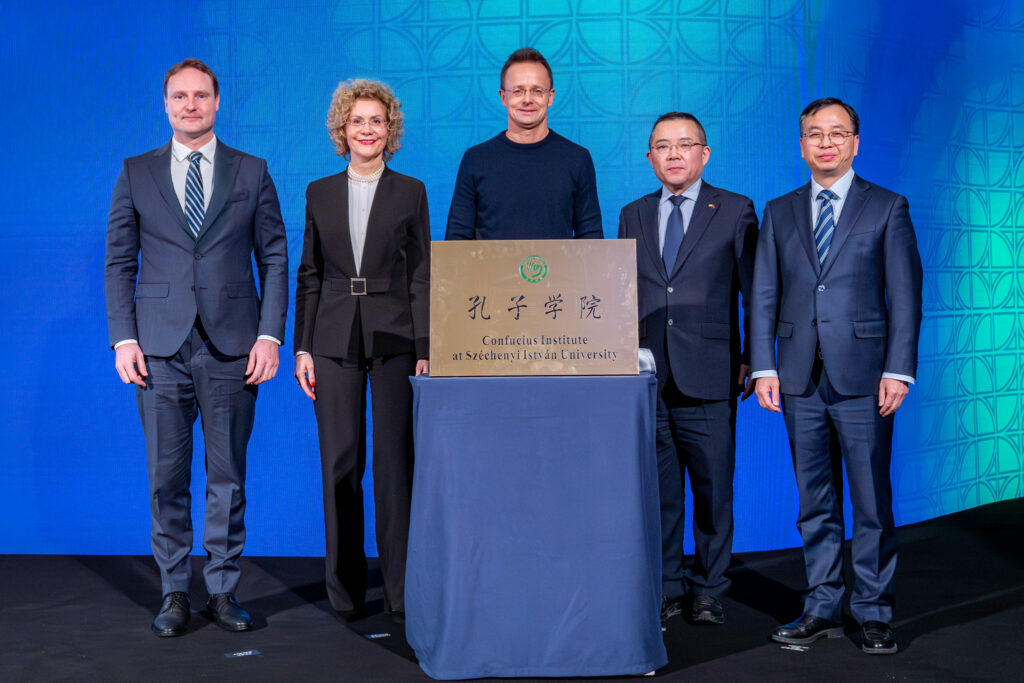
In his address, Gong Tao, Ambassador of the People’s Republic of China to Hungary, emphasised that the establishment of Hungary’s seventh Confucius Institute clearly reflects the dynamic development of Chinese–Hungarian relations, as well as the fact that the two countries are strategic partners on the path of modernisation. He pointed out that both China and Hungary are committed to the green transition, the modernisation of industrial structures, and innovation-driven development, in which universities play a decisive role.
The Ambassador also noted that China has now been Hungary’s largest foreign investor for the third consecutive year, that the volume of bilateral trade continues to grow, and that new industrial co-operations are being launched in both countries. He expressed his conviction that the Confucius Institute of Széchenyi István University will play an important role in further deepening educational, scientific, and cultural relations between the two nations.
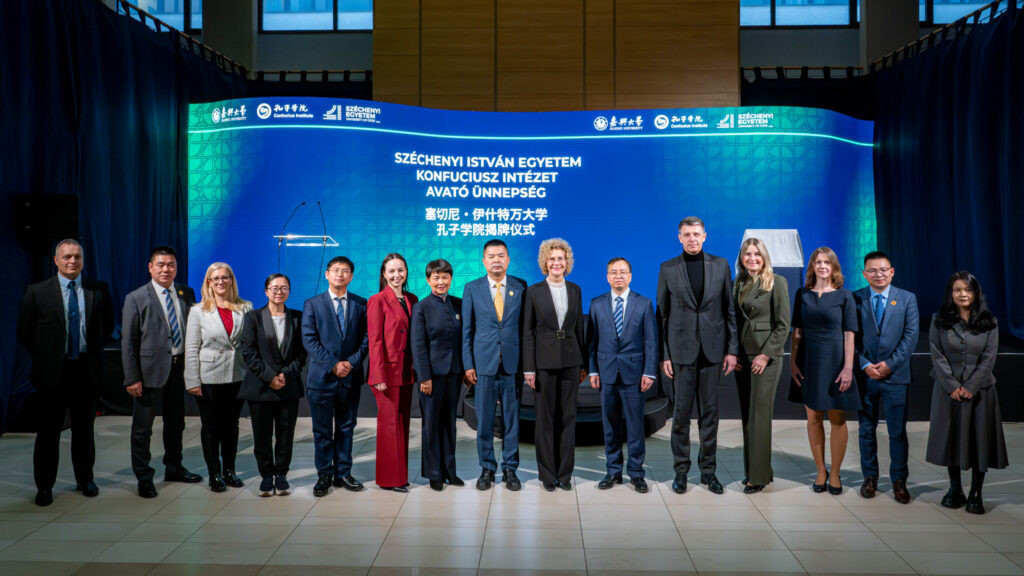
Group photo of the members of the Chinese delegation and representatives of Széchenyi István University (Photo: András Adorján)
Péter Szijjártó, Minister of Foreign Affairs and Trade, emphasised that the establishment of the Confucius Institute in Győr is a sign of mutual respect, from which intensified cooperation and stronger people-to-people relations can be expected. He expressed his gratitude to the leadership of Jiaxing University for deciding to enter into an alliance with Széchenyi István University. “This represents a major step forward for us, because, similarly to Széchenyi István University, you place strong emphasis on engineering and the natural sciences, and share the conviction that industry and education must work closely together,” he said. He noted that the partnership between the two institutions simultaneously strengthens Hungarian–Chinese economic cooperation and gives new momentum to reinforcing the foundations of the Hungarian economy. He also stated: “In contrast to Europe, we Hungarians are seated at that particular table where the future rules of the world order are being written. This demonstrates the success of the foreign policy strategy pursued over the past decade, in which we set ourselves the goal of ensuring that every major global power centre has a vested interest in Hungary’s success.”
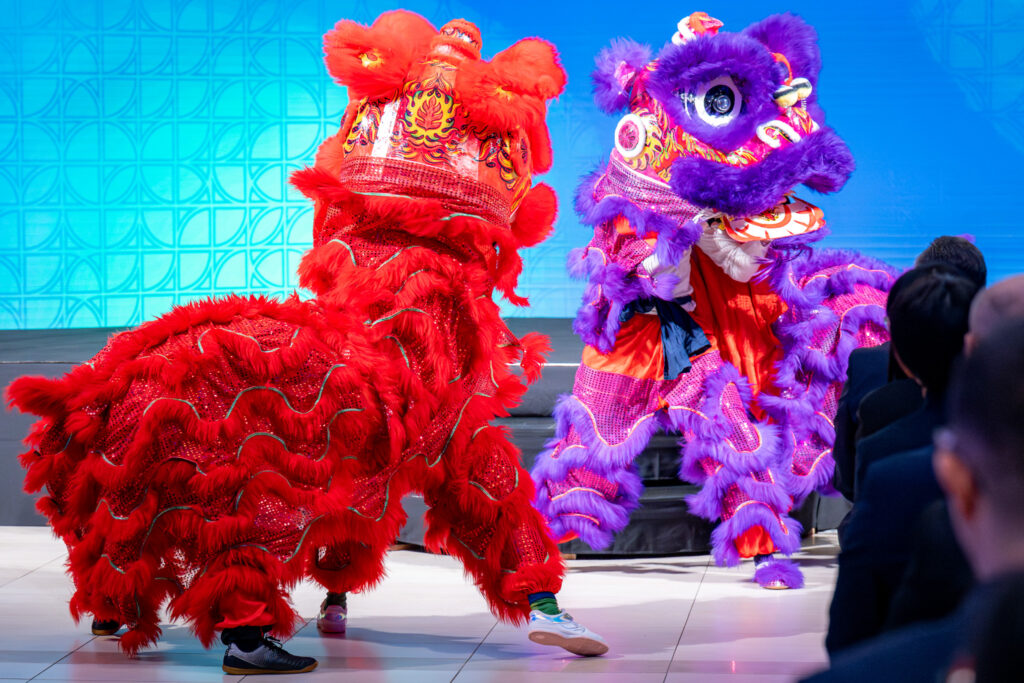
The programme was enriched by a spectacular cultural element: the Hungarian Chang Wu Martial Arts Federation performed a lion dance, a Chinese cultural symbol of strength, good fortune, and new beginnings (Photo: András Adorján)