
Created: 2026.01.19. 09:34
2025 marked a turning point for the Arrabona Racing Team: the team changed categories and completed its first electric-powered car. At their customary event entitled Design Freeze, the team reported on the experiences gained during the first steps along this new path and on their current plans. It became clear that through continuous development they can move closer to the leading group year by year.
The student team of Széchenyi István University, Arrabona Racing Team, finished first in the internal combustion category at Formula Student East in the summer of 2024. All the conditions were in place for a successful continuation – the expertise of the members, as well as the support of the institution and sponsors – yet they chose to seize the opportunity to change direction and, with a new sponsor at their side, committed themselves to electric propulsion. In doing so, they followed trends in the automotive industry and motorsport, while the Formula Student competition series itself is also moving towards electric power.
As expected, the beginning of the new era was primarily about expanding the knowledge base and gaining experience. Accordingly, the main task of this season is the further development of last year’s vehicle, ART_12. Among other topics, this was discussed at the team’s traditional Design Freeze event, where the concept of the next car was also presented.
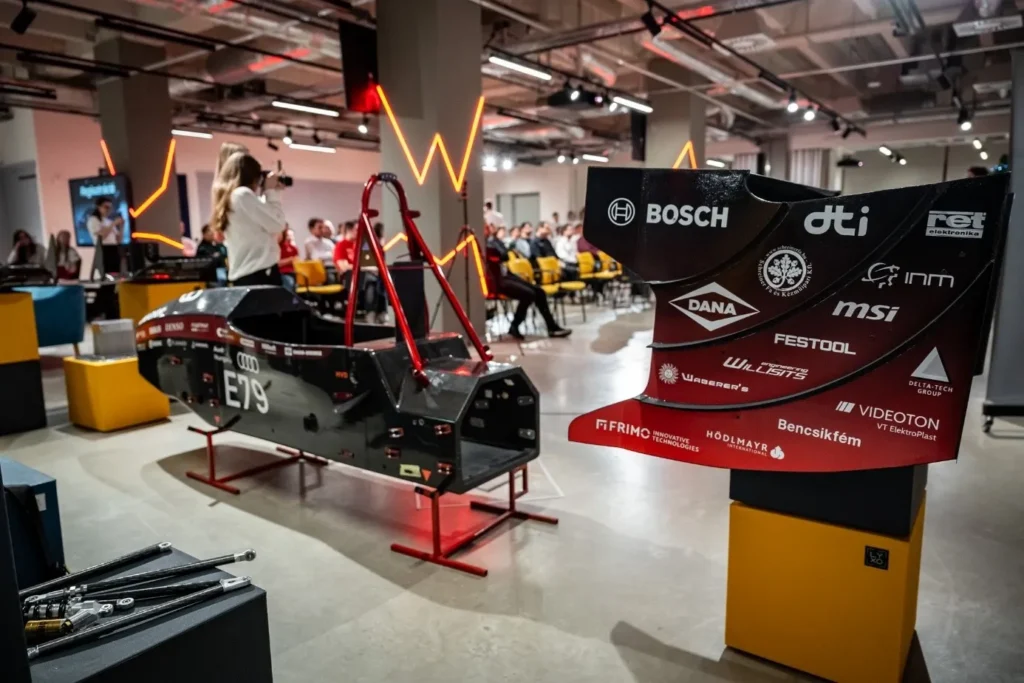
At the event, Dr Gábor Dogossy, Dean of the Audi Hungaria Faculty of Engineering, emphasised in his welcome speech that it is of outstanding importance for the University to provide practice-oriented knowledge connected to a real industrial environment, one of the key pillars of which is the Arrabona Racing Team. “The team’s success is also due to the fact that, alongside engineering students, those from economic, legal and social science fields also play an active role, and this multidisciplinary cooperation ensures that the team can respond to challenges in a professional manner,” he stated.
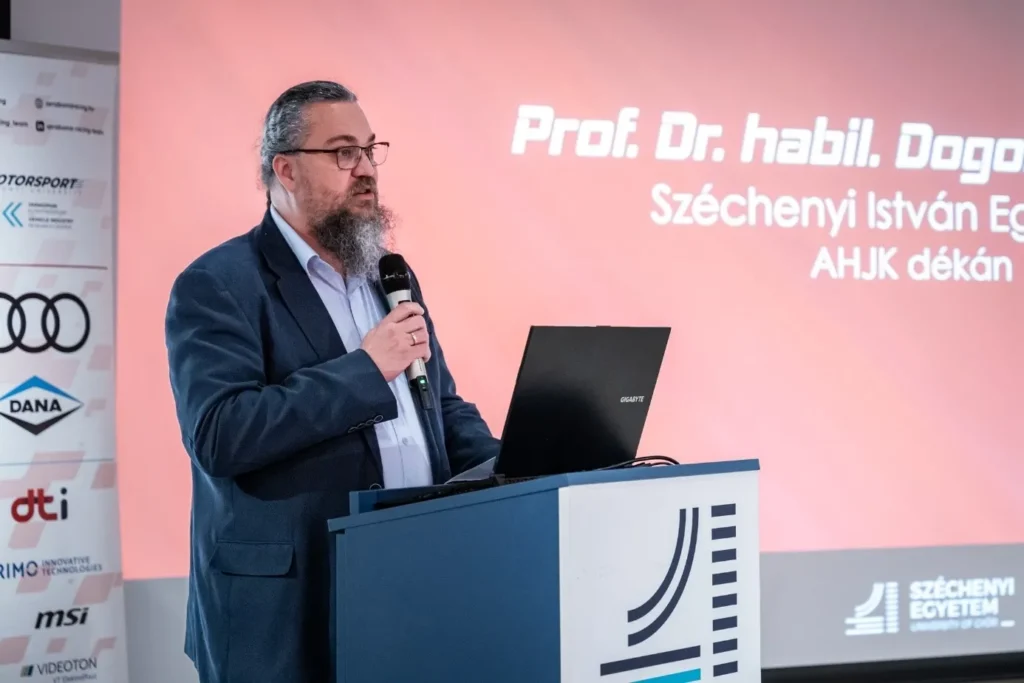
“Our goal is to educate professionals who not only understand the knowledge they acquire, but are also able to apply it,” stressed Dean Dr Gábor Dogossy (Photo: Máté Dudás)
This line of thought was continued by Tamás Rónai, Manager of Audi Hungaria’s Vehicle Development Division, who pointed out that students involved in ART can essentially work within the framework of a micro-enterprise already during their university years. “Team members can try their hand at design, development and manufacturing, and thus enter the labour market equipped with all this knowledge,” he underlined, adding that the company currently employs nearly thirty engineers who are former members of the team, clearly demonstrating the success of this talent development pathway.
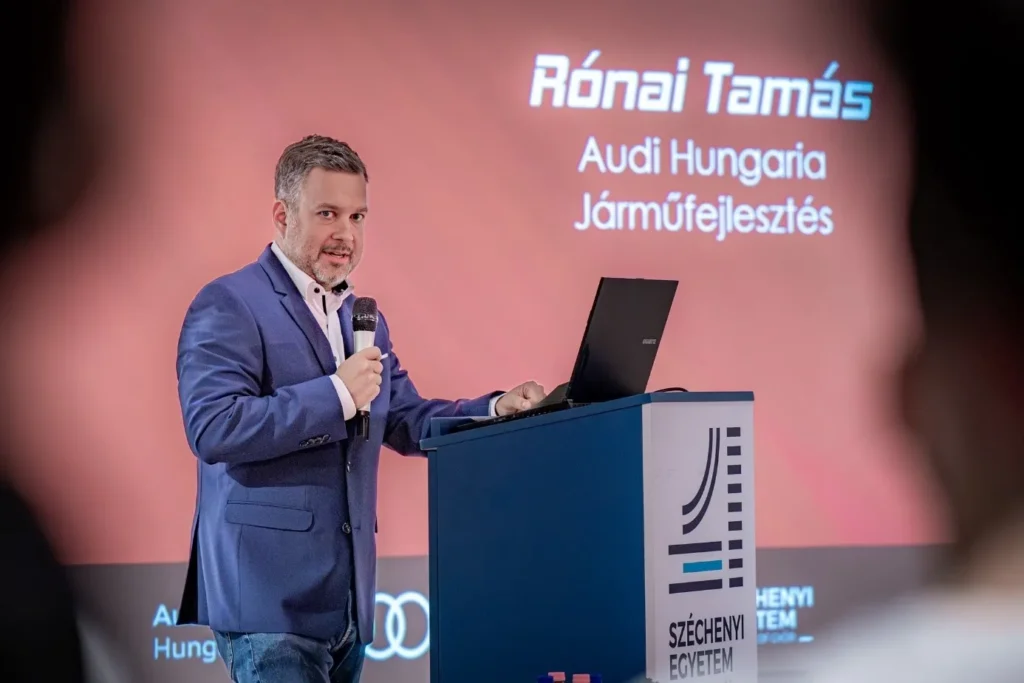
Audi has a long-standing tradition in motorsport and will also begin its participation in Formula 1 in 2026, Tamás Rónai reminded the audience (Photo: András Adorján)
The assessment of the previous season was presented by Gergely Vojnits, Team Leader of Arrabona Racing Team: “We tried to complete two years’ worth of development work in a single year, and this was more or less successful. Unfortunately, Formula Student East was cancelled last year, and at the Croatian competition we encountered a problem with our battery, which meant we were unable to take part in the dynamic events. At the same time, we performed well in the static events, where presentations are required, and with our first electric car we achieved 16th place out of 27 teams,” he said.
As was also mentioned, the size of the Arrabona Racing Team has increased significantly compared to previous years. Illustrating this growth, the team leader revealed that they started September with 36 members, received 117 applications, and eventually selected 51 new team members.
“Our plan is to have the car completed by April so that we can test it as much as possible. Encouraged by last year’s successes, we have set ourselves the goal of reaching the podium in the presentation events, and finishing in the top ten overall on track. If we manage to further refine the car, we may be capable of achieving this feat,” stated Gergely Vojnits.
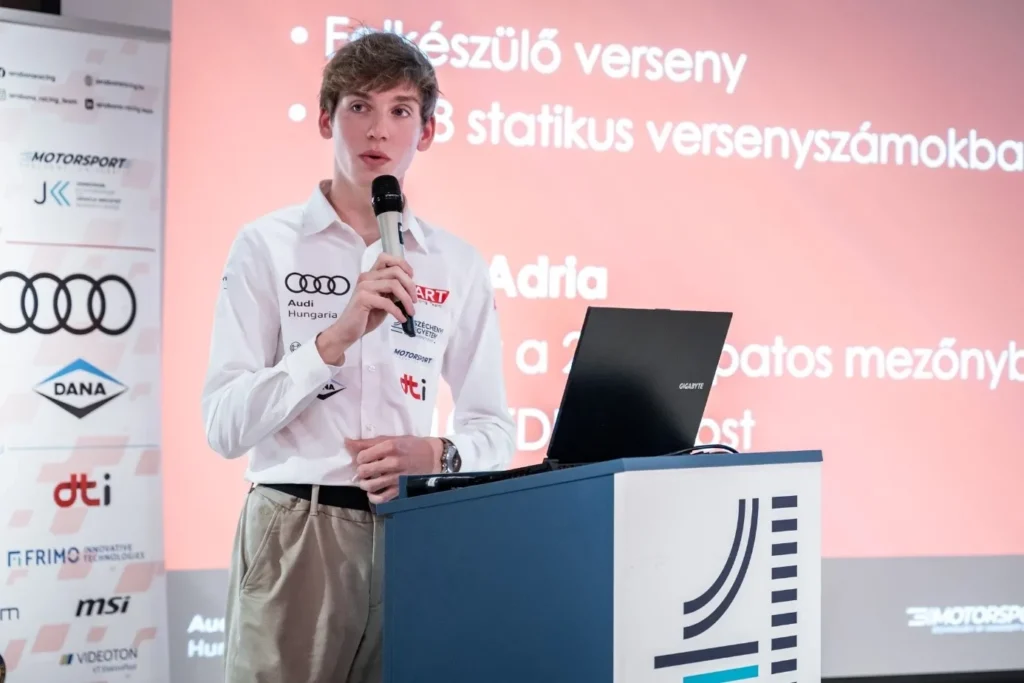
“This year we are targeting the German, Austrian and Hungarian competitions,” said Team Leader Gergely Vojnits (Photo: Máté Dudás)
The developments planned for this year were presented by Technical Lead, Mátyás Frech, who described the team’s strategy as continuous improvement through small, incremental steps. “We consider last year’s construction to be good, so we did not introduce revolutionary changes; instead, we improved existing solutions in several areas. Most importantly, we further developed the drivetrain and the battery management system. We implemented regenerative braking in the car, allowing us to recover additional energy, while retaining the hydraulic braking performance as well,” he explained.
The team simulates every element of the vehicle; for example, they can estimate the lifespan of the drivetrain in advance, enabling them to take timely measures to extend it. Weight reduction was mentioned several times during the presentation, including in relation to the accelerator pedal and the suspension rocker arms, which are now manufactured using carbon-composite material technology, resulting in significant cost savings in production. Summarising the developments, the technical director stated: “With regard to the aerodynamic package, the rear wing has undergone the most extensive development, and we have also designed a rear diffuser for the car, both of which significantly reduce aerodynamic drag.”
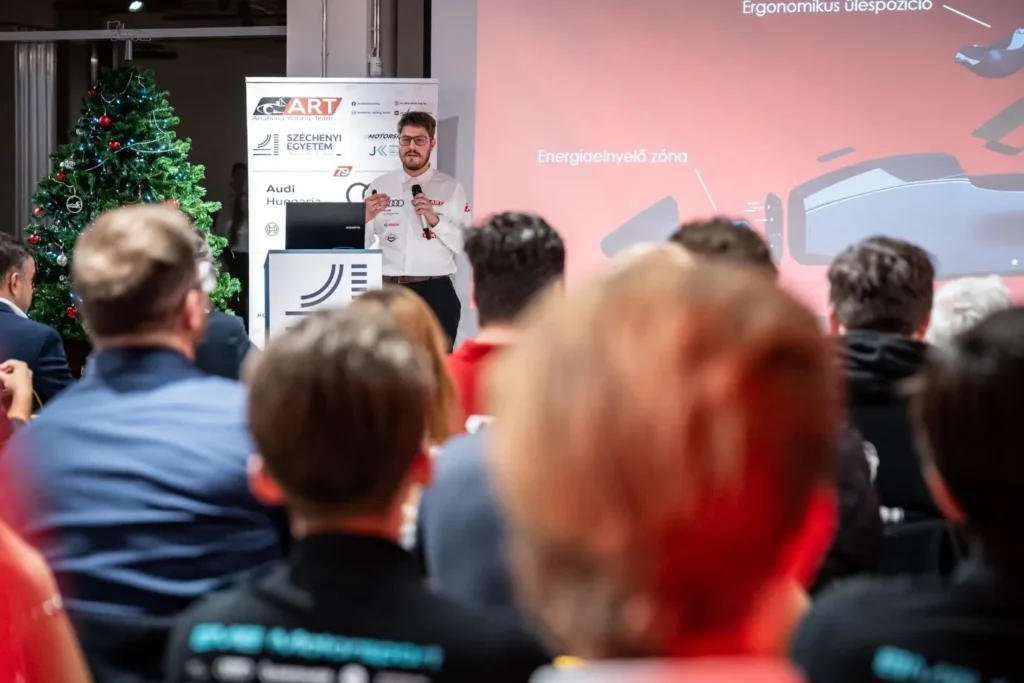
“The electric motors and inverters operate in a single-circuit liquid cooling system, while the battery is air-cooled,” explained Mátyás Frech (Photo: Máté Dudás)