
Created: 2025.12.10. 15:16
The spring semester will once again see the launch of Széchenyi István University’s aircraft operations specialist engineer and aircraft operations specialist training. To offer a more flexible schedule, the institution is introducing a modular version of its Hungarian–English programme—alongside the two specialist postgraduate courses already available to degree holders. In this modular (micro-credential) format, applicants are not required to have a higher-education degree, and qualifications can be obtained one module at a time. The application deadline for both tracks is 12 January 2026.
Széchenyi István University launched its pilot training this September for graduates with an engineering degree under the title “Aircraft Operations Specialist Engineer,” and for those with non-engineering degrees under the title “Aviation Specialist.” The three-semester, English-taught programme is delivered in cooperation with professional partners such as Wizz Air and Fly-Coop Ltd., which has more than two decades of experience. Theoretical classes take place on Fridays and Saturdays in Győr, while flight training is conducted at several airports around the country—including Fertőszentmiklós, Pér, Budaörs, Kadarkút and Lipót—depending on students’ needs. Pilot candidates also complete simulator tasks, primarily to prepare for unexpected situations.
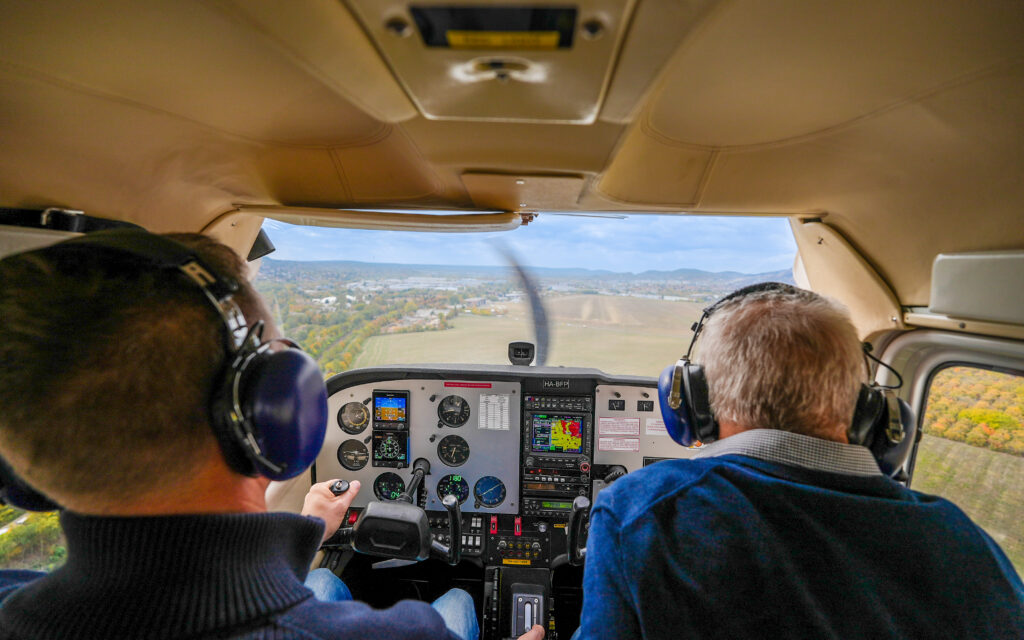
“Experience from the first admission period showed that many applicants found the intensive schedule of the one-and-a-half-year programme challenging. During this time, they must learn to fly safely in single-engine and later twin-engine aircraft, during the day, then at night, and even in poor visibility. For this reason, together with the University leadership and the institution’s Centre for Adult Education and Competence Development, we have developed a modular version of our programme,” said Associate Professor Dr Gergely Teschner, programme director.
He added that the essence of the new structure is that the curriculum can be learned in consecutively built modules, allowing everyone to progress at their own pace and according to their own schedule. This option is offered in the form of partial-knowledge (micro-credential) courses, which do not require a University degree and can even be completed with a secondary-school leaving certificate. The first module is the “Private Pilot Licence (PPL) training,” which can be taken independently and prepares participants to fly small, single-engine aircraft.
“It is important to note that one requirement for admission is proficiency in English, which applicants do not need to verify with a language exam—we assess it through an interview. Admission also requires a Class 1 medical certificate, but those who only wish to complete the first module (the PPL) may apply with a Class 2 certificate. The application deadline is 12 January in both cases, which still gives us enough time to arrange the required medical examinations before the 1 February start,” the programme director explained. He emphasized that those who complete the full programme—either modular or the three-semester version—will qualify to work as pilots at any airline. However, due to the University’s partnership with Wizz Air, graduates receive priority placement opportunities at the airline.

Graduates can find employment as commercial pilots at any airline.
The tuition fee for the aircraft operations specialist engineer and aircraft operations specialist postgraduate programmes is 95,000 euros (approximately 37 million forints), which includes theoretical instruction, 205 hours of flight training, and exam fees. The one-semester Private Pilot Licence course costs 13,200 euros (about 5.15 million forints), covering theoretical instruction, exam fees, and 45 flight hours. Those who complete the full modular training will log roughly 50 more flight hours than participants in the postgraduate version. In both cases, the tuition fee can be financed through an interest-free student loan up to age 45. For more information: nextgenlearn.sze.hu or here.