
Created: 2025.12.05. 10:27
Dr Barna Hanula, Associate Professor at Széchenyi István University, was recently recognised with the Best Lecturer Award at the 71st Wandering Assembly Conference and Exhibition of the Hungarian Electrotechnical Association. The lecturer of the University’s Audi Hungaria Faculty of Engineering earned the recognition based on the votes of the attendees. In connection with the award, he spoke to us about today’s energy crisis, the development of engineering education and issues surrounding a sustainable automotive industry.
Dr Barna Hanula joined Széchenyi István University in 2011 to put his extensive international experience in engine development at the service of improving engineering education. For eight years he headed the University’s Audi Hungaria Faculty of Engineering as Dean, and today he is responsible, among other things, for the nationally unique, English-taught, project-based undergraduate programme in Vehicle Engineering. From the moment he arrived in Győr, he advocated a practice-oriented approach, and today this mindset underpins the Faculty’s educational, scientific and research-development activities.
The associate professor was recently recognised with a special award: at the 71st Wandering Assembly Conference and Exhibition of the Hungarian Electrotechnical Association, held this year in Szeged, he won the Best Speaker Award based on the votes of the participants. The conference serves each year as a professional compass for the energy sector and a forum for representatives of the government, research sphere and industry. The programme covered, among other topics, the future of nuclear energy and wind power in Hungary, the security of energy supply, the integration of renewable energy sources into the system, the application of artificial intelligence, and the digitalisation of networks.

Dr Barna Hanula, Associate Professor at Széchenyi István University (left), received the Best Lecturer Award at the 71st Wandering Assembly Conference and Exhibition of the Hungarian Electrotechnical Association (Photo: András Adorján)
Dr Barna Hanula earned the audience award for his presentation entitled “Sustainability Issues of the Generational Transition in Transport.” “As a former vehicle developer, I started working on electric and hybrid propulsion, continually monitoring market achievements. I realised that for sweeping challenges such as environmental and climate protection, we tend to respond with simple solutions, using a one-dimensional perspective to address a highly complex issue. So far, however, this has not succeeded, as the amount of carbon dioxide emitted has not decreased in recent years,” he outlined as the basic premise of his research. He revealed that currently 37 per cent of the CO₂ emitted by humanity comes from electricity generation, meaning that prioritising electric propulsion alone does not solve the issue.
“When we talk about climate protection, most people think of household activities such as reducing gas consumption, minimising heating or limiting car journeys. Household end-use, however, accounts for only ten per cent of total CO₂ emissions. The question arises: what constitutes the remaining ninety per cent? It is everything we purchase: from clothing to furniture, all products manufactured by industry – with the largest share related to electricity. Despite renewable energies, these numbers have not yet begun to fall. Together with my colleagues, we concluded that meaningful change requires analysing the issue from a broader perspective and at system level, also considering adjacent fields,” he explained. He stressed that in order to make progress, we need to assess the success – or indeed failure – of previous steps and shift the emphasis towards fast and, above all, cost-effective measures.
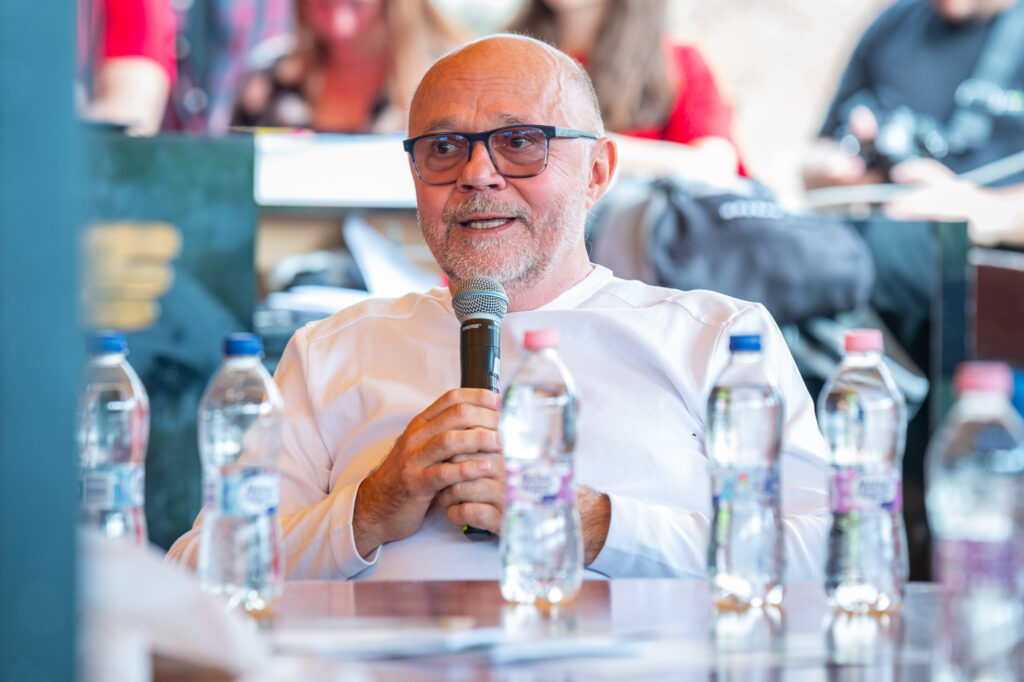
Dr Barna Hanula said that today’s university students are also interested in sustainability and are open to new approaches. He explained that traditional frontal teaching is no longer effective, as engineering thinking is truly developed by asking questions and engaging in active problem-solving. “We start from quite far back, as most Hungarian students arrive at their first classes as passive participants, but after a few sessions I manage to get them to ask questions and take part in the discussion. There are significant differences between learning methods: after reading the course material, 10% is retained; after hearing it, 20%; but through conversation, 70% remains in the students’ minds. I also make my students aware of this: contributing during classes is worth more than three times as much as merely observing,” he emphasised.
He added that he is optimistic about the employability of engineering students at Széchenyi, as the spread of project-based approaches also develops so-called soft skills, which make later work easier. “The most important thing is that young people are able to adapt to changes in industry and always strive to solve the challenge at hand. In the future, we will need professionals who learn easily and quickly, who are curious, communicate well and can work collaboratively to solve problems. What those problems will be, we do not yet know,” he said. He stressed that one of the major advantages of the vehicle engineering programme – one of the University’s most popular courses – is that it centres on an extremely complex structure in which everything can be found, from computers and artificial intelligence to sensors and heat engines, enabling students to acquire diverse knowledge and to practise problem-solving skills in a tangible way.