Created: 2025.12.03. 12:13
In recent days, Széchenyi István University’s twin satellite entered the Earth’s orbit aboard the Hungarian small satellite Hunity. The operation of the experimental panels developed by the university’s SZESAT Interdisciplinary Special College marks another milestone for students in Győr as they pursue their ultimate goal: launching an independently developed satellite into space.
For years, the SZESAT Interdisciplinary Special College at Széchenyi István University has been engaged in satellite development. Their first major success came in the summer of 2023, when they sent a communication module into space aboard the MRC 100 satellite. The students’ development work has now reached a new chapter: a few days ago, their first twin satellite also entered Earth orbit. On 28 November at 19:44 (Hungarian time), the Transporter-15 mission launched from California’s Vandenberg Space Force Base aboard a SpaceX Falcon 9 rocket, carrying 140 spacecraft—including the Hungarian small satellite known as Hunity.
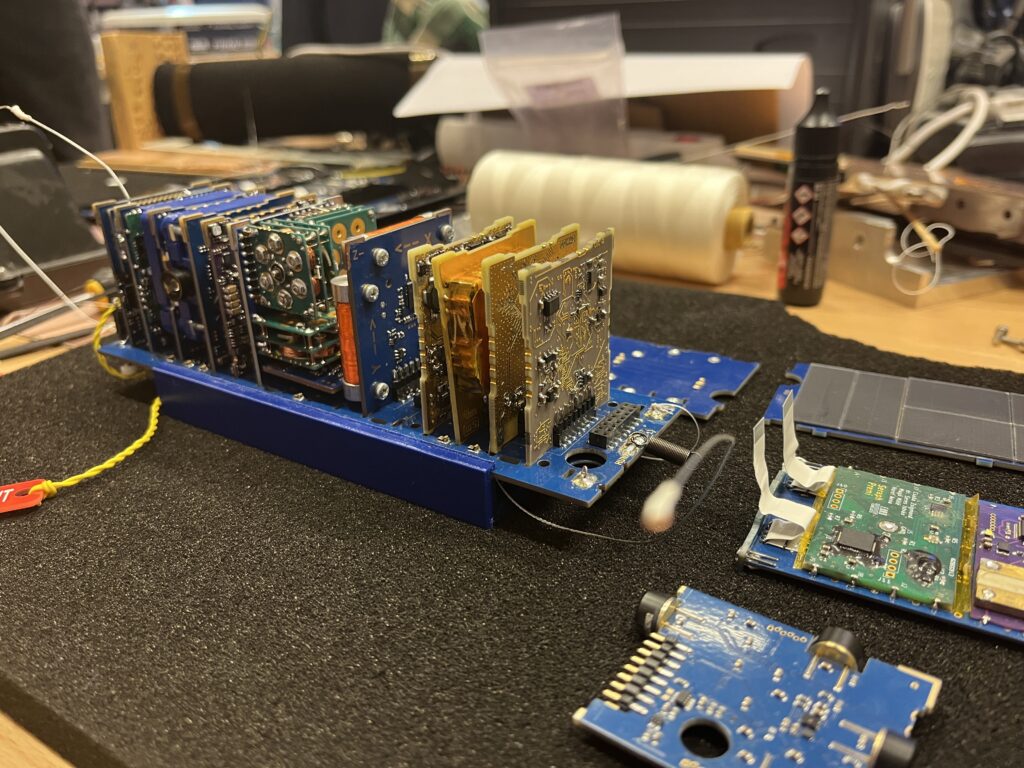
“Our University plays a key role in a programme implemented with the participation of the National Media and Infocommunications Authority and led by the Budapest University of Technology and Economics (BME). As part of the project, we installed our fully autonomous 1PQ (‘twin’) satellite—measuring 5 × 5 × 5 centimetres and developed by SZESAT—onto Hunity, which is a 3PQ-sized satellite (5 × 5 × 15 centimetres). It consists of four modules. The power supply and monitoring module generates energy for the other units using solar panels. This connects to the battery module, which provides energy storage. We equipped the power generation and storage systems with measuring instruments and multiple layers of protection to ensure reliable operation throughout the satellite’s entire lifespan. The device has its own control computer, which manages the modules and maintains communication with BME’s satellite unit. Measurement data are transmitted to the ground station via our communications module,” explained Gábor Marton, research engineer at the University’s Space Technology and Space Law Research Centre, who was a member of the SZESAT satellite development team as a master’s student.
He added that following the successful launch, preparations are underway on the Győr campus to receive signals from the twin satellite, control the device, and process the data—supported by a guided antenna system. “The experience gained through this programme contributes not only to future-oriented research but also significantly supports our ultimate goal: creating the first independently developed satellite from Győr,” he said.
Dr Péter Vári, associate professor at the University, programme director of the special college, and deputy director general of the National Media and Infocommunications Authority, noted that Széchenyi István University has repeatedly proven its capability to excel even in outer space. “This success is the result of close collaboration among engineering, law, and economics students. The aim of the SZESAT special college is to engage students from all disciplines—and even high school students interested in space. There are few universities in Hungary where young people can gain real experience in spacecraft development, and Széchenyi István University is one of them,” he emphasized. “We are already working on our next project, our own independent satellite, and we warmly welcome any university student who wants to be part of our mission: the conquest of space.”