
Created: 2026.07.07. 09:37
The CyberTrident Challenge cybersecurity incident response competition, held recently at the Győr campus of Széchenyi István University, focused on the technological, legal and organisational challenges of cybersecurity. Teams composed of students from different institutions had the opportunity to test their knowledge by managing realistic incident scenarios.
The Deák Ferenc Faculty of Law and Political Sciences at Széchenyi István University treats cybersecurity—an issue that has become a global priority—as one of its key areas of focus. The University, which was the first in Hungary to launch a master’s programme in cybersecurity law, also operates a dedicated Department of Modern Technology and Cybersecurity Law. Its head, Dr Roland Kelemen, considers it particularly important to adopt a multidisciplinary approach to the field, as cyber-attacks can only be effectively countered through cooperation among multiple disciplines.
This principle was also highlighted by the inaugural CyberTrident Challenge cybersecurity incident response competition, jointly organised by ACPM IT Consulting Plc., the Faculty of Law and Political Sciences of Széchenyi István University, and the University’s Department of Artificial Intelligence and High-Performance Computing (HPC). In addition to students from the host institution, participants included students from the University of Public Service and Óbuda University, competing in eight teams. During a complex incident simulation based on a realistic scenario, contestants were required to develop solutions for handling the consequences of a cyberattack while taking technical, legal and managerial considerations into account.
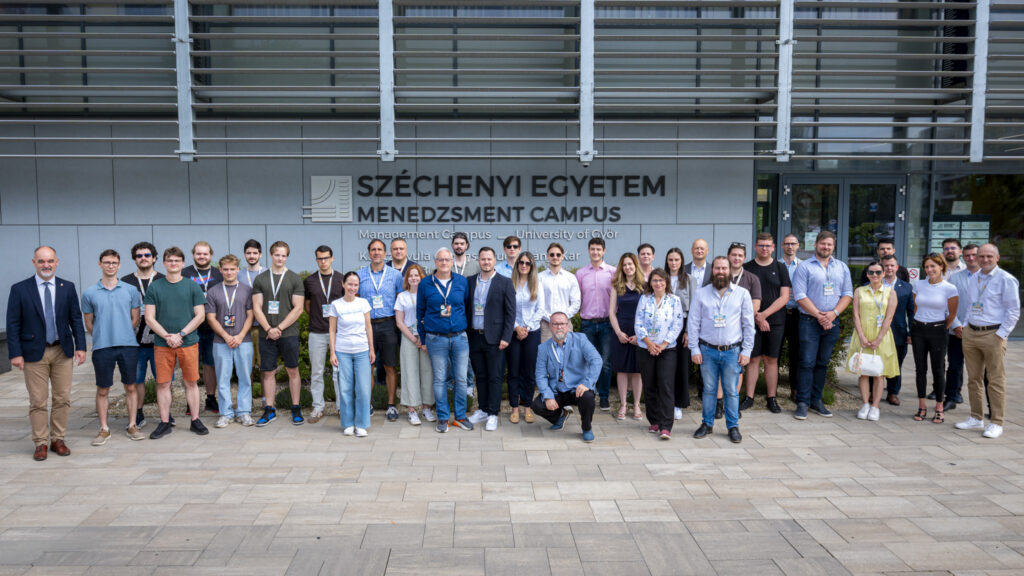
Participants of the CyberTrident Challenge cybersecurity incident response competition held at Széchenyi István University. (Photo: András Adorján)
At the opening ceremony, Professor Dr Péter Smuk, Dean of the Faculty of Law and Political Sciences, explained that the role of law in society is to provide effective and well-functioning regulation. To achieve this, communication between different academic disciplines is essential. “This is indispensable not only for identifying new societal challenges and phenomena that require regulation—such as cyber threats—but also for addressing them effectively. Our competition helps future professionals gain experience in interdisciplinary cooperation already during their studies,” he emphasised.
Márton Miklós, Chief Executive Officer of ACPM IT Plc. and President of the Hungarian Cybersecurity Cluster, added that cybersecurity is only one-third a technical issue, while two-thirds relates to regulatory matters—a reality reflected in the composition of the competing teams. Bence Havasi, Deputy Head of Department at the Defence Cybersecurity Authority, stressed the importance of cybersecurity exercises, which help reveal weaknesses both in technological systems and in human factors, while also contributing to the improvement of organisational processes.
Dr Ferenc Szemeti, Cybersecurity Director at the Supervisory Authority for Regulated Activities, pointed out that the digital world has become one of the most important arenas of modern life. While it brings convenience and efficiency, it also introduces risks. “Cyberattacks are becoming increasingly sophisticated, affecting not only the largest organisations but all of us,” he noted. He added that it is not enough merely to recognise that an incident has occurred; rapid decisions based on effective teamwork are also required.

Students completed the tasks in teams of three. (Photo: András Adorján)
Following the opening remarks, participants received their assignments. In solving them, they were required not only to uncover the technical background of the simulated incident but also to interpret the relevant legal framework and management processes (GRC). Their tasks included identifying attack methods and vulnerabilities, developing recovery measures, assessing risks, and examining the legal and compliance requirements affecting organisational operations.
The winning team represented Óbuda University and consisted of Sándor Bajkai, Gergő Rabata and Ákos Czetin. Second place went to Dorina Bosits, Bendegúz Kraus and Levente Birkás from Széchenyi István University, while third place was awarded to another team from the same institution, comprising Noémi Szigedi-Tóth, Ottó László Imre and Dániel Hegyi. The special prize for the best IT team member was awarded to Levente Birkás, a student at Széchenyi István University. The special prize for the best legal compliance team member went to Dr Éva Török, who, after completing her studies at Széchenyi István University, is currently a student at the Ludovika University of Public Service.