
Created: 2026.07.03. 09:18
At the national final of one of the world’s most significant educational robotics-building and programming competitions, 161 teams and 416 competitors measured their robotics, programming and innovation skills at Széchenyi István University’s Győr campus. The best performers in the Hungarian final of the World Robot Olympiad 2026 will represent Hungary at the World and European championships.
The World Robot Olympiad (WRO) is one of the world’s most significant educational robotics-building and programming competitions, encouraging young people’s interest in science, engineering and information technology since 2004. In Hungary, the competition has been organised by Edutus University since 2014. The national final of the series was held at Széchenyi István University on the last weekend of June, where 161 teams and 416 competitors competed. Participants arrived from 39 towns to demonstrate their robotics, programming and innovative abilities.
The final was opened by Zoltán Tanács, Minister for Science and Technology, who recalled his childhood readings in his welcome speech. As he noted, the novels of Isaac Asimov had a great influence on him. The renowned author was already writing about the world of robotics in the 1950s, which is now part of everyday life. He pointed out that robotics has grown into an industry of astonishing speed. “We now have a community present that can become a driving force in this industry,” he stated. He emphasised that while the number of robots per ten thousand people in Hungary is 133, in South Korea it is one thousand. “This means we are somewhat behind, with enormous development ahead of us, which is, at the same time, very good news for participants of the competition. A great many robots will need to be designed, programmed, repaired and enhanced, and they have already begun to acquire the knowledge required for this. It is fantastic,” he summarised. He encouraged young people to design robots that improve people’s lives—ones that not only accelerate processes but also provide greater freedom and a healthier lifestyle.
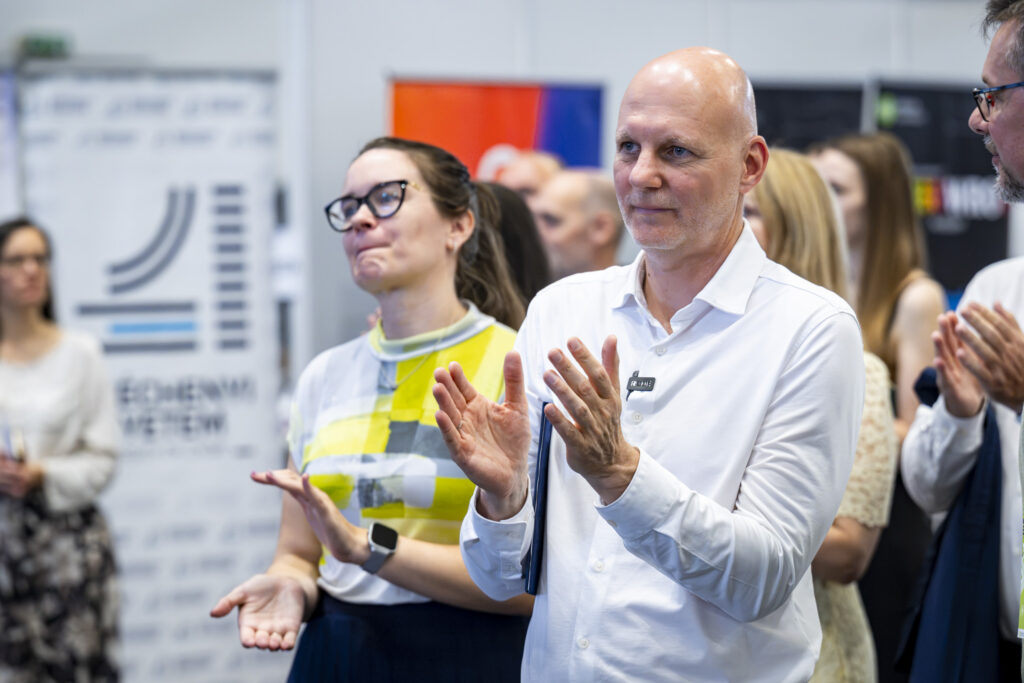
Minister of Science and Technology Zoltán Tanács encouraged young people to design robots that make people’s lives better (Photo: Máté Dudás)
Mayor of Győr, Bence Pintér, said that the young people who reached the final will become Hungary’s future engineers, researchers and technology leaders. He added that the tasks in the final—such as those related to artificial intelligence, autonomous vehicles or green solutions—represent real global challenges. “This is where ideas may emerge that in a few years could turn into university research, projects, patents and successful enterprises,” he emphasised. He highlighted that Győr is a stronghold of innovation and the automotive industry in Hungary, and that the symbiosis between the industrial ecosystem, the University and Audi is unique, making it an ideal place for further studies.
Dr Ferenc Friedler, Rector and Vice-President for Scientific Affairs of Széchenyi István University, stated that the institution’s mission is to prepare its students for successful professional careers, and therefore it gladly joins programmes addressing dedicated young people every year. “For a young person to become truly successful in their chosen profession, at least five factors are necessary: purposefulness, teamwork, language skills, professional competence and general knowledge,” he listed. He added that all opportunities are open to the competition participants for a successful career, and wished them to make the most of these.
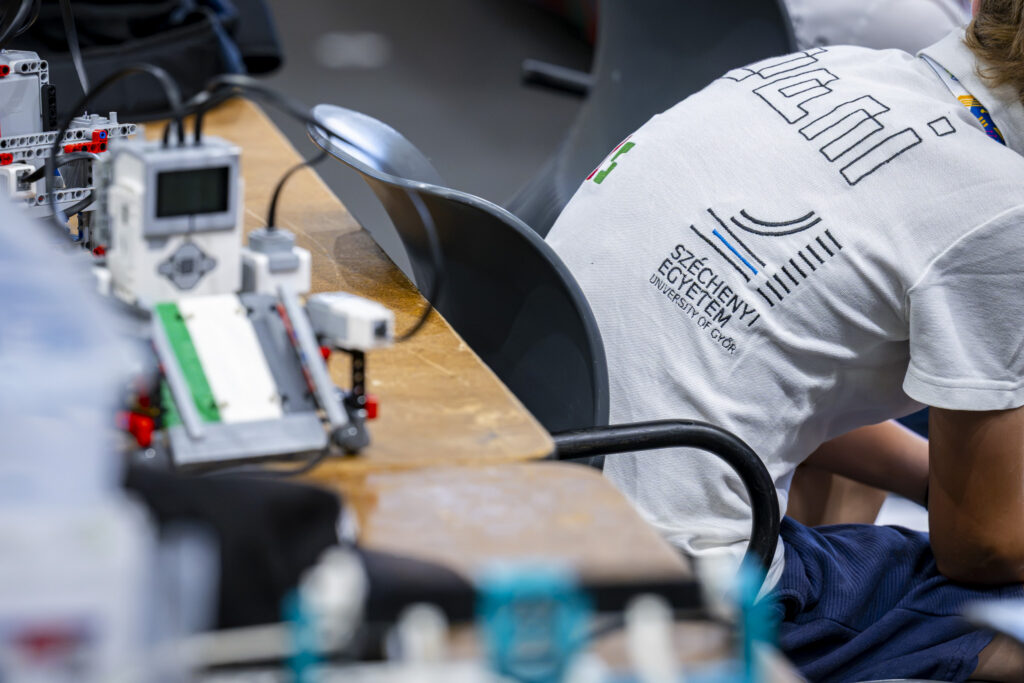
The World Robot Olympiad (WRO) hosted the national finals at Széchenyi István University (Photo: Máté Dudás)
Imre Pintér-Péntek, Vice-President of the Hungarian Chamber of Commerce and Industry and President of the Győr-Moson-Sopron County Chamber, stated that the labour-intensive economy based on cheap workforce has come to an end in Hungary, replaced by a knowledge-based economy. “We must help young people acquire as much knowledge as quickly as possible so that they can put it in the service of the economy. This is why the Chamber is involved in career guidance, the coordination of dual training, and the creation of excellent workplaces,” he said.
Péter Tamás Szilasi, Director for Digital Education, Development and International Affairs at Edutus University and WRO project manager, explained that an increasing number of schools and teachers recognise the importance of the programme. “This year, three hundred teams from seventy towns competed, which represents more than a fifty per cent increase compared to the previous year. They are part of a vast community, as 32,000 teams compete worldwide, comprising more than one hundred thousand young people from over one hundred countries,” he pointed out.
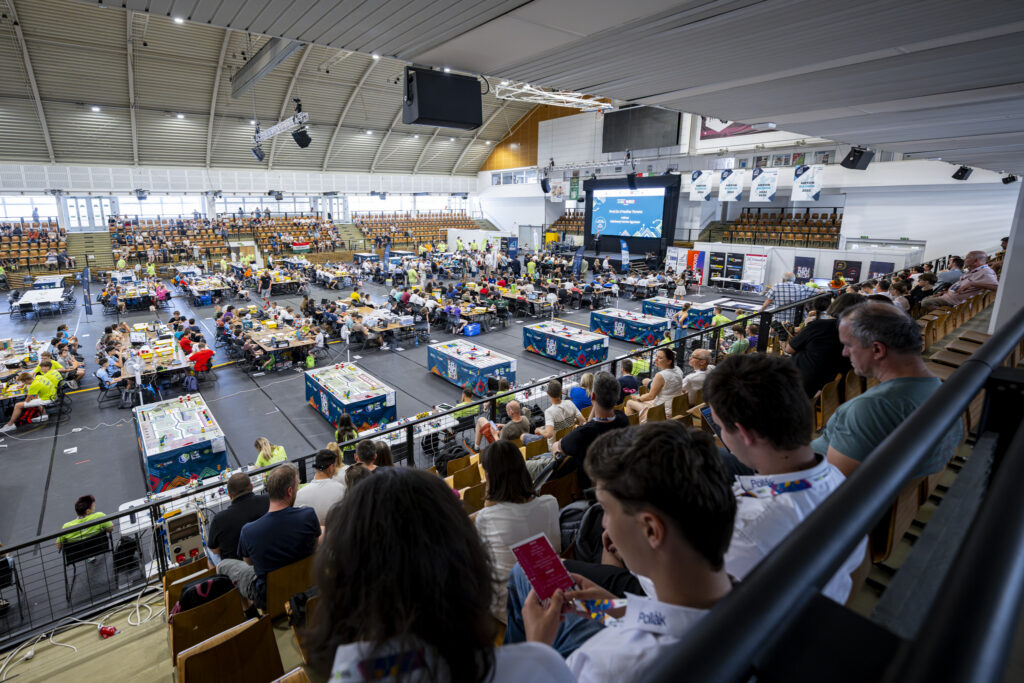
In the final of the series, 416 competitors from 161 teams competed against each other (Photo: Máté Dudás)
Following the opening speeches, the two-day competition began, where young participants competed in the official categories of WRO RoboMission, Future Innovators, Future Engineers and RoboSports, as well as in the KIDS Starter category and the EduDigiTech drone competition. The Hungarian final also carried significant international stakes: the most successful Hungarian teams qualified for the 2026 World Robot Olympiad world final in Puerto Rico, as well as for the WRO Open Championship Europe in Zagreb.