
Created: 2026.05.27. 12:47
Innovative student projects were showcased recently at the Hungarian Startup University Program (HSUP) Demo Day event organised at the Győr Innovation Park of Széchenyi István University. During the event, ten teams presented their developments, with some of the best ideas including healthcare- and sustainability-focused solutions.
Széchenyi István University supports the strengthening of entrepreneurial and innovation-oriented thinking not only through industrial collaborations, but also by striving to provide practical opportunities for its students, lecturers and researchers throughout the journey from idea generation to implementation. One important element of these efforts is the Hungarian Startup University Program (HSUP), in which the institution has participated since the very beginning: since 2021, more than 2,300 students have joined the e-learning-based, two-semester programme. During this period, participants are required to design the model of a business venture, which may eventually develop into a real startup. As a result, around 800 students are currently working on developing their own start-up ideas.
At the Demo Day event concluding this year’s programme, students presented their ideas in project teams and delivered their pitches in English, with each team given five minutes to present. The presentations were evaluated by experts who supported the young participants from different perspectives, yet with a shared innovation-oriented mindset. The jury included Dr Szabolcs Rámháp, Associate Professor at the University and institutional coordinator of HSUP, Bálint Szüle, Head of Strategy and Partnerships at Uni Inno Zrt., and Dr Gábor Szabó-Szentgróti, Associate Professor, associate professor at the university and researcher in management and organisational sciences, as well as workplace wellbeing. Participants received not only evaluations, supporting the further development of their projects.
“The aim of the event is also to help young participants prepare for the national competition through the feedback provided by the evaluators, which the best projects may enter following a multi-stage selection process. In addition, from this year onwards, we have launched a student innovation scholarship programme, for which the winners may also apply,” explained Dr Szabolcs Rámháp, Associate Professor and institutional coordinator of HSUP.

Dr Szabolcs Rámháp, Associate Professor and institutional coordinator of HSUP welcomed participants of the Demo Day (Photo: Máté Dudás)
According to the jury’s decision, first place was awarded to the Anti-Roll MedCap team, consisting of Gergő Egyházy and Martin Zsíros. Their project is a laboratory sampling cap designed to prevent sample tubes from rolling away and breaking by means of specialised structure, thereby reducing the need for repeated examinations. The development may primarily offer a practical solution for hospitals and private laboratories, while the team is also considering long-term opportunities in international markets and through industrial licensing.
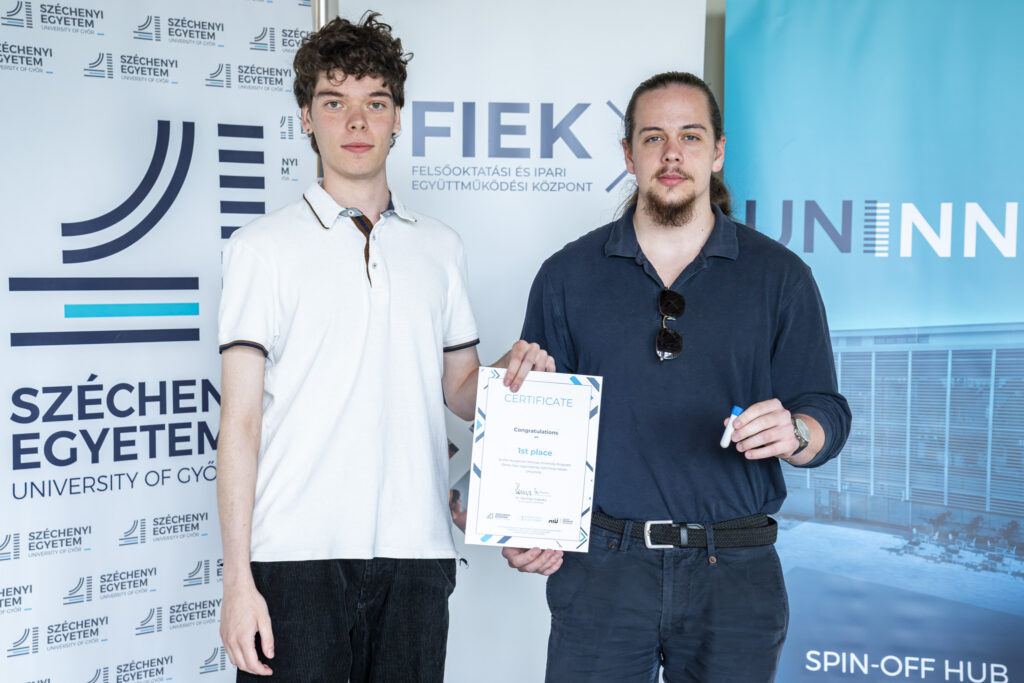
Members of the first placed Anti-Roll MedCap team, Gergő Egyházi and Martin Zsíros (Photo: Máté Dudás)
Second place went to Med Band, represented by Petra Pellérdi and Zsombor Szabó. Their development is an intelligent medication dispenser and wristband system aimed at supporting medication adherence among elderly people and reducing the risks associated with missed or incorrect medication intake.
Third place was awarded to BorrowFit, created by Vivien Darázs, Péter Molnár and Petra Lukács. Their project is based on the concept of a community-based clothing rental platform designed to promote sustainable fashion and extend the lifecycle of garments through a digital marketplace platform.
The event was organised by the Higher Education and Industry Cooperation Centre of Széchenyi István University, which each year offers numerous programmes for students interested in developing and implementing their innovative ideas, including in the upcoming semester. Further information and upcoming programmes are available on its social media platforms, including Facebook and Instagram, as well as on its website.