
Created: 2026.05.21. 08:56
Teams composed of students and lecturers delegated by universities from member states competed against one another at the rehearsal event of NATO’s largest cyber defence exercise, the Locked Shields Partner Run. Hungary achieved its best result to date at the recent competition, finishing among the top three. Three engineering informatics students, two law students and one law lecturer from Széchenyi István University also contributed to the success.
Locked Shields is the world’s largest and one of the most complex real-time cyber defence exercises, involving cyber security experts from NATO allies and partner countries. Dr László Vikman, Lieutenant Colonel and lecturer at the Deák Ferenc Faculty of Law and Political Sciences of Széchenyi István University, also participated in preparing this year’s event. Every year, the Locked Shields Partner Run programme is organised as a “rehearsal” for the exercise, involving universities and market actors, and providing students with the opportunity to test their theoretical knowledge under real-life conditions.
The online competition, organised by the NATO Cooperative Cyber Defence Centre of Excellence (CCDCOE), featured national teams made up of members delegated by universities from various countries. Participating nations are divided into two groups: red and blue teams. The former simulates attacks, while the latter is responsible for defence. During the exercise, participants face not only technical challenges, but also communication and complex legal issues. The Hungarian delegation, participating as a blue team, included students and lecturers from Budapest University of Technology and Economics, Óbuda University, Ludovika University of Public Service, Eötvös Loránd University, University of Pécs, as well as from Széchenyi István University.
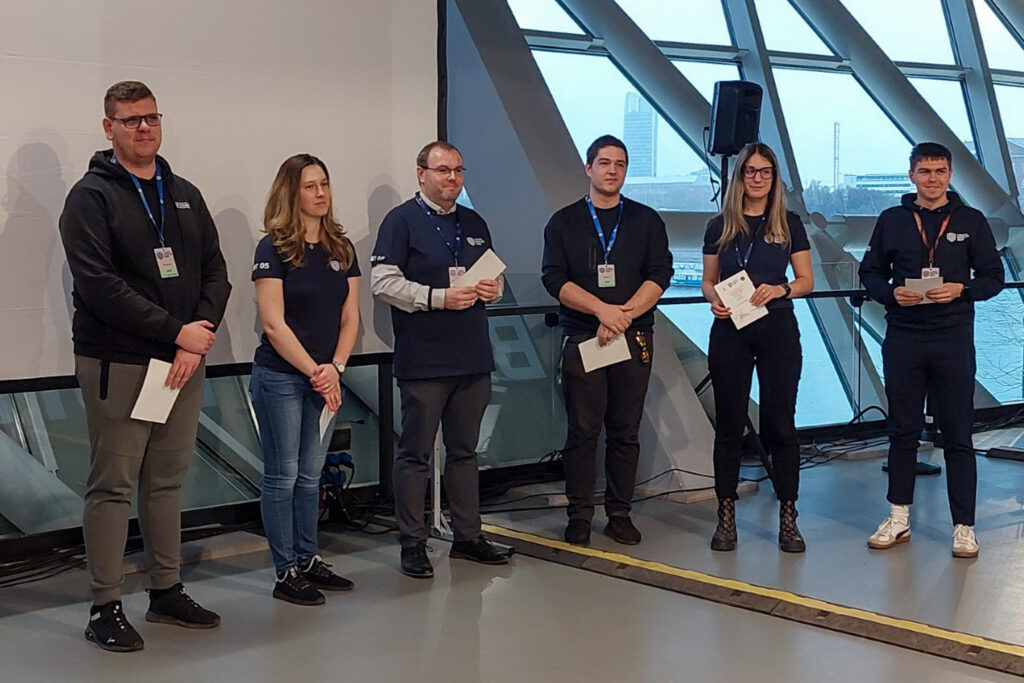
Széchenyi István University was represented by engineering informatics student Viktor Synek, law student Virág Herold, Dr Roland Kelemen, Head of the Department of Modern Technology and Cybersecurity Law at the Deák Ferenc Faculty of Law and Political Sciences, computer science engineering students Ádám Ragasits and Csongor Kiss, and law student Dorina Bosits (Photo: Dr Anna Vörösné Bánáti-Baumann)
Ádám Ragasits, Viktor Synek and Csongor Kiss represented the Győr-based institution as computer science engineering students. According to Csongor Kiss, while his teammates primarily focused on web vulnerabilities and database protection, his responsibilities included infrastructure operation and defence. “During the exercise, we had to protect a highly complex system consisting of numerous virtual servers and specifications from attacks. The first day of the two-day simulation focused on reconnaissance, meaning we mapped our infrastructure and prepared for incidents that could be anticipated in advance. The second day was about a continuous series of decisions, where, by applying what we had learned at university and working together as a team, we had to fend off ongoing attacks. These proved extremely varied, ranging from denial-of-service attacks to database breaches,” explained Csongor Kiss.
Dorina Bosits and Virág Herold participated in the Hungarian team as law students from Széchenyi István University. “When a country comes under attack today, protecting infrastructure connected to cyberspace inevitably forms part of the response. Alongside the IT-related challenges, numerous other issues arise, including complex legal questions that require rapid and effective answers,” summarised Dorina Bosits. She emphasised that the complexity lay in the fact that all actions had to comply with international law while remaining proportionate yet firm. “The intensity of the competition is reflected in the fact that it required continuous work from morning until evening without interruption. Separate teams responsible for each functional area received points for their responses to the challenges that emerged, and the final ranking was based on these scores. We are proud to have contributed to Hungary’s best-ever result,” she stated.
The students agreed that the simulation was truly a “deep-water” experience for them, from which they learned a great deal and gained highly valuable practical insight into real-life situations.
Dr Roland Kelemen, Associate Professor and Head of the Department of Modern Technology and Cybersecurity Law at the Deák Ferenc Faculty of Law and Political Sciences in Győr, and member of the Partner Run legal team, explained that the competition serves as the rehearsal for the world’s largest cyber defence exercise, involving highly diverse teams in which technical, communication and legal fields all play active roles. “In this competition – just as in everyday life – cooperation between engineers and legal professionals is essential, as without it tasks cannot be completed successfully. In addition, the complex challenges that had to be solved during the competition provided extremely valuable professional experience, and we will certainly incorporate these lessons into our cyber security law programmes,” he concluded.