
Created: 2026.05.12. 09:29
The Albert Kázmér Faculty of Agricultural and Food Sciences at Széchenyi István University participated as a co-organiser in the regional consultation of the Food and Agriculture Organization of the United Nations, which served as preparation for the conference to be held in Tajikistan in May. The consultation focused on policy issues related to sustainable agri-food systems, aligning the role and contribution of the academic sector. The programme may also pave the way for the institution to host future FAO scholarship students.
The Albert Kázmér Faculty of Agricultural and Food Sciences at Széchenyi István University took part as a co-organiser in the FAO online consultation, which aimed to support the academic preparations for the 35th FAO Regional Conference. The recent consultation sought to contribute to evidence-based policymaking related to sustainable and resilient agri-food systems through the scientific achievements of the higher education and research sectors.
Representatives of universities and professional organisations from across the region attended the meeting. At the beginning of the programme, Dr Tamás Tóth, Dean and Research Professor, introduced the Faculty, highlighting how the institution, founded in 1818, combines more than two centuries of agricultural education traditions with modern technological solutions. Participants were also introduced to the faculty’s Smart Farm infrastructure, where data-collecting robots, drones, precision crop production and automated livestock farming systems, as well as modern food industry laboratories, support educational and research activities.
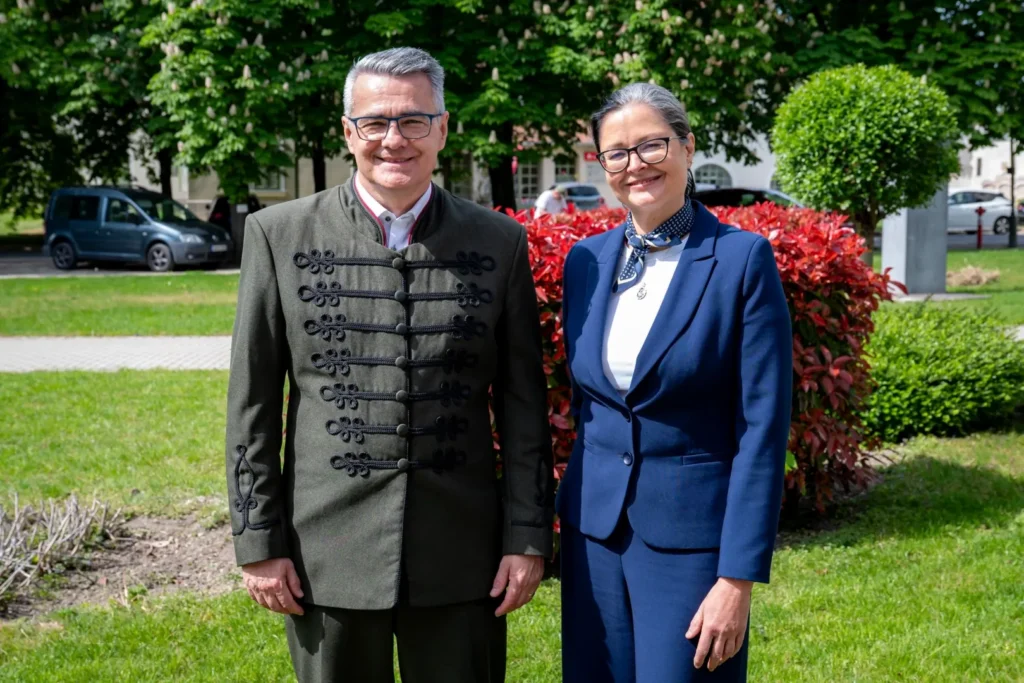
The Albert Kázmér Faculty of Agricultural and Food Sciences of Széchenyi István University joined the FAO regional consultation as co-organiser. The photo shows Dean, Dr Tamás Tóth and Dr Anikó Juhász, coordinator of the programme. (Photo: András Adorján)
The event, which focused on strengthening the relationship between science and policymaking, was organised around three main thematic areas: sustainability, the resilience of agri-food systems, and financing transformation in Europe and Central Asia.
The discussion also highlighted the experiences of countries across the region. “It was interesting to see that despite geographical and developmental differences, we face very similar challenges in agriculture. The impacts of climate change, the difficulties of developing rural infrastructure, and issues related to knowledge transfer are common concerns in several countries,” said Dr Anikó Juhász, adviser to the Albert Kázmér Faculty of Mosonmagyaróvár and coordinator of the programme.
She added that the cooperation is driven by a dual objective. “Sustainability is one of the strategic priorities of Széchenyi István University, while the FAO is a leading international actor in this field. In addition, our goal is for the Faculty to participate in the scholarship programme financed by FAO member state contributions, which provides participating universities with the opportunity to host international students,” she emphasised.
One of the main outcomes of the online consultation is the preparation of a joint academic statement, which representatives of the participating institutions will present at the 35th FAO Regional Conference to be held in Tajikistan in May.